
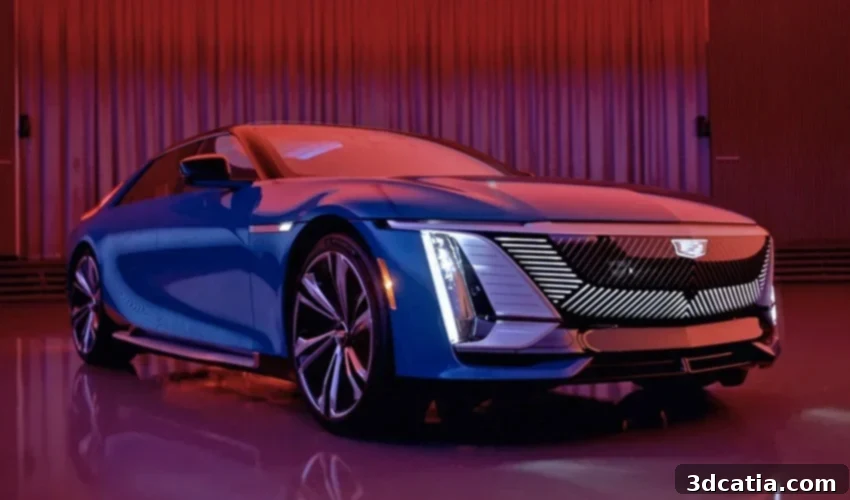
Cadillac Celestiq 2024: Redefining Luxury EVs with Extensive 3D Printing and Bespoke Craftsmanship
The esteemed American manufacturer of high-end, luxury vehicles, Cadillac, has recently unveiled its highly anticipated 2024 Cadillac Celestiq. This groundbreaking vehicle is poised to set new benchmarks in the ultra-luxury electric vehicle segment, with a starting price expected to exceed $300,000. Cadillac proudly highlights that the Celestiq stands apart from many of its predecessors and rivals, not just as a statement of luxury, but as a testament to advanced engineering and cutting-edge manufacturing. Central to this distinction is its remarkable integration of new technologies, particularly the extensive application of 3D printing, also known as additive manufacturing.
The Cadillac Celestiq, a magnificent electric sedan, boasts an impressive total of 115 3D printed parts. This significant number underscores a profound commitment to leveraging additive manufacturing beyond mere prototyping. These components serve diverse functions, ranging from critical structural elements that contribute to the vehicle’s integrity and performance, to intricate parts designed to enhance passenger safety. Furthermore, the varying sizes and complexities of these components open up unprecedented avenues for personalization and customization, allowing discerning buyers to tailor large sections of their opulent car to their precise tastes and preferences. This innovative approach signifies a pivotal shift in automotive production, moving towards a future where luxury is synonymous with bespoke, digitally crafted perfection.
Cadillac’s venture into high-volume 3D printing for the Celestiq, however, is not an isolated phenomenon within the automotive industry. Indeed, numerous vehicle manufacturers are increasingly embracing additive manufacturing for a myriad of reasons, from design innovation to supply chain resilience. For instance, General Motors, Cadillac’s parent company, famously turned to metal additive manufacturing to mitigate supply chain disruptions that threatened the delivery of its 2022 Chevrolet Tahoe models. A last-minute design modification necessitated additional parts, specifically a new spoiler closeout seal. By rapidly producing these critical components using 3D printing, GM successfully averted a potential delay impacting approximately 30,000 vehicles, demonstrating the technology’s power in ensuring production continuity and agility.
Beyond crisis management, 3D printing has also found its way into performance and niche luxury vehicles. The iconic BMW i8 Roadster, for example, incorporated 3D printed components for its soft-top mechanism, showcasing the technology’s capability for intricate and lightweight parts. Similarly, the hypercar manufacturer Koenigsegg integrated 3D printed elements, such as exhaust components and turbocharger impellers, in models like the CC850, leveraging additive manufacturing for optimal performance and complex geometries. Historically, many manufacturers have exploited this technology primarily for low-volume applications, rapid prototyping, and tool creation. What makes the 2024 Cadillac Celestiq truly revolutionary is the sheer volume of 3D printed parts integrated into a production vehicle. This expansive adoption could fundamentally redefine automotive design and customization, paving the way for unprecedented levels of personalization and manufacturing efficiency across the industry.
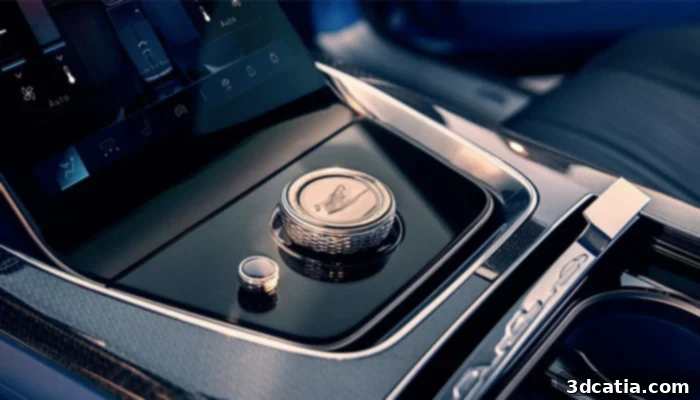
The luxurious interior of the Cadillac Celestiq, featuring advanced 3D printed components like the console. (Photo credits: Cadillac)
Cadillac’s Extensive Embrace of 3D Printing for Interior and Exterior Elements
Delving deeper into the specific applications, one of the most prominent and tactile 3D printed parts in the Cadillac Celestiq is its sophisticated steering wheel. Manufactured using advanced metal 3D printing technology, this component is a prime example of how additive manufacturing enables both intricate design and robust functionality. While Cadillac has not disclosed the exact 3D printer or specific metallic alloy utilized for this masterpiece, its imposing volume and complex contours suggest the use of a large-format industrial metal additive manufacturing system. The ability to customize this central interface is a significant luxury offering. Buyers can personalize everything from its exquisite coating and choice of finishes to the potential for bespoke ergonomic grips. Moreover, the opportunity to engrave one’s name or a unique design directly onto the steering wheel transforms it from a functional item into a deeply personal artifact, reflecting the unparalleled bespoke experience Cadillac aims to deliver with the Celestiq.
The innovation extends throughout the vehicle’s cabin. Key interaction points such as the window switches, door handles, and even the intricate console decoration are also meticulously crafted using 3D printing. This allows for unparalleled design freedom, enabling Cadillac’s designers to create complex geometries, delicate textures, and integrated functionalities that would be challenging, if not impossible, to achieve with traditional injection molding or machining processes. The use of additive manufacturing in these visible and frequently touched components not only enhances the aesthetic appeal and luxury feel but also allows for rapid design iterations and custom tooling, ensuring that every detail contributes to the Celestiq’s exclusive character. This level of detail in 3D printed interior parts elevates the vehicle’s perceived quality and offers a truly unique tactile experience for occupants.
Beyond aesthetics and customization, Cadillac has strategically employed 3D printing for critical safety and structural components in its electric sedan. A prime example is the manufacturing of seat belt buckles, parts that are absolutely essential for occupant protection. These buckles are engineered through additive manufacturing to possess superior strength and resilience, designed to withstand significant impact forces during severe collisions. This demonstrates the increasing confidence in additive manufacturing not just for non-critical parts, but for components where failure is not an option. The ability to precisely control material properties and internal geometries through 3D printing allows engineers to optimize these safety features for maximum performance under stress, potentially offering a new level of passive safety previously unattainable with conventional methods.
Furthermore, additive manufacturing has been instrumental in producing various structural parts for the Celestiq. While specific details regarding the “lower part of the sedan” that utilizes this technology have not been fully disclosed, it is highly probable that 3D printing has been used for complex brackets, mounts, and possibly even integrated sub-assemblies within the chassis. The inherent advantages of 3D printing for structural elements include topological optimization, which allows for the creation of lightweight yet incredibly strong designs by placing material only where it is functionally needed. This capability is particularly crucial for electric vehicles like the Celestiq, where every gram saved contributes to an extended driving range and improved dynamic performance. By consolidating multiple traditionally manufactured parts into a single, complex 3D printed component, Cadillac can also reduce assembly complexity, improve part accuracy, and potentially enhance overall vehicle rigidity and crashworthiness.
The strategic deployment of 3D printing throughout the 2024 Cadillac Celestiq offers a multitude of benefits, solidifying its status as a technological leader. Firstly, it provides unparalleled design freedom, allowing Cadillac engineers and designers to move beyond the constraints of traditional manufacturing processes. This enables the creation of organic, intricate shapes and integrated functionalities that contribute to both the aesthetic appeal and ergonomic excellence of the vehicle. Secondly, it significantly accelerates the design and development cycle. Prototypes and even final production parts can be rapidly iterated and manufactured on demand, drastically reducing the time from concept to market compared to conventional tooling-intensive methods. This agility is invaluable in the fast-evolving EV market. Thirdly, 3D printing facilitates mass customization, a hallmark of luxury. Each Celestiq can truly be a unique creation, reflecting its owner’s individual style, thanks to the flexibility of additive manufacturing to produce one-off or small-batch personalized components without prohibitive costs. This bespoke approach redefines the luxury experience, moving beyond standard options to truly personalized automotive artistry.
In essence, the 2024 Cadillac Celestiq is not merely a new electric vehicle; it represents a paradigm shift in automotive luxury and manufacturing. By integrating over 100 3D printed parts, Cadillac is not only pushing the boundaries of vehicle design and personalization but also demonstrating the industrial viability and transformative potential of additive manufacturing for high-volume, premium production. This flagship EV sets a precedent for how future vehicles, especially in the luxury segment, will be conceived, engineered, and brought to life, merging cutting-edge technology with timeless craftsmanship. The Celestiq stands as a testament to Cadillac’s vision for an electrified, exquisitely customized, and technologically advanced future for automotive excellence.
For those eager to delve deeper into the specifications and exquisite details of this pioneering luxury EV, comprehensive information on the Cadillac Celestiq is available directly on the official Cadillac website. You can explore its features and design philosophy HERE.
What are your thoughts on the groundbreaking 2024 Cadillac Celestiq and its extensive use of 3D printing in luxury automotive production? We invite you to share your insights in a comment below or join the conversation on our LinkedIn, Facebook, and Twitter pages! For the latest advancements and news in the dynamic world of 3D printing, don’t forget to sign up for our free weekly Newsletter here, delivered straight to your inbox! You can also find all our engaging videos and exclusive content on our YouTube channel.
*Cover Photo Credits: Cadillac