

Revolutionizing Additive Manufacturing: Reinforce3D’s Delta and CFIP Technology for Enhanced Performance
Additive manufacturing, commonly known as 3D printing, has transformed how we design and produce components across numerous industries. At its core, the additive process typically involves four fundamental stages: initial design and modeling, sophisticated lamination or slicing, the actual printing or fabrication, and finally, post-processing. While each stage is crucial for producing a functional part, the post-processing step often dictates the final quality, aesthetic appeal, and, critically, the mechanical performance of the printed object. It’s during this phase that parts receive their optimal surface finish, and in many cases, their physical and mechanical properties are significantly reinforced.
The constant pursuit of stronger, lighter, and more durable 3D printed parts has driven innovation in post-processing techniques. A remarkable example of this innovation is a new post-processing system poised to set a new benchmark in the additive manufacturing industry. This groundbreaking solution is the “Delta” machine, developed by the visionary startup Reinforce3D, which leverages their patented CFIP (Continuous Fibre Injection Process) technology. The Delta system offers an unparalleled method to reinforce 3D printed parts by precisely injecting continuous fibers, resulting in components that are not only significantly lighter but also exhibit dramatically superior mechanical performance compared to traditionally produced or post-processed parts. This innovation promises to unlock new applications and push the boundaries of what’s possible with additive manufacturing.
The Genesis of Reinforce3D and the Vision Behind Delta
Reinforce3D’s journey began as a promising project within the esteemed Eurecat technology center, a hub of innovation located in Catalonia, Spain. This initial incubation provided a fertile ground for the foundational research and early development of the CFIP technology. Recognizing its immense potential, an investment fund, specifically BeAble Innvierte Kets Fund (BIKF), decided to provide crucial capital in 2022, enabling the spin-off and formal launch of Reinforce3D as a standalone startup. This strategic investment, alongside the continued involvement of Eurecat and co-founder Marc Crescenti, solidified the company’s mission: to develop and bring to market a revolutionary post-processing solution for the evolving 3D printing industry.
Under the dynamic leadership of its CEO, Blanca Garro, Reinforce3D has experienced rapid growth and swift technological maturation. In a relatively short period, the company has transformed its innovative concept into a robust industrial solution. The Delta machine, powered by the unique CFIP process, is slated for its official unveiling at Formnext 2023 in Frankfurt, one of the world’s leading trade fairs for additive manufacturing. This presentation is anticipated to be more than just a product launch; it aims to fundamentally change the existing paradigm of post-treatment in 3D printing, offering new capabilities that were previously unattainable. To truly grasp the significance of this system, its applications, and the performance benefits of CFIP technology across various industries, we delve deeper into its core properties and characteristics below.
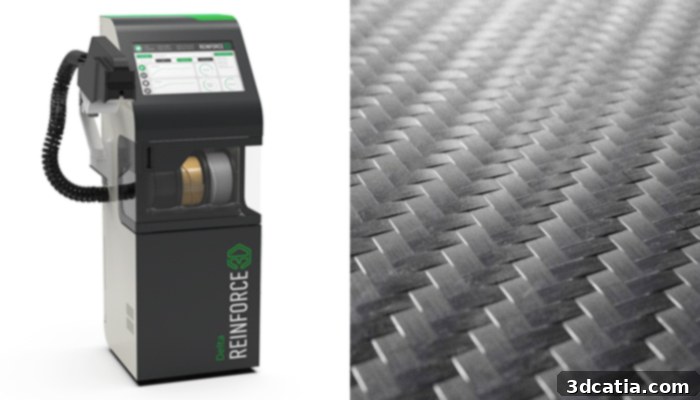
The Delta from Reinforce3D allows users to strengthen parts through the injection of continuous fibers, enhancing both lightness and mechanical integrity.
A Deeper Dive into Reinforce3D’s Delta and the CFIP Technology
The CFIP technology represents a paradigm shift in how 3D printed parts are reinforced. Unlike conventional additive manufacturing processes that attempt to integrate fibers during the printing stage – often compromising print speed or geometric complexity – CFIP strategically focuses on improving part properties in a crucial subsequent step. This innovative approach ensures that the fundamental benefits of 3D printing, such as design freedom and material flexibility, are not constrained by the reinforcement process. With the advent of the Delta machine, what was once a promising developmental technology has now become a tangible and powerful reality, ready for industrial application.
At its core, the CFIP method involves the precise injection of continuous fibers into pre-designed tubular cavities within the 3D printed part. These cavities are intentionally incorporated into the initial part design, allowing for targeted reinforcement exactly where it’s needed most. Crucially, CFIP utilizes continuous fibers, such as high-strength carbon fibers, rather than short, chopped fibers. This distinction is vital for achieving superior mechanical performance. The continuous fibers are carried into these intricate channels by a specialized resin, which then cures, creating a robust, structurally integrated composite that significantly strengthens the entire part. This meticulous process ensures optimal fiber alignment and load transfer, leading to dramatic improvements in overall part integrity and functionality.
Key Advantages and Material Versatility of CFIP
The primary and most compelling advantage of continuous fibers over their chopped counterparts lies in their ability to exponentially enhance part performance, rather than offering mere incremental improvements. Continuous fibers provide superior load-bearing capabilities, better stress distribution, and significantly higher tensile strength and stiffness, which are critical for demanding applications. Beyond carbon fibers, Reinforce3D’s CFIP technology is also compatible with other high-performance materials like glass and Aramid fibers, offering engineers a wider spectrum of properties to leverage. Furthermore, Reinforce3D is actively pursuing the expansion of CFIP’s capabilities to include natural fibers in the future, showcasing a commitment to sustainable innovation and broader material compatibility.
The Reinforce3D team elaborates on the Delta machine’s design philosophy: “The Delta machine represents an evolution of the CFIP technology, specifically engineered to adapt seamlessly to the rapidly evolving demands of the additive manufacturing industry. It achieves this by automating the reinforcement process and significantly facilitating its integration into industrial production workflows.” This focus on automation and ease of use underscores its readiness for mainstream manufacturing adoption. A standout feature of CFIP is its capability for integral bonding of different components. By injecting continuous fibers through multiple parts, the system creates uninterrupted fiber continuity from one end to the other. This results in far stronger bonds than those achieved with conventional joining methods, such such as adhesives or mechanical fasteners, thus opening up new possibilities for multi-material assemblies and complex modular designs.
The versatility of the Delta machine is a significant differentiator, especially when compared to methods that reinforce parts *during* the manufacturing process. By detaching the reinforcement step, Delta becomes compatible with a vast array of additive manufacturing technologies and materials. This includes high-throughput, production-focused 3D printing technologies like HP’s Multi Jet Fusion (MJF), which primarily work with thermoplastic polymers. This compatibility means users can leverage the cost-effectiveness and speed of these widely adopted technologies, then post-process parts with CFIP to achieve performance levels typically associated with more expensive materials or manufacturing methods. Furthermore, the Delta machine’s capabilities extend far beyond plastics; it can be applied to a diverse range of additive manufacturing materials, including high-performance metals and advanced ceramics, greatly broadening its industrial applicability and impact.
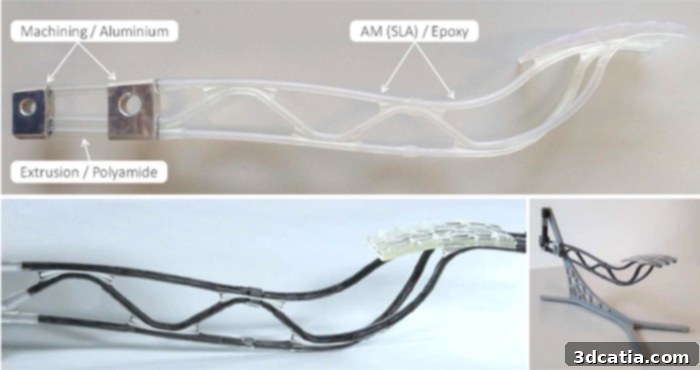
CFIP technology by Reinforce3D offers broad compatibility with various 3D printing techniques and materials, including widely used plastics and advanced metals.
Optimized Design and Seamless Integration with Industry 4.0
Beyond mechanical enhancement, another significant benefit of the Delta machine and CFIP technology is its potential for material reduction. By enabling the creation of hollow parts that are subsequently reinforced with continuous fibers, the system can achieve the same, or even superior, rigidity and strength as solid parts, but with significantly less material. This not only translates to cost savings but also contributes to creating lighter components, which is invaluable for industries where weight reduction directly impacts performance, such as aerospace, automotive, and robotics.
Ease of use and operational efficiency are hallmarks of the CFIP machine. It boasts a user-friendly graphical interface accessible via a touch screen, simplifying operation and reducing the learning curve for technicians. Furthermore, its compact size is a strategic advantage, making it perfectly suited for integration into existing laboratories and workshops. This allows it to seamlessly coexist with conventional 3D printers and other manufacturing equipment, facilitating hybrid workflows and localized production. Crucially, the Delta machine is designed to be Industry 4.0 ready. This means it can be readily integrated with advanced automation and robotics systems, enabling the creation of highly efficient, end-to-end production workflows that minimize human intervention and maximize output, paving the way for fully automated additive manufacturing lines.
Reinforce3D’s Transformative Role in the 3D Printing Industry
Reinforce3D’s CFIP technology is not merely an improvement; it is widely anticipated to be a game-changing disruptive innovation within the additive manufacturing landscape. Its unparalleled ability to significantly enhance the performance of 3D printed parts, coupled with its remarkable versatility in terms of compatible materials and its potential across a multitude of industries, positions it as a truly promising technology for industrial-scale 3D printing applications. By providing a reliable and efficient method for post-print reinforcement, Reinforce3D is addressing a critical bottleneck in the widespread adoption of additive manufacturing for high-performance end-use parts.
With the imminent launch of the Delta machine and its expected commercialization from 2024, Reinforce3D aims to unlock a new frontier of possibilities for users who seek to imbue their final 3D printed parts with advanced mechanical properties. From prototypes requiring rigorous testing to final components demanding exceptional strength-to-weight ratios, the Delta machine will empower designers and manufacturers to push the boundaries of innovation. Early insights into its main features and expected results indicate that the industry can anticipate a new standard for performance and efficiency in additive manufacturing post-processing.
Beyond offering the cutting-edge Delta machine, Reinforce3D is committed to fostering widespread adoption of CFIP technology through comprehensive consulting services. These services are meticulously designed to assist companies in seamlessly integrating CFIP into their existing operations. The expert consulting covers a broad spectrum of critical areas, including advanced topological optimization for part design, optimization of the entire 3D printing process, strategic integration with injection molding workflows, rigorous testing protocols, and precise cost estimation for industrialization efforts. Whether you are eager to learn more about the Delta solution’s capabilities or are looking to leverage Reinforce3D’s deep expertise through their consulting service, we encourage you to visit their official website HERE. Additionally, for a firsthand experience and to engage directly with the Reinforce3D team, be sure to visit their booth at Formnext 2023, located at booth B119 in Hall 12.0.
What are your thoughts on Reinforce3D and their innovative CFIP technology? We invite you to share your insights and comments below, or connect with us on our social media platforms: LinkedIn, Facebook, and Twitter. To stay informed on the very latest developments in 3D printing, don’t forget to sign up for our free weekly Newsletter here, delivered straight to your inbox! You can also explore all our comprehensive video content on our dedicated YouTube channel.
*All Photo Credits: Reinforce3D