
Revolutionizing Industries: Latest 3D Printing Innovations in Medical, Construction, and Advanced Manufacturing
The world of additive manufacturing continues its rapid evolution, pushing boundaries across diverse sectors. This week, we delve into a series of groundbreaking 3D printing innovations that are poised to reshape medical procedures, construction methodologies, and advanced industrial applications. From creating realistic human tissue models for surgical training to pioneering bioresorbable implants that stimulate natural bone growth, and from introducing highly automated concrete printers to developing revolutionary multi-metal fabrication processes, these advancements highlight the transformative power and versatility of 3D printing technology. These positive updates underscore a future where precision, efficiency, and customization are not just aspirations, but tangible realities, driving progress in fields critical to human well-being and industrial productivity.
Simulated Skin for Advanced Surgical Training
In a significant breakthrough for medical education and surgical preparedness, researchers at the University of Minnesota have successfully engineered and 3D printed a new type of advanced skin model. This innovation marks a substantial leap forward from previous generations of simulated tissues, which were often simplistic, rigid, and lacked the nuanced characteristics of real human skin. The conventional models, while useful for basic practice, fell short in providing surgeons with the tactile feedback and realistic material response necessary for truly comprehensive training.
The newly developed technique by the University of Minnesota team leverages sophisticated 3D printing capabilities to replicate the intricate properties found in biological tissues. Crucially, these models can mimic the directional strength, softness, and unique stretchiness inherent in real skin, offering an unparalleled level of realism. This fidelity is vital for surgeons to develop refined motor skills and a deeper understanding of tissue manipulation before operating on patients.
Adding another layer of realism, the researchers ingeniously integrated microcapsules within the simulated tissue. These tiny capsules contain a liquid designed to mimic blood, providing a lifelike response during surgical incisions. The brilliance of this approach lies in the microcapsules’ ability to prevent the simulated blood from drying out prematurely or interfering with the precision of the 3D printing process itself. This ensures that the models maintain their realistic properties throughout a training session, from initial incision to suturing.
A preliminary study conducted with practicing surgeons yielded highly promising results. Participants reported that these new surgical models offered vastly improved tactile feedback and a more authentic response to cutting compared to their conventional counterparts. This enhanced realism translates directly into more effective training, potentially reducing surgical errors and improving patient outcomes. Looking ahead, the research team is already exploring the expansion of this technology to print other vital organ models, with the ambitious goal of advancing surgical training across a broader spectrum of medical procedures. This development holds immense promise for revolutionizing how future generations of medical professionals acquire critical surgical skills, ensuring they are better prepared for the complexities of real-world operations.
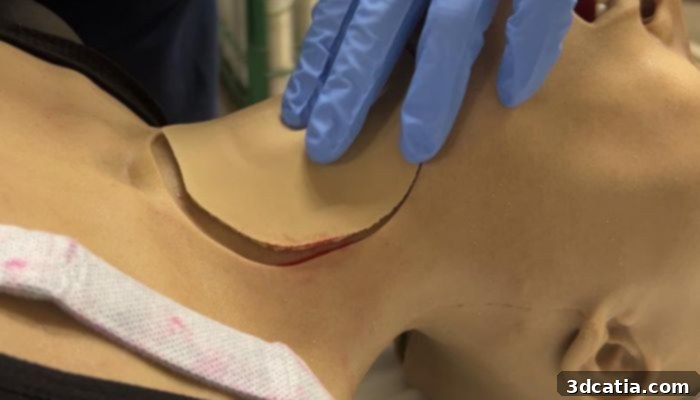
3D printed simulated skin for training (Photo Credit: McAlpine Research Group)
A Groundbreaking Bioresorbable Cranial Implant in Germany
In a monumental achievement for reconstructive medicine and neurosurgery, the Municipal Clinic of Dessau, Germany, has successfully performed an innovative operation involving a bioresorbable cranial implant. This procedure represents a paradigm shift from traditional methods, where patients would typically receive permanent implants made from inert materials, necessitating a lifelong presence of foreign material within the body.
Prof. Dr. Klaus Zweckberger, the head physician of the Neurosurgery Clinic, eloquently articulated the profound significance of this new method. He emphasized, “We can not only treat patients safely, but also stimulate natural bone growth. This eliminates the need for lifelong use of foreign material.” This statement highlights the dual benefit of the bioresorbable implant: providing immediate structural support while simultaneously fostering the body’s own regenerative capabilities. The implant, designed to gradually dissolve over time, encourages the patient’s natural bone tissue to grow and replace it, effectively creating a completely integrated and natural cranial structure.
Under the expert direction of Dr. Henrik Giese, the patient received a completely new skull segment that, critically, is engineered to fuse with the existing bone and actively promote bone reconstruction. Dr. Giese further underscored the remarkable accuracy achieved with this pioneering technique: “The precision of the implant was impressive: it integrated into the existing cranial structure like a custom-made key. The combination of 3D printing, bioresorbable material, and autologous bone marrow opens up completely new perspectives in reconstructive medicine.” The unparalleled precision afforded by 3D printing allows for patient-specific implants that fit perfectly, minimizing complications and optimizing healing.
This innovative approach marries the advantages of personalized 3D printing with cutting-edge bioresorbable materials and the patient’s own autologous bone marrow. This synergistic combination not only ensures a perfect anatomical fit but also provides the biological cues necessary for the body to regenerate its own bone. Such advancements hold immense potential for patients suffering from cranial defects due to trauma, disease, or congenital conditions. It promises reduced long-term complications associated with foreign materials, enhanced aesthetic outcomes, and ultimately, a better quality of life. This success story from Dessau unequivocally establishes a new benchmark for personalized and regenerative medical treatments using additive manufacturing.
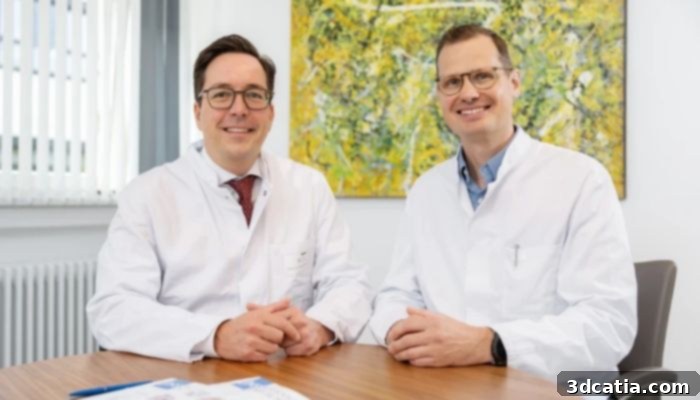
Prof. Dr. Klaus Zweckberger and Dr. Henrik Giese (photo credits: SKBS)
Introducing Coral’s New Generation 3D Concrete Printer
The construction sector is undergoing a profound transformation, with additive manufacturing emerging as a pivotal technology for enhancing efficiency, sustainability, and design flexibility. As the adoption of 3D printing in construction becomes increasingly widespread, the market is witnessing a surge of new players, each striving to deliver more reliable, faster, and safer solutions. Amidst this competitive landscape, Coral is making a notable entry with its Coral 3DCP Gen25 concrete printer, set to be unveiled for the first time in early October.
The Coral 3DCP Gen25 is designed to address many of the current challenges in 3D concrete printing. A key feature is its mass-produced nature, which suggests a focus on scalability and accessibility, making advanced construction technology available to a broader market. Furthermore, its easy transportability is a significant advantage, allowing for rapid deployment to various construction sites, from urban developments to remote locations, thus reducing logistical complexities and setup times. The printer also boasts advanced automation capabilities, streamlining the construction process and minimizing the need for manual labor, which in turn enhances safety and reduces operational costs.
According to Coral, the 3DCP Gen25 is engineered for immediate readiness and global deployment. This claim highlights the company’s confidence in its printer’s robust design and user-friendly interface, enabling rapid integration into existing construction workflows anywhere in the world. This new concrete printer promises to accelerate project timelines, facilitate the creation of complex architectural geometries that are difficult or impossible with traditional methods, and significantly reduce material waste due to the precision of additive layering. The potential for cost savings, coupled with improved structural integrity and environmental benefits, positions the Coral 3DCP Gen25 as a strong contender in the evolving landscape of automated construction. Its introduction signals a future where sustainable, efficient, and innovative building practices are within reach for projects of all scales.
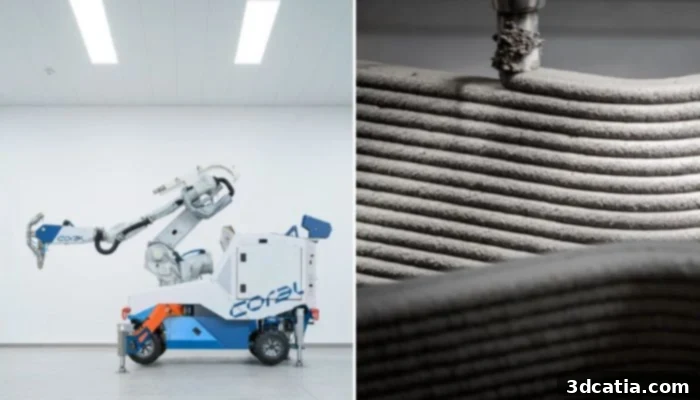
On the left, the 3D concrete printer; on the right, the layer-by-layer process (photo credits: ICE Coral)
ETH Zurich Unveils Revolutionary Multi-Metal 3D Printing Process
In a testament to cutting-edge engineering and innovation, students from ETH Zurich presented an innovative multi-metal 3D printer in September 2025. This prototype is set to redefine the capabilities of additive manufacturing by allowing for the simultaneous printing of different metals in a single, continuous step. This breakthrough addresses a critical limitation of traditional multi-material printing, which often involves laborious changeover processes, leading to increased material waste, longer production times, and reduced efficiency.
The “Rapture” project, as it’s known, saw six dedicated students develop this sophisticated machine over nine months. At its core, the printer utilizes a rotating platform that continuously feeds various metal powders, which are then fused together using a precisely controlled laser. This ingenious design completely eliminates the need for sequential material changes, drastically saving both time and raw materials. The ability to deposit multiple metals concurrently opens up unprecedented possibilities for creating components with functionally graded material properties – where different sections of a single part possess distinct mechanical or thermal characteristics tailored to specific performance requirements.
This novel process is particularly well-suited for manufacturing complex cylindrical components, such as rocket nozzles. In such demanding applications, different sections of the nozzle require varying material properties to withstand extreme temperatures, pressures, and corrosive environments. Conventionally, producing such parts is incredibly challenging and time-consuming, often requiring multiple manufacturing steps and assembly. With ETH Zurich’s multi-metal 3D printer, manufacturing time is significantly reduced, offering a streamlined and highly efficient production method for these critical parts.
The development was not without its technical hurdles. Key challenges included achieving precise coordination between the laser, the various powder feeds, and the gas supply, as well as managing gas flow effectively to prevent oxidation of the reactive metals during the printing process. Overcoming these complexities demonstrates the advanced engineering prowess of the ETH Zurich team. Recognizing the immense potential of this technology, ETH has already filed a patent for the process, and the prototype earned a nomination for the prestigious Spark Award 2025, underscoring its innovative impact.
Currently, the technology can be employed for components with a maximum diameter of 20 cm, a limitation that the team aims to expand in future iterations. The anticipated applications are vast and far-reaching, including critical sectors such as aeronautics, aerospace, and general mechanical engineering, where high-performance, functionally optimized metal components are essential. This multi-metal 3D printing process holds the promise of ushering in a new era of material design and manufacturing, enabling lighter, stronger, and more durable parts for the next generation of industrial innovations.
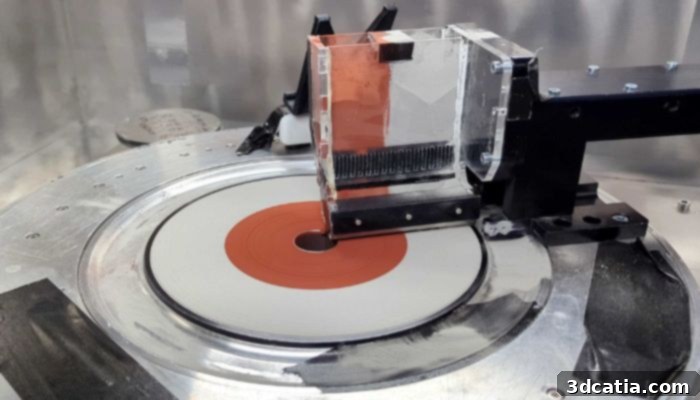
Photo Credits: ETH Zurich
These recent breakthroughs exemplify the incredible versatility and potential of 3D printing across critical industries. From enhancing medical training and patient care with bioresorbable implants and realistic surgical models, to accelerating construction with automated concrete printers, and revolutionizing advanced manufacturing with multi-metal capabilities, additive manufacturing is clearly at the forefront of innovation. The future promises even more integrated and sophisticated applications that will continue to push the boundaries of what’s possible.
What are your thoughts on these cutting-edge 3D printing advancements, particularly the realistic 3D printed skin for surgical training? We invite you to share your perspectives in a comment below or join the discussion on our LinkedIn or Facebook pages! Don’t miss out on the latest developments – sign up for our free weekly Newsletter to get essential 3D printing news delivered straight to your inbox. You can also explore all our insightful videos on our YouTube channel. For those particularly interested in more medical and dental 3D printing news, a dedicated page awaits you HERE.
*Cover Photo Credit: Getty Images