
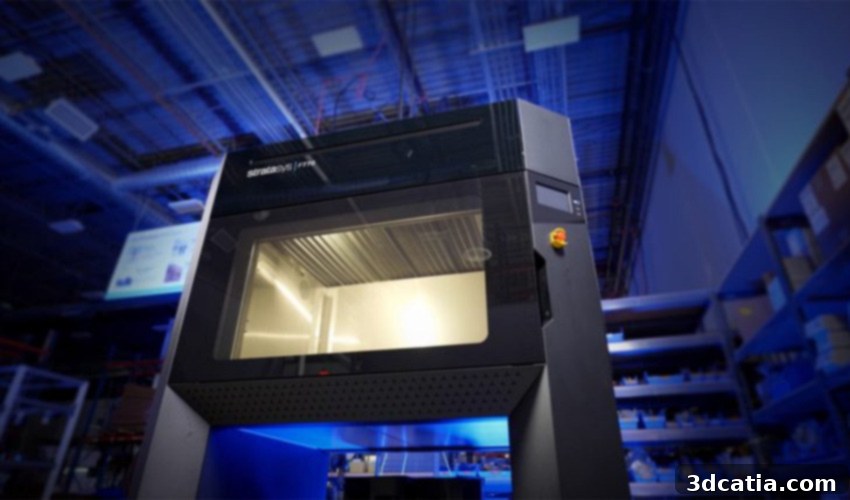
Stratasys Unveils Three New 3D Printers: Ushering in the Additive Manufacturing 2.0 Era for Production Parts
Stratasys, a global leader and one of the most established companies in the world of industrial 3D printing, has announced the launch of three innovative new polymer 3D printers. This significant release, encompassing the Stratasys H350™ 3D printer, Stratasys Origin One, and Stratasys F770™ 3D printer, is strategically designed to capture a substantial share of the multi-billion dollar market for additive manufacturing of end-use parts. By leveraging diverse technologies, these systems aim to accelerate the crucial transition from traditional manufacturing methods to additive manufacturing, particularly for low-to-mid-volume production applications that are currently underserved. This pivotal moment marks Stratasys’ definitive entry into what it terms the “Additive Manufacturing 2.0 Era,” focusing on precision, high production capabilities, and large-format printing to meet a broad spectrum of customer demands.
Accelerating into the Additive Manufacturing 2.0 Era
For several years, the additive manufacturing (AM) industry has been advocating for greater recognition of 3D printing’s value as an indispensable manufacturing tool. The recent global disruptions, particularly those impacting supply chains during the pandemic, have only underscored the urgent need for more resilient and flexible production methods. Stratasys believes these new systems will significantly accelerate this industry-wide shift. Dr. Yoav Zei, CEO of Stratasys, articulates this vision clearly: “We are accelerating into the Additive Manufacturing 2.0 era, in which we see global manufacturing leaders move beyond prototyping to fully embrace the agility that 3D printing brings to the entire manufacturing value chain. The disruptions we are seeing today on both the supply and demand side of global supply chains are a clear sign that the status quo isn’t working. Additive manufacturing gives companies the total flexibility to decide when, where, and how to produce parts. That’s why we’re committed to being the complete provider of polymer 3D printing solutions for our world-class customer base.”
This “Additive Manufacturing 2.0” philosophy signifies a profound shift from merely creating prototypes to integrating 3D printing seamlessly into full-scale production workflows. It’s about empowering manufacturers with unprecedented agility, enabling them to respond swiftly to market changes, customize products efficiently, and localize production to mitigate geopolitical risks and supply chain vulnerabilities. Stratasys’ commitment to this era is reflected in its dedication to offering comprehensive polymer 3D printing solutions that span various technologies, materials, and applications, ensuring that businesses can leverage AM for true industrial production.
Fostering a Digital Manufacturing Ecosystem through Strategic Partnerships
Beyond pushing AM further into the forefront for end-use parts, Stratasys emphasized the critical importance of cultivating a robust digital manufacturing ecosystem during the press conference. This ecosystem thrives on collaboration, bringing together partners from diverse industries and across the entire AM value chain. These extensive partnerships with companies specializing in materials, software, and services are crucial for developing the best possible solutions for the evolving market. Dr. Zei highlighted that these newly launched machines are a direct outcome of these varied and vital collaborations, enabling Stratasys to effectively address and overcome a wide range of challenges within additive manufacturing.
A comprehensive digital manufacturing ecosystem ensures that customers have access to not just advanced hardware, but also optimized materials tailored for specific applications, intelligent software for streamlined workflows, and expert services for implementation and support. This holistic approach ensures that the barriers to adoption for industrial AM are lowered, allowing more companies to integrate 3D printing into their production lines with confidence. These collaborations allow for rapid innovation, ensuring that Stratasys’ offerings remain at the cutting edge and truly meet the complex demands of modern manufacturing.
Introducing Stratasys’ Groundbreaking Production 3D Printers
Stratasys’ new lineup of polymer solutions is meticulously engineered to address a variety of additive manufacturing needs, catering to different scales, precision requirements, and part sizes. Each machine represents a significant leap forward in production capabilities, offering manufacturers unprecedented flexibility and control.
1. Stratasys Origin One: Precision and Volume for Intricate Parts
The Stratasys Origin One, a result of the successful collaboration and subsequent acquisition of Origin by Stratasys at the end of 2020, is designed to deliver production-scale 3D printing for highly detailed and intricate parts. This system is anticipated to excel in end-use manufacturing applications across demanding sectors such as medical, aerospace, and automotive. The Origin One utilizes Stratasys’ proprietary P3™ technology, which is based on advanced Digital Light Processing (DLP) principles. This process, combined with a software-first architecture, allows for the efficient production of high volumes of parts with exceptional accuracy and surface finish.
Chris Prucha, Vice President of Products and R&D and co-founder of Origin, highlighted the extensive enhancements made to the new Origin One. He noted that the printer boasts over 100 hardware design improvements, which translate directly into tangible benefits for users. These improvements include: 1.) Better ergonomics for customers, refining the entire production workflow and making the machine more user-friendly. 2.) Improved serviceability, enabling rapid on-site servicing through Stratasys’ extensive global service team, minimizing downtime. 3.) Substantially more headroom than its predecessor, allowing for future software updates to further enhance P3 print speeds, reliability, and precision. As a result, the Stratasys Origin One is projected to produce even more accurate parts at print speeds that are 10-30% faster than previous iterations. During the conference, Mark Savage of T3 further attested to the transformative impact of the Origin One for his team, stating that it has enabled them to print parts with complex geometries and internal features that would have been impossible to create with traditional manufacturing methods like injection molding, unlocking new design possibilities and functional capabilities.
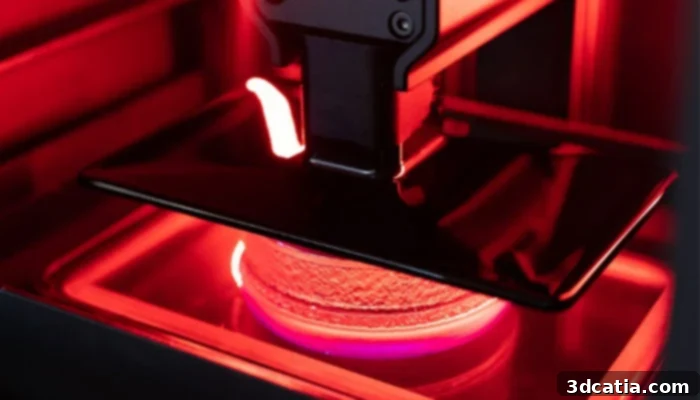
The Origin One 3D printer delivers high precision and volume.
2. Stratasys H350: Consistent Production with SAF™ Technology
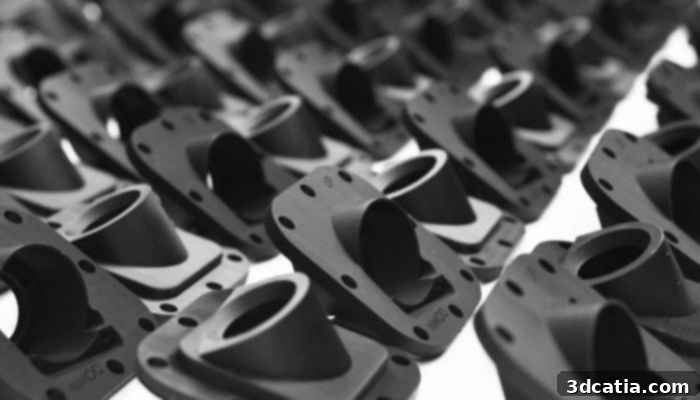
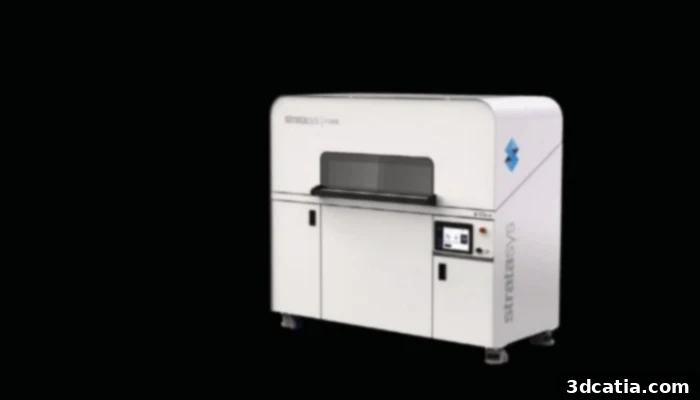
Moving into the realm of powder bed fusion, the Stratasys H350 printer introduces Stratasys’ innovative SAF™ technology, first announced in March. This machine marks Stratasys’ strategic entry into the powder bed fusion market, offering an advanced solution for manufacturers who demand production consistency, predictable cost per part, and complete control over the production of thousands of parts. The H350 is engineered to produce more consistent, production-grade plastic parts, empowering users with greater command over both the printing process and overall costs.
This consistency and control are achieved through several ingenious features. Notably, the H350 utilizes infrared technology to infuse polymer particles simultaneously from left to right in a single pass. This unique directional fusing process ensures that all particles, regardless of their position within the build chamber, experience the exact same thermal environment as they are fused. This uniform thermal experience is critical for producing parts with consistent mechanical properties and dimensional accuracy across the entire build platform. Additionally, the H350 boasts an impressively high reuse rate for unfused powder, significantly contributing to reduced material waste and lower operational costs in the printing process. A compelling user case demonstrated that the H350 not only delivered low costs per part but also achieved remarkably short turnaround times – as little as 24 hours for low-to-mid volume production batches. Crucially, the SAF technology consistently ensured high part quality and repeatability, factors that are paramount for any manufacturing environment. This makes the H350 ideal for applications requiring robust, production-ready parts in industries like consumer goods, medical devices, and industrial machinery.
3. Stratasys F770: Large-Format FDM for Industrial Applications
Finally, Stratasys has expanded its FDM (Fused Deposition Modeling) portfolio with the introduction of the Stratasys F770™ 3D printer. This machine is distinguished by featuring the longest fully heated build chamber on the market, offering a generous build volume exceeding 13 cubic feet. As expected, this robust solution is specifically designed to meet the growing market demand for printing exceptionally large parts, either as single large components or in batches. Priced under $100,000, the F770 positions itself as a relatively affordable industrial-grade machine of its size, making advanced large-format FDM technology accessible to a broader range of manufacturers.
The F770 is perfectly suited for a wide array of applications, including large-scale prototyping, the creation of robust jigs and fixtures, and tooling applications that require standard thermoplastics. Its fully heated build chamber is crucial for producing large, dimensionally stable parts by minimizing warpage and ensuring consistent material extrusion. The printer has also been engineered with a strong emphasis on ease of use. Dough Steindl from Sub-Zero Group, a renowned manufacturer of luxury appliances, attested to this simplicity, noting that his team was able to commence printing within an hour of receiving the machine. The F770 incorporates several features that streamline the printing process, such as soluble support material, which drastically simplifies post-processing and reduces labor. Furthermore, the integration of GrabCAD Print™ software streamlines the entire workflow, from design to print, while enterprise connectivity is seamlessly enabled through the MTConnect standard and the GrabCAD SDK, facilitating data management and integration into existing manufacturing ecosystems. If you would like to find out more about Stratasys’ 3D printers and their innovative technologies, you can find more information on the official Stratasys website HERE. Stratasys will also be holding a live event on Wednesday, April 28, to provide a deeper dive into these groundbreaking 3D printers and their underlying technologies.
Stratasys’ Commitment to the Future of Manufacturing
With the launch of the H350, Origin One, and F770, Stratasys reaffirms its position as a vanguard in the polymer 3D printing industry. These new machines are not merely incremental updates but foundational pillars for the “Additive Manufacturing 2.0 Era,” enabling manufacturers to transition from traditional methods to a more agile, efficient, and resilient production paradigm. By addressing critical needs for precision, volume, and large-format capabilities, Stratasys is empowering industries to innovate faster, optimize supply chains, and unlock new possibilities in design and functionality. The company’s commitment to fostering a collaborative digital manufacturing ecosystem further strengthens its holistic approach, ensuring that customers receive comprehensive solutions that extend beyond hardware to include advanced materials, intelligent software, and robust support. This strategic expansion solidifies Stratasys’ role as a complete provider of polymer 3D printing solutions, driving the future of industrial manufacturing forward.
What are your thoughts on the new Stratasys 3D printers and their potential impact on additive manufacturing? Let us know in a comment below or connect with us on our Linkedin, Facebook, and Twitter pages! Don’t miss out on the latest 3D printing news – sign up for our free weekly Newsletter here, delivered straight to your inbox. You can also explore all our insightful videos on our YouTube channel.
*All Image Credits: Stratasys