
Revolutionizing Water Systems: Novall’s Additive Manufacturing Success with Arkema’s Bio-Sourced Rilsan® PA11
In the dynamic landscape of modern product development, additive manufacturing, commonly known as 3D printing, plays an increasingly pivotal role. This transformative technology enables rapid prototyping and iterative design cycles, significantly accelerating the journey from concept to market and leading to impressively shorter production times. Recognizing this immense potential, many forward-thinking design offices have proactively equipped themselves with advanced 3D printing solutions. Their goal: to ignite innovation, streamline development processes, and quickly introduce differentiated products to a competitive market. A prime example of this strategic adoption is Novall, a French company renowned for its expertise in industrial product design. Three years ago, Novall made a decisive move, establishing a dedicated entity focused entirely on additive manufacturing. Today, this specialized division leverages 3D printing technology to not only design but also to produce small series of components meticulously tailored to the precise requirements of its diverse customer base. This strategic integration allows Novall to offer bespoke solutions that would be economically unfeasible or prohibitively expensive to produce using conventional manufacturing methods, such as injection molding. The company’s additive manufacturing entity operates primarily with a sophisticated powder sintering process, and crucially, utilizes Arkema’s Rilsan® Polyamide 11. This material stands out for being 100% bio-sourced, derived entirely from castor oil, underscoring Novall’s commitment to both performance and sustainability. The exceptional combination of chemical resistance and robust mechanical properties inherent in Rilsan® PA11 empowers Novall to engineer ACS (French Certificate of Sanitary Compliance) certified components. These components are specifically designed for direct and safe contact with drinking water, finding critical applications in innovative solutions like hydrogenators and advanced filtration systems.
Novall’s journey into additive manufacturing began several years ago with a strategic investment in a state-of-the-art 3D printing machine. This move was not merely an upgrade but a deliberate alternative to outsourcing, driven by a clear vision to achieve faster, more localized, and ultimately more agile production capabilities. A significant collaboration for Novall is with Save Innovations, a company dedicated to providing essential electrical power to equipment crucial for the modernization of drinking water networks. The context for this partnership is particularly pressing in France, where the existing water network infrastructure, often dating back 50 years, faces a concerning leakage rate of approximately 20%. This statistic highlights the urgent and paramount importance of modernizing these vital networks to ensure efficient and sustainable water distribution. In response to this critical challenge, Novall embarked on the design and development of Picogen, a groundbreaking, patented pico-turbine. This ingenious device integrates both a turbine and a regulator, meticulously engineered to optimize electricity production. Picogen’s innovative design enables it to generate the necessary electricity directly within the water network, powering the very equipment used for its modernization. This self-sustaining solution significantly reduces reliance on external power sources and contributes to the operational efficiency of water infrastructure. Demonstrating its efficacy and reliability, the Picogen solution was successfully installed and integrated into the extensive network of Eau de Paris in 2018, marking a significant milestone in the ongoing efforts to enhance France’s drinking water infrastructure.

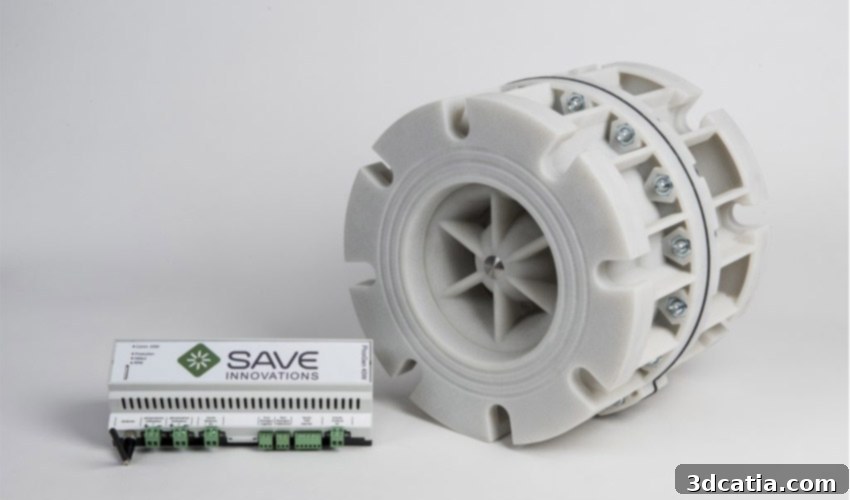
Picogen is a patented pico-turbine consisting of a turbine and regulator that optimizes electricity production
Optimizing Performance: The Strategic Choice of Selective Laser Sintering and Rilsan® PA11
The use of Rilsan® PA11 in turbine design
The selection of the appropriate 3D printing process and material was a critical phase for Novall. After conducting a series of exhaustive tests on various additive manufacturing technologies, the company definitively opted for selective laser sintering (SLS). This decision was driven by SLS’s ability to produce highly complex geometries with excellent mechanical properties, making it ideal for their demanding industrial applications. Complementing this process choice was the meticulous selection of material. Novall identified Rilsan® Polyamide 11 (PA11) as the superior choice due to its outstanding suite of chemical and mechanical properties, which are particularly crucial for components in direct contact with drinking water. PA11 distinguishes itself with very low water absorption characteristics, a vital attribute for maintaining dimensional stability and performance in aquatic environments. Beyond this, it boasts exceptional mechanical strength, demonstrating remarkable ductility and superior impact resistance. These properties ensure the longevity and reliability of parts under various operational stresses. Critically, Rilsan® PA11 is inherently compatible with direct contact with drinking water, meeting stringent health and safety standards without requiring additional post-processing. In contrast, other commonly used polyamides, such as PA12, often necessitate special coatings or revalidation processes to achieve similar certifications for potable water contact. Ronald Bosch, CEO of Novall, elaborated on this crucial decision: “We were hesitating between PA12 and PA11, but in various tests we found that PA11 performs better in water. Its inherent properties negated the need for additional treatments, simplifying our production while guaranteeing safety and durability.” This robust performance in aquatic environments proved that Rilsan® PA11 was the ideal material for the efficient series production of their innovative, connected pico-turbine, ensuring both functionality and compliance.
The specific design and manufacturing of the turbine body exemplify the advanced capabilities enabled by additive manufacturing with Rilsan® PA11. Novall meticulously 3D printed the turbine body using a specialized glass-bead filled Rilsan® Polyamide 11, further enhancing the material’s already impressive characteristics. This robust component measures approximately 350 x 400 mm and weighs a substantial 8 kilograms, underscoring the ability of SLS to produce large, functional industrial parts. A cornerstone of its application in drinking water systems is its ACS certification (Attestation de Conformité Sanitaire in French). This crucial certification signifies that the component is fully approved for direct and prolonged contact with drinking water, assuring its safety and non-contamination properties. The ACS certification process itself is a rigorous and comprehensive evaluation, conducted by laboratories officially authorized by the French health service. This stringent assessment involves a thorough screening of the material’s formulation and extensive testing to determine its suitability for contact with potable water, ensuring that no harmful substances leach into the water and that the material maintains its integrity over time. This stringent regulatory compliance is a key differentiator for Novall, enabling their innovative products to be deployed in sensitive applications where public health and safety are paramount.
By leveraging Arkema’s high-performance Rilsan® PA11 material, Novall was able to design and produce a turbine that exhibits superior chemical and mechanical performance, meticulously engineered to withstand the demanding constraints of its aquatic environment over an extended lifespan. For instance, the material ensures optimum sealing critical for hydraulic systems, preventing leaks and maintaining operational efficiency. Furthermore, the incorporation of glass beads in the PA11 matrix significantly enhances properties such as increased ion exchange, which can be beneficial in specific water treatment applications. Ronald Bosch emphasized the transformative impact of additive manufacturing on their capabilities: “This part was made according to a specific process and material; we could not have used this PA11 with traditional manufacturing processes to achieve the same performance or complexity. 3D printing offers many benefits that simply weren’t possible before.” Among these compelling benefits is the ability to implement local manufacturing, which drastically reduces the carbon footprint associated with long-distance shipping and complex global supply chains. Additionally, the inherent freedom of design offered by additive manufacturing allows each part to be conceptualized and produced as a single, monolithic block. This innovative approach eliminates the need for complex assemblies involving multiple components, reducing potential failure points and streamlining the manufacturing process. Furthermore, this single-material construction greatly facilitates recycling efforts, as the entire part is made from a homogeneous material, simplifying end-of-life processing and contributing to a circular economy. It is also noteworthy that Rilsan® PA11 is proudly made from castor oil, a vegetable oil derived from a renewable resource, positioning it as a significantly more sustainable alternative compared to many traditional petroleum-based materials within the industrial sector. Rilsan® PA11 also boasts impressive refresh rates, further cementing its eco-friendly credentials. In line with its commitment to sustainable sourcing, Arkema is one of the four founding members of the Pragati project, an impactful initiative launched in 2016. This project was established with the noble goal of fostering sustainable castor crop production practices in India. Since its inception, Pragati has successfully engaged castor seed growers in proactive dialogues and has driven the widespread adoption of improved, sustainable farming techniques, thereby ensuring an ethical and environmentally responsible supply chain for Rilsan® PA11.

Rilsan® PA11 is made from castor oil, a vegetable oil that is more sustainable compared to other materials in the oil industry
Ronald Bosch concludes with a compelling summary of Novall’s achievements and strategic positioning: “We were able to develop a cutting-edge manufacturing process with a specific material that precisely meets our highly demanding application needs in the aquatic field. Through this dedicated effort, we have successfully obtained ACS certification, which represents a key market advantage that empowers our end customers to confidently integrate and utilize our innovative products within complex drinking water systems, knowing they meet the highest standards of safety and performance.” Novall’s success story with Picogen exemplifies how strategic adoption of additive manufacturing, coupled with advanced bio-sourced materials like Arkema’s Rilsan® PA11, can drive significant innovation, enhance sustainability, and meet critical industry demands for high-performance and certified components in vital infrastructure like drinking water networks. This fusion of technology and material expertise paves the way for a new generation of sustainable and highly efficient industrial products. Do you want to know more about Arkema’s Rilsan® PA11 and its diverse applications? Find more comprehensive information and detailed technical specifications HERE.
What are your thoughts on the exceptional properties and sustainable advantages of Rilsan® PA11? We invite you to share your insights and comments below, or engage with us on our Facebook and Twitter pages! Additionally, remember to sign up for our free weekly Newsletter, ensuring you receive all the latest news on groundbreaking progress, cutting-edge research, and inspiring entrepreneurial ventures in the dynamic world of 3D printing, delivered directly to your inbox!