
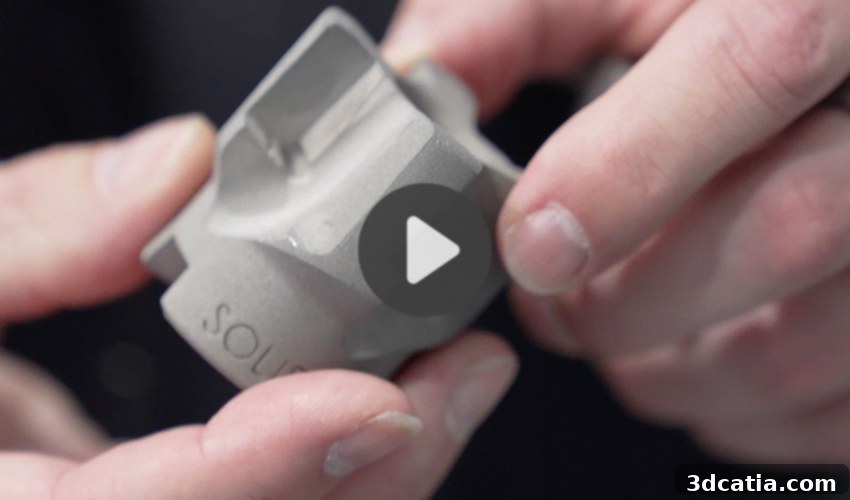
SolidCAM Forges the Future: Uniting CNC Machining with Metal Additive Manufacturing
In the rapidly evolving landscape of modern manufacturing, the synergy between traditional subtractive methods and innovative additive technologies is becoming increasingly undeniable. Additive manufacturing, commonly known as 3D printing, is no longer a niche technology but a powerful complement to established processes like Computer Numerical Control (CNC) machining. Leading this transformative charge is SolidCAM, a company long renowned for its cutting-edge Computer-Aided Manufacturing (CAM) solutions.
SolidCAM made a significant announcement at IMTS, signaling its strategic entry into the metal additive manufacturing market through a pivotal partnership with Desktop Metal. This bold move underscores SolidCAM’s commitment to advancing the manufacturing industry by bridging the gap between subtractive and additive processes. Since this announcement, SolidCAM has become a vocal advocate for the advantages of integrating CNC machining with metal 3D printing, particularly emphasizing the transformative potential of metal binder jetting technology.
To delve deeper into SolidCAM’s vision and explore how the convergence of 3D printing and CNC machining can revolutionize the industrial sector, we had the distinct opportunity to meet with the company’s leadership at Formnext 2022. Our discussions included insightful conversations with Michael Leditzky, the COO of Global SolidCAM and CEO of SolidCAM Additive, and Joerg Vollmann-Schipper, Sales Manager at SolidCAM Additive. They provided an in-depth perspective on SolidCAM’s strategic entry into the 3D printing market, outlined how businesses can effectively integrate CAM solutions with additive manufacturing, highlighted potential applications born from this powerful combination, and shared their forward-looking views on the future of manufacturing.
SolidCAM’s Strategic Leap into Additive Manufacturing
SolidCAM’s decision to venture beyond its core CAM expertise into additive manufacturing is a testament to its forward-thinking approach. For decades, SolidCAM has been synonymous with precision and efficiency in CNC machining. Their move into metal 3D printing, especially binder jetting, is not merely an expansion but a strategic evolution aimed at offering comprehensive manufacturing solutions. Michael Leditzky explained that the company recognized the growing demand for complex geometries, rapid prototyping, and on-demand production that traditional CNC alone cannot always fulfill efficiently. By partnering with Desktop Metal, a leader in binder jetting technology, SolidCAM gains access to a robust and scalable metal additive manufacturing platform.
This strategic pivot announced during IMTS reflects a deeper understanding of the market’s trajectory towards integrated, hybrid manufacturing workflows. SolidCAM’s leadership believes that the future of manufacturing lies in the intelligent combination of the strengths of both additive and subtractive processes. This philosophy allows manufacturers to overcome the limitations of each individual technology, unlocking new possibilities in design, material usage, and production efficiency. The integration also ensures that SolidCAM remains at the forefront of manufacturing innovation, providing its customers with the tools they need to stay competitive in a rapidly changing global market.
The Unparalleled Power of Hybrid Manufacturing: Synergies of CNC and 3D Printing
The concept of hybrid manufacturing, where additive and subtractive processes work in concert, represents a significant paradigm shift. Additive manufacturing excels at creating intricate, complex geometries, internal channels, lightweight structures, and consolidating multiple parts into a single component, all while minimizing material waste. However, 3D printed parts often require post-processing to achieve the stringent surface finish and dimensional accuracy demanded by many industrial applications. This is where CNC machining steps in, perfectly complementing AM.
CNC machines can perform high-precision finishing operations, create tight tolerances, and achieve superior surface quality on parts that were initially 3D printed. This symbiotic relationship means that manufacturers can leverage the design freedom and material efficiency of 3D printing for the initial part creation, and then utilize the precision and speed of CNC machining for critical features. For instance, a complex aerospace component could be 3D printed to achieve an optimized lightweight design, and then machined on critical mating surfaces or bearing seats to meet exact specifications. This integrated approach not only enhances part performance but also streamlines the entire production workflow, potentially reducing lead times and overall manufacturing costs, especially for low-volume, high-value components.
Industries such as aerospace, automotive, medical, and tooling stand to benefit immensely from this hybrid approach. In aerospace, complex brackets and engine components can be optimized for weight and performance. In the medical field, customized implants and surgical tools can be precisely tailored to individual patient needs. Tooling manufacturers can produce highly customized molds or inserts with intricate cooling channels, previously impossible with traditional methods, and then machine them to their final specifications. SolidCAM’s vision is to make this powerful synergy accessible and manageable through its integrated software solutions.
Exploring Metal Binder Jetting: SolidCAM’s Chosen Path for Metal AM
Among the various metal additive manufacturing technologies, SolidCAM has strategically focused on metal binder jetting. Joerg Vollmann-Schipper elaborated on why this particular process aligns so well with SolidCAM’s objectives. Binder jetting is a 3D printing process where a liquid binding agent is selectively deposited to join powder particles, layer by layer, to form a green part. Unlike laser-based metal AM technologies (like SLM or DMLS), binder jetting does not involve melting the metal powder, allowing for much higher print speeds and larger build volumes, thus making it more suitable for higher production rates and broader material versatility.
Key advantages of binder jetting include its speed and scalability, which can significantly reduce per-part costs for suitable applications. It also allows for the use of a wide range of metal powders, offering flexibility in material selection. However, parts produced via binder jetting require sintering in a furnace after printing to achieve full density and mechanical properties. This sintering process can lead to slight shrinkage and warpage, making subsequent CNC machining almost always necessary for critical features to meet final specifications. This inherent need for post-processing makes binder jetting a natural fit for SolidCAM, as it plays directly into their expertise in precision machining and CAM software integration. SolidCAM provides the tools and knowledge to efficiently machine these sintered parts, ensuring dimensional accuracy and surface quality.
Insights from Formnext 2022: A Conversation with SolidCAM’s Leadership
At Formnext 2022, the premier global event for additive manufacturing, our discussion with Michael Leditzky and Joerg Vollmann-Schipper provided invaluable insights into SolidCAM’s strategic direction. They articulated a clear rationale for entering the 3D printing market: to empower manufacturers with a complete workflow solution that encompasses both the creation of complex geometries and their precision finishing. Michael Leditzky emphasized that SolidCAM isn’t just selling a 3D printer; they are offering an integrated ecosystem that leverages their decades of experience in CAM to optimize the entire hybrid manufacturing process.
Regarding market adoption, Joerg Vollmann-Schipper acknowledged that integrating new technologies can present challenges, but SolidCAM aims to simplify this. Their approach involves providing comprehensive training, intuitive software interfaces that bridge CAD/CAM with AM workflows, and dedicated support to help companies transition smoothly. They envision a future where designing a part for additive manufacturing automatically considers the subsequent CNC operations, creating a seamless and efficient digital thread from design to final part.
They also highlighted several compelling applications that are now possible through this combination. Beyond typical prototyping, SolidCAM sees immense potential in producing custom tooling, jigs, and fixtures with optimized internal structures for weight reduction or enhanced performance. Small-batch production of end-use parts, especially those with complex internal cooling channels for thermal management in electronics or molds, becomes economically viable. Furthermore, the ability to repair high-value components by adding material additively and then precisely machining it back to specification offers significant cost savings and extends product lifecycles. This proactive approach to combining technologies positions SolidCAM as a critical enabler for manufacturers looking to innovate and optimize their production capabilities.
Looking ahead, SolidCAM’s executives painted a picture of a manufacturing future driven by digitalization, automation, and intelligent integration. They believe in the concept of “Industry 4.0,” where machines, software, and human expertise are interconnected, leading to smarter factories and more adaptive production systems. The combination of CAM solutions with 3D printing is a foundational element of this future, allowing for rapid iteration, customized production, and a more sustainable manufacturing footprint through reduced waste and optimized material use. SolidCAM is actively developing solutions that facilitate digital twins and closed-loop manufacturing, ensuring that data flows seamlessly throughout the entire production cycle, from initial design to final inspection.
SolidCAM’s Role in Shaping the Manufacturing Landscape
SolidCAM’s venture into additive manufacturing is more than just a product line expansion; it’s a statement about their commitment to shaping the future of industrial production. By providing comprehensive CAM solutions that now seamlessly integrate with metal 3D printing, especially binder jetting, SolidCAM is empowering manufacturers to embrace a hybrid approach that maximizes efficiency, reduces costs, and unlocks unprecedented design freedom. Their expertise in precision machining ensures that the benefits of additive manufacturing, such as complex geometries and part consolidation, are realized without compromising on critical tolerances or surface finishes. SolidCAM is not just adapting to change; it’s actively driving it, offering the tools and knowledge necessary for businesses to thrive in the new era of advanced manufacturing.
The company’s leadership recognizes that successful adoption of these hybrid technologies requires more than just innovative hardware and software. It demands a holistic approach that includes customer education, robust technical support, and continuous R&D to address emerging industry needs. SolidCAM’s long-standing reputation for customer-centric solutions positions them uniquely to guide their clients through this transformative journey, ensuring that they can fully leverage the combined power of CNC machining and metal 3D printing to create superior products and more efficient processes.
Join the Conversation: Your Thoughts on SolidCAM’s Hybrid Vision
What are your thoughts on SolidCAM’s pioneering efforts to integrate 3D printing with CNC machining? Do you foresee hybrid manufacturing becoming the new standard across industries? We invite you to share your insights and experiences in the comments section below, or engage with us on our various social media platforms, including LinkedIn, Facebook, and Twitter. Don’t miss out on the latest advancements and news in the world of 3D printing and advanced manufacturing. Sign up for our free weekly Newsletter here to get cutting-edge updates delivered straight to your inbox. You can also explore more insightful content and interviews by visiting our YouTube channel for an extensive library of videos.