
Revolutionizing Facial Wound Healing: WFIRM’s 3D Bioprinted BioMask for Personalized Skin Regeneration
The Wake Forest Institute for Regenerative Medicine (WFIRM), a leading institution in the United States, stands at the forefront of translating groundbreaking scientific discoveries into transformative clinical therapies. With a strong commitment to pioneering advancements, WFIRM’s interdisciplinary team is diligently working on engineering over 30 distinct replacement tissues and organs, alongside developing innovative healing cell therapies. Their mission is to address some of the most pressing challenges in medicine, offering hope for patients suffering from a wide range of conditions, from organ failure to severe injuries.
In a significant stride towards achieving their ambitious goals, WFIRM researchers have recently unveiled a remarkable innovation that promises to revolutionize facial wound treatment: a 3D bioprinted mask designed to accelerate healing and minimize scarring. This cutting-edge development exemplifies WFIRM’s dedication to pushing the boundaries of what’s possible in regenerative medicine, leveraging advanced technologies like 3D bioprinting to create patient-specific solutions.
Addressing the Challenges of Facial Wound Healing with Advanced 3D Bioprinting
The challenges associated with healing severe facial wounds, particularly those resulting from burns or traumatic injuries, are profound. Beyond the immediate medical concerns, such injuries often carry significant psychological and social burdens due to their impact on appearance and function. Traditional treatment methods, while effective to a degree, frequently involve transplanting healthy skin from other parts of the patient’s body (autologous grafts) or from donors (allografts) to the affected area. While these approaches can save lives and restore some function, they are not without considerable drawbacks. Risks of infection are ever-present, and the grafting process often leads to noticeable scarring, both at the donor site and the recipient site. Furthermore, for patients with extensive burns, a critical complication can be the severe scarcity of sufficient undamaged skin available for harvesting grafts, limiting treatment options and prolonging recovery.
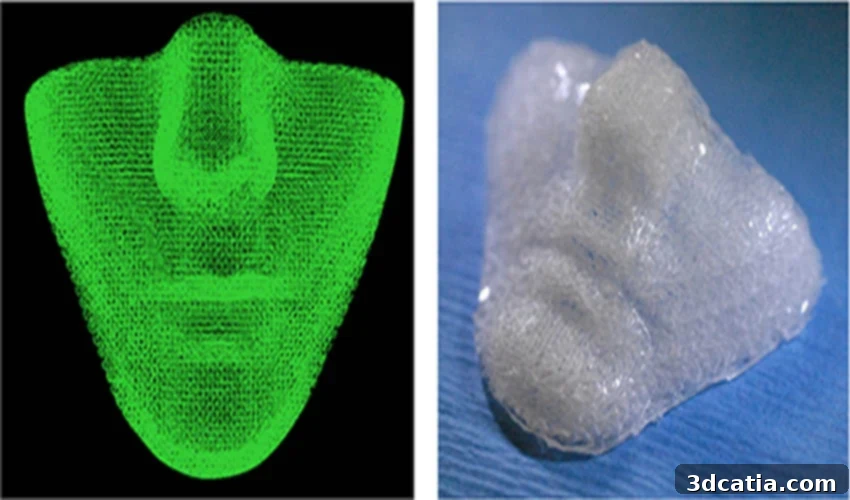
Recognizing these limitations, a dedicated team from WFIRM published their groundbreaking research in the esteemed journal Bioprinting. Their proof-of-concept study introduces a novel approach that harnesses the power of 3D bioprinting technologies to create customized, bioengineered skin substitutes. This innovative solution, aptly named the “BioMask,” is integrated directly into a specialized dressing. Designed for a precise and tight fit, the BioMask adheres directly onto a patient’s facial wound, much like a conventional mask, ensuring optimal contact and therapeutic delivery. This personalized fit is crucial for promoting effective regeneration and could mark a paradigm shift in how facial injuries are treated.
The BioMask: A Breakthrough in Personalized Skin Regeneration
The 3D printed BioMask developed by the WFIRM team represents a significant leap forward in personalized medicine. Its design leverages advanced imaging and fabrication techniques to ensure an unparalleled level of customization. Crucially, the BioMask can be perfectly shaped to a patient’s unique facial contours, thanks to its foundation in high-resolution computer tomography (CT) images of the individual’s face. This patient-specific design capability means that the mask can precisely match the topography of the wound, ensuring maximum contact and therapeutic effect, a feature largely absent in conventional treatments. Furthermore, the BioMask is engineered to incorporate the patient’s own skin cells, significantly reducing the risk of rejection and enhancing the natural regenerative process.
The innovative construction of the BioMask involves a sophisticated layering process. To build this complex therapeutic device, the team ingeniously combined a specialized wound dressing with three distinct layers of cell-laden hydrogels. Hydrogels are biocompatible, water-rich polymeric materials that provide a supportive matrix for cells, mimicking the natural extracellular environment of tissues. These hydrogels act as a scaffold, delivering and nurturing the patient’s cells directly to the wound site, encouraging them to proliferate and differentiate into new, healthy skin tissue. This meticulous combination of a protective dressing and cellular hydrogels is key to the BioMask’s potential to accelerate healing and promote superior skin regeneration.
Accelerating the Healing Process with Cutting-Edge Bioprinting Technology
The fabrication of the BioMask relies on WFIRM’s state-of-the-art in-house 3D integrated tissue-organ printing (ITOP) system. This advanced bioprinting platform is a marvel of engineering, capable of precisely dispensing up to six different cell types and various biomaterials simultaneously. The ITOP system’s multi-material and multi-cell printing capabilities are essential for creating complex, multi-layered structures like the BioMask, which requires the precise placement of different cellular components and hydrogels to mimic native skin architecture. This technological prowess allows for the creation of intricate biological constructs with unprecedented accuracy and repeatability, crucial for clinical applications.
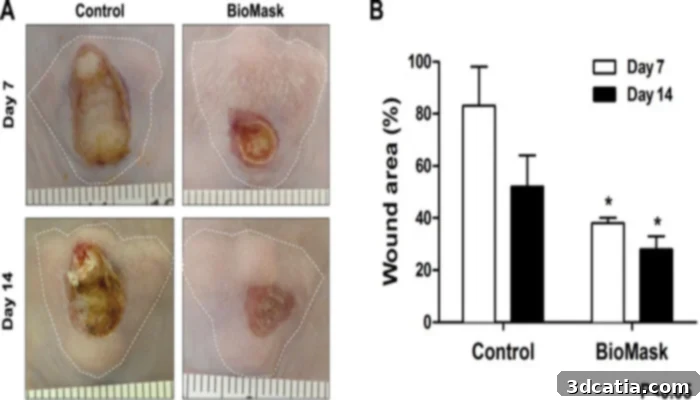
In the experimental phase of this pioneering project, the WFIRM team meticulously applied the BioMask to a wound created on a face-shaped structure within a mouse model. This animal model allowed researchers to observe and evaluate the efficacy of the BioMask in a controlled biological environment. Upon examining the results, the findings were remarkably positive. The team observed significant regeneration of skin tissue at the wound site, notably consisting of both the epidermis (outermost layer) and dermis (inner layer) of the skin. The successful regeneration of these distinct skin layers is a critical indicator of functional tissue repair, suggesting that the BioMask facilitates a comprehensive healing process rather than just superficial closure.
Further validating the BioMask’s effectiveness, rigorous tests conducted on a control group provided compelling evidence. These comparative studies confirmed a marked increase in epidermal and dermal cell counts in the BioMask-treated wounds after both seven and fourteen days. Such quantitative data underscores the BioMask’s ability to actively stimulate cellular proliferation and tissue growth, indicating a robust and accelerated healing response. The consistent positive outcomes across multiple evaluations strongly support the therapeutic potential of this innovative bioprinted solution for complex facial injuries, paving the way for future clinical trials.
Credits: WFIRM
Dr. Anthony Atala, a distinguished director of WFIRM and a co-author of the groundbreaking paper, eloquently articulated the profound implications of this research. “The BioMask could have great clinical impact for patients by providing effective and rapid restoration of facial skin following serious burn or injury,” he stated. This highlights the urgent need for better treatments for facial trauma, where timely and effective intervention can significantly improve patient outcomes and quality of life. Dr. Atala further emphasized the synergy between advanced technology and personalized care: “The bioprinting technology, combined with the face CT image, utilised for this concept allows for the fabrication of a personalized shape of a patient’s face so that we can take better care of the wound.” This statement underscores the core principle of the BioMask: delivering precise, custom-tailored regenerative therapy directly to the site of injury, promising a future where facial wound healing is not only faster but also results in superior aesthetic and functional restoration.
The successful development of the BioMask by WFIRM marks a significant milestone in the field of regenerative medicine and 3D bioprinting. It exemplifies how personalized medicine, driven by innovative additive manufacturing techniques, can address complex medical challenges that have long plagued traditional treatments. By offering a solution that can integrate a patient’s own cells into a precisely fitted, bioengineered scaffold, the BioMask has the potential to dramatically improve the prognosis for individuals suffering from facial trauma, minimizing scarring and restoring both appearance and confidence. This research not only offers a concrete solution for facial wounds but also serves as a powerful testament to the broader capabilities of 3D bioprinting in creating functional tissues and organs for therapeutic use, bringing us closer to a future where damaged body parts can be fully regenerated.
You can find out more about the results of their research HERE.
What are your thoughts on this revolutionary research and the future of 3D bioprinting in medicine? We invite you to share your insights and comments below, or join the conversation on our Facebook and Twitter pages! Stay informed about all the latest breakthroughs and innovations in additive manufacturing by signing up for our free weekly Newsletter, delivered straight to your inbox.