

Unlocking Additive Manufacturing’s Future: Deep Dive into RAPID + TCT 2025 Conference Tracks
RAPID + TCT stands as a premier event in the additive manufacturing industry, consistently offering far more than just a traditional trade show experience. At its core, the conference component is a powerhouse of knowledge, meticulously designed to propel attendees into the future of 3D printing. This year’s event promises an unparalleled learning opportunity with over 140 meticulously curated technical presentations, thoughtfully organized into eight distinct tracks. Access to these invaluable sessions is exclusively granted to attendees holding a conference pass, which can be secured for all three days of the event or for a specific day that aligns with your professional interests. Within these tracks, participants can delve into a comprehensive array of topics, spanning the entire additive manufacturing lifecycle – from foundational design principles and advanced material science to intricate process optimization techniques for diverse parts, alongside a multitude of real-world applications. The presentations are not merely theoretical; they are crafted and delivered by leading experts from global powerhouses such as Ford, Siemens Energy, BlueForge Alliance, the U.S. Navy, and many more, ensuring insights directly from the forefront of industry innovation and practical implementation.
While industry-specific tracks like aerospace, defense, ecosystem, healthcare, and mobility offer immediate, intuitively applicable solutions, two particular tracks at this year’s conference are absolutely fundamental for any professional aiming to truly enhance and deepen their additive manufacturing capabilities: **Materials Development** and **Process Development**. These two pillars represent the foundational science and engineering that underpin all practical applications of 3D printing, making them indispensable for sustainable innovation. They may not always seem as intuitively applicable as a finished product or a specific industry vertical, but understanding the intricacies of advanced materials and optimized processes is paramount for anyone seeking to master additive manufacturing, whether they are a seasoned expert looking to push technological boundaries or a newcomer eager to grasp the technology’s core principles. Every attendee, regardless of their current proficiency, will gain profound benefits and actionable insights from exploring these critical areas, which are the true drivers of AM’s evolution.

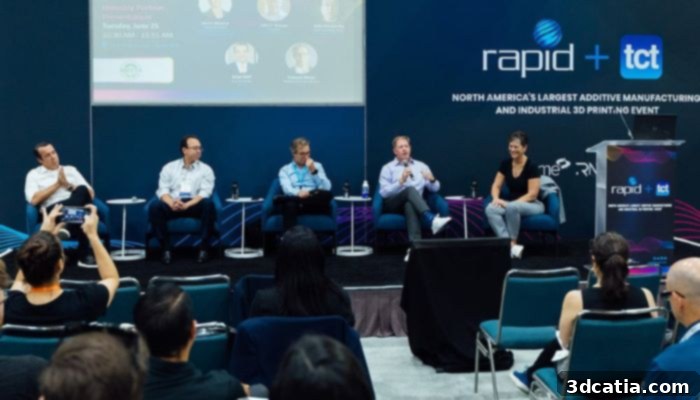
Conference and technical presentations are the core of RAPID + TCT 2025, driving innovation in additive manufacturing.
For those who haven’t yet secured their spot at RAPID + TCT 2025, it’s certainly not too late to join this essential industry gathering and connect with pioneers in additive manufacturing. You can conveniently register HERE and take advantage of an exclusive offer: use the promo code ‘3DNATIVES’ to receive a significant 20% discount on a Conference Pass for the entire event, or alternatively, claim a free Expo Pass to explore the expansive exhibit hall. But the benefits don’t stop there! Registering also enters you into an exciting giveaway to win a revolutionary 3D printed golf club from COBRA PUMA GOLF. This cutting-edge club is not yet available to the general public, making it a truly unique and desirable prize. The winner must pick up their prize in person at COBRA PUMA GOLF’s dedicated presentation at RAPID + TCT, adding an exclusive layer to this fantastic opportunity. Now, let’s delve deeper into what you can expect from these two pivotal tracks that are shaping the very future of additive manufacturing.
Advancing Materials for Additive Manufacturing at RAPID + TCT
When discussing the advancement and broader adoption of additive manufacturing, the criticality of **material development** cannot be overstated. It is, unequivocally, one of the most important driving forces behind the widespread growth and enhanced performance of 3D printing technologies across all sectors. This inherent importance explains the immense volume of research, innovation, and investment dedicated to the development and meticulous optimization of diverse materials—be it high-performance polymers, robust metals, versatile composites, or resilient ceramics—specifically engineered for various 3D printing processes. Recognizing this foundational role, RAPID + TCT has rightfully positioned materials development as one of its core and most relevant conference tracks, offering unparalleled insights into the very building blocks of tomorrow’s additive manufacturing solutions.
But why is material science so profoundly important in the realm of 3D printing? While a substantial amount of attention is often directed towards the intricacies of the actual 3D printing processes and sophisticated machinery, it is the choice and intrinsic properties of the material itself that ultimately determine the final characteristics, functionality, and performance of a printed part. Whether a component needs to exhibit exceptional strength, remarkable flexibility, superior heat resistance, specific electrical conductivity, or biocompatibility, these crucial properties are fundamentally dictated by the material selected and its ability to be processed additively without degradation. Therefore, the ongoing investigation into novel materials, their unique behaviors under additive manufacturing conditions, and how they can be effectively utilized and optimized within specific 3D printing workflows is considered absolutely critical by industry experts and researchers alike. Breakthroughs in materials unlock entirely new applications, push the boundaries of what’s possible, and enable previously unattainable performance benchmarks in demanding industries like aerospace, medical, and automotive.

Anyone with a conference pass will be able to attend the technical presentations at RAPID + TCT 2025, including those in the materials track.
Across Tuesday, Wednesday, and Thursday, attendees equipped with a Conference Pass will have the exclusive opportunity to immerse themselves in the presentations within this dynamic track. Many of these sessions will be delivered by pioneering researchers from distinguished universities and cutting-edge research institutions, who are truly at the forefront of material innovation for additive manufacturing. For instance, a highly anticipated talk presented by experts from the University of Waterloo and The Barnes Global Advisor will shed light on the groundbreaking use of crack-free 7A76 high-strength aluminum alloy with laser powder bed fusion. This specific development is particularly significant for applications demanding exceptional structural integrity, lightweight solutions, and superior fatigue resistance, such as those found in critical aerospace components and high-performance automotive parts.
Indeed, advanced alloys constitute a major focal point within the metal additive manufacturing discussions at this event, addressing key challenges and unlocking new capabilities. Various presentations will delve into crucial aspects like enhancing Inconel 718 superalloy properties through the precise control of Selective Laser Melting (SLM) and innovative boronizing techniques, offering pathways to superior performance in extreme temperature and high-stress environments. Another session will explore the fabrication of custom alloy wire feedstock for large-area Directed Energy Deposition (DED), a critical step towards more efficient and larger-scale production of complex metal parts with tailored properties. Furthermore, a dedicated study on Niobium alloys will reveal their immense potential as next-generation materials for ultra-high-temperature applications, vital for advanced aerospace propulsion, energy systems, and other demanding industrial contexts. All these discussions are absolutely crucial for professionals dedicated to industrializing and significantly advancing metal additive manufacturing, particularly within demanding sectors like aerospace, defense, and power generation where material performance is non-negotiable.
Beyond metals, advanced composites are also exceptionally well-represented in the materials track, showcasing the incredible versatility and sustainable potential of additive manufacturing. A fascinating presentation from the University of Maine, for instance, will unveil a novel lobster shell composite material tailored for temporary structural applications, highlighting truly sustainable and bio-inspired material innovations that could reduce environmental impact. Concurrently, researchers from the University of Dayton will concentrate on the development and application of Ni/SiC composites, known for their enhanced strength, stiffness, and wear resistance in challenging industrial environments. These sessions underscore the broad spectrum of material science pushing the boundaries of what’s possible with 3D printing, from bio-derived solutions to high-performance engineering materials.
In the realm of polymers, several technical sessions will specifically address their application in various critical industries, emphasizing both functional properties and manufacturing advancements. Examples include detailed discussions on flame-retardant materials designed for electronic connectors, ensuring enhanced safety and robust performance in sensitive devices where fire resistance is paramount. Another crucial session will focus on the long-term performance and efficacy of 3D printed thermal and optical components, which are essential for advanced lighting applications, illustrating the precision and functional integration possible with polymeric additive manufacturing. Furthermore, the critical role of powders—both metal and polymer—as the fundamental feedstock for many 3D printing processes will also be a star topic in this track, covering advancements in their formulation, characterization, quality control, and handling techniques to ensure optimal print outcomes.
In essence, the materials development track at RAPID + TCT is meticulously designed to cater to every industrial 3D printing process and specific application need, offering a wealth of information for those looking to innovate with new substances. It’s an invaluable resource for engineers, material scientists, product developers, and business leaders who are keen on pushing the envelope of additive manufacturing, transforming theoretical concepts into high-performance, production-ready components. This track serves as a vital bridge between cutting-edge academic research and practical industrial implementation, empowering attendees to bring additive manufacturing to its next evolutionary level by understanding its fundamental material constraints and opportunities.
Process Development as a Conference Track: Optimizing Additive Manufacturing Workflows for Peak Performance
Beyond the foundational materials, **Process Development** emerges as another exceptionally critical conference track that has garnered significant attention at RAPID + TCT 2025. This particular track is notably broader in its scope, encompassing a diverse array of topics that fall under the expansive umbrella of optimizing additive manufacturing workflows, from initial design to post-production. From sophisticated software solutions that govern the entire digital thread to intricate methodologies for ensuring superior part quality and repeatability, this track offers a holistic view of how to refine and perfect the 3D printing journey from concept to final, high-performance product. It’s where theoretical understanding meets practical application to unlock efficiency and reliability.
Much like the profound impact of material selection, the chosen 3D printing process and the meticulous execution of that process play an absolutely significant role in determining the ultimate characteristics and performance of a finished part. Consider, for example, how photopolymerization processes are renowned for their ability to produce parts with exceptionally fine detail and smooth surface finishes, making them ideal for intricate models, visual prototypes, or medical devices requiring high resolution. Conversely, processes like laser powder bed fusion (LPBF) are celebrated for manufacturing parts with superior mechanical strength, density, and structural integrity, crucial for functional components in demanding industrial environments such as aerospace engines or orthopedic implants. This inherent distinction underscores a fundamental principle: a user must intelligently select and then expertly optimize the technology that is best suited to the specific requirements and desired properties of each individual part, taking into account factors like cost, speed, and desired performance. Furthermore, the continuous optimization of these processes—whether it occurs during the initial design phase through simulation, throughout the actual printing operation via in-situ monitoring, or in the critical post-processing steps (like heat treatment or surface finishing)—is paramount to ensuring the consistent production of high-quality, reliable final parts that meet stringent industry standards. The importance of this track, therefore, cannot be overstated for anyone serious about achieving excellence and scalability in additive manufacturing.
Sustainability is another subject that will be covered in the process track at RAPID + TCT
Within the process development track, some of the most directly applicable presentations for industrial users will center on cutting-edge topics that are rapidly transforming the sector. These include in-depth discussions around the challenges and opportunities in **large-scale 3D printing**, a quickly growing trend addressing the demand for bigger, more complex parts across industries such as construction, marine, and tooling. Sessions on **continuous printing** will explore methodologies for increasing throughput and operational efficiency, moving additive manufacturing closer to mass production paradigms and reducing per-part costs. Furthermore, the integration and impact of advanced **software solutions** will be a significant theme, featuring insights into powerful tools like **digital twins** for virtual prototyping, real-time monitoring, and predictive maintenance, as well as sophisticated **optimization tools** that enhance part performance, reduce material usage, and accelerate design cycles. Additional critical subjects covered include the fine-tuning of specific process parameters for various printing technologies and comprehensive strategies for achieving improved quality, repeatability, and certification in manufactured parts. Esteemed speakers from some of the most innovative companies in the additive manufacturing space, including industry giants like Stratasys, Formlabs, Ricoh, and ADDiTEC, among others, will share their invaluable expertise. This makes the Process Development track an absolute must-see for both beginners seeking to understand fundamental workflows and experienced professionals striving to further industrialize and perfect 3D printing operations within their respective organizations.
One particularly vital aspect often overlooked but increasingly gaining prominence in process development is **sustainability**. As the image caption wisely points out, and indeed, many presentations within this track will address how optimizing 3D printing processes can lead to more environmentally friendly and resource-efficient manufacturing. This includes crucial topics such as reducing material waste through precise deposition, optimizing energy consumption of machines, exploring recyclable or bio-degradable support structures, and implementing comprehensive lifecycle assessments for additive manufactured parts to understand their cradle-to-grave impact. These discussions are crucial for companies aiming to meet evolving environmental regulations, reduce their carbon footprint, enhance corporate social responsibility, and appeal to a growing market of eco-conscious consumers and partners. By focusing on sustainable practices in process development, RAPID + TCT highlights the industry’s commitment to responsible innovation and a greener future for manufacturing.
So there you have it! The conference schedule this year at RAPID + TCT 2025 has truly proven to be an exceptionally impactful one, with the **Materials Development** and **Process Development** tracks standing out as pivotal to anyone serious about the future of additive manufacturing. These tracks offer the deep technical insights and forward-thinking strategies necessary to drive innovation, overcome challenges, and unlock new possibilities in 3D printing, making them indispensable for progress. That is precisely why, if you have not already, you should absolutely make sure to secure your discounted Conference Pass HERE without delay, to gain access to this invaluable knowledge.
Will you be securing your Conference Pass HERE for RAPID + TCT 2025? What specific topics or insights are you most excited for among the diverse tracks offered? We invite you to share your thoughts and expectations in a comment below or engage with us on our vibrant social media platforms, including LinkedIn, Facebook, and Twitter pages! And don’t forget to sign up for our free weekly Newsletter here, ensuring the latest and most relevant 3D printing news is delivered straight to your inbox every week! You can also find all our insightful videos and compelling content on our dedicated YouTube channel for an even deeper dive into the dynamic world of additive manufacturing.
*All Photo Credits: SME