
IceSL: Unlocking Advanced 3D Printing with Powerful Slicing and Script-Based Modeling Software
The landscape of manufacturing and design has been irrevocably transformed by the advent of 3D printing, a revolutionary technology that empowers creators to manifest intricate, bespoke objects directly from digital blueprints. This transformative process, however, hinges on a crucial intermediary step: the use of a slicer. A 3D slicer is indispensable software that precisely dissects a digital 3D model into thousands of successive, thin layers, simultaneously generating critical print instructions and, when necessary, designing robust support structures. The meticulous execution of this slicing operation profoundly dictates the ultimate quality, structural integrity, and aesthetic finish of the final 3D printed part. Amidst a crowded field of specialized software, IceSL has emerged as a particularly innovative and robust solution. Launched in 2012, this free, open-source slicer has carved out a unique niche, developed by the visionary MFX (Matter from Graphics) research team, pushing the boundaries of what’s possible in additive manufacturing.
The MFX team, the driving force behind IceSL, is a distinguished research collective comprised of leading experts from Inria, the Université de Lorraine, and the CNRS (French National Centre for Scientific Research). Their collaborative efforts are centered within the esteemed LORIA laboratory, where they relentlessly pursue solutions to the complex challenges associated with intricate geometric shapes. Their research focuses primarily on the critical intersection of computer graphics and advanced additive manufacturing techniques. IceSL, born from this fertile ground of cutting-edge research, is a remarkably versatile software package. It boasts broad compatibility with both Windows and Linux operating systems, catering to a diverse user base, and has been meticulously engineered to support a wide array of 3D printers, including popular FDM (Fused Deposition Modeling) and DLP (Digital Light Processing) technologies. To address varying user needs and levels of expertise, IceSL is strategically offered in three distinct versions: IceSL-slicer, IceSL-forge, and SliceCrafter, each providing a tailored experience while maintaining the core innovation synonymous with the MFX team’s work.
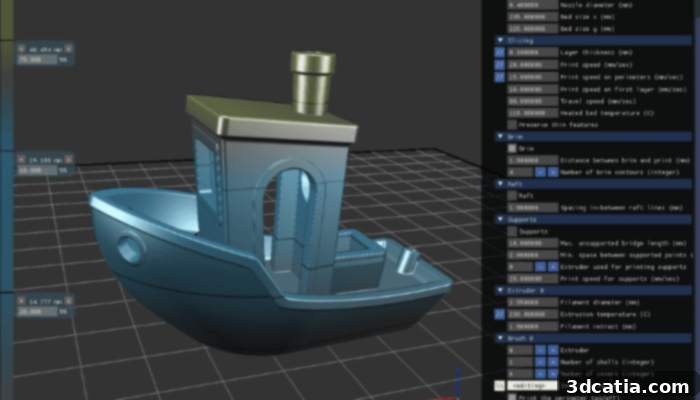
IceSL is not just slicing software; it’s also used to create sophisticated 3D models through scripting.
Exploring the Diverse IceSL Versions: Tailored for Every 3D Printing Workflow
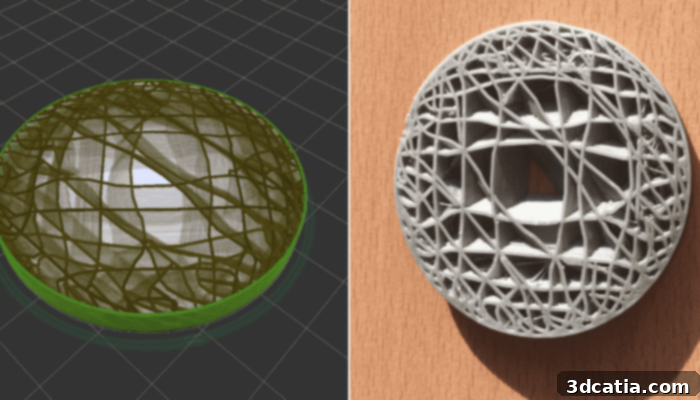
Understanding the diverse needs of 3D printing enthusiasts and professionals, IceSL offers a meticulously crafted suite of versions, each optimized for specific workflows and user requirements. First in line is **IceSL-Slicer**, which, as its name suggests, is a dedicated, powerful slicing-only version. This variant focuses entirely on the critical task of transforming 3D models into printer-ready instructions. It supports a comprehensive range of industry-standard 3D model formats, such as STL (Stereolithography), alongside geometry scripts, to generate precise print instructions, predominantly in the form of G-code. G-code is the universal language that 3D printers understand, dictating every movement of the print head, extruder, and build plate. Beyond FDM, IceSL-Slicer also excels in preparing models for DLP printers, enabling the creation of high-resolution images essential for these resin-based technologies. As a complete slicing solution, IceSL-Slicer is packed with innovative features designed to streamline and optimize the printing process. One notable innovation is its “progressive filling” capability, which allows for highly customizable and precise infill patterns, ensuring models are prepared with optimal structural integrity and material efficiency prior to the commencement of printing.
Elevating the capabilities of 3D printing software, **IceSL-forge** stands out as the most comprehensive and arguably the most powerful iteration of the IceSL software. This version transcends the traditional role of a mere slicer by seamlessly integrating advanced 3D modeling functionalities directly within its environment. This unique fusion of modeling and slicing empowers users with unprecedented flexibility and creative control, making it ideal for designing and producing highly complex, parametrically customizable shapes. The 3D modeling within IceSL-forge is executed through powerful scripts, leveraging the widely adopted Lua language. This script-based approach to modeling offers significant advantages over traditional GUI-driven CAD software, particularly for intricate or repetitive designs, allowing for dynamic modifications and generative design workflows. The core advantage of IceSL-forge lies in its groundbreaking ability to directly slice and generate the necessary G-code instructions for a 3D printer straight from these scripts, completely eliminating the conventional, often cumbersome, requirement of first creating a mesh (like an STL file). This revolutionary approach drastically simplifies the entire workflow of preparing models for printing, offering a significantly more efficient, adaptable, and robust solution tailored for advanced users, researchers, and professional 3D printing applications where precision and programmatic control are paramount.
Rounding out the IceSL ecosystem is **SliceCrafter**, an accessible and convenient online version of the slicing software. While it might offer slightly less computational power and fewer advanced features compared to the desktop-bound IceSL-slicer, SliceCrafter’s primary strength lies in its unparalleled accessibility. Running entirely within a web browser, it liberates users from the need for any software installation or specific operating system requirements. This means that 3D printing enthusiasts and professionals can access and utilize its core slicing functionalities from virtually any location, on any device with an internet connection. This “anywhere, anytime” capability makes SliceCrafter an invaluable tool for quick slicing tasks, collaborative projects, or for users who frequently switch between different workstations, ensuring that the power of IceSL’s slicing engine is always just a few clicks away.
Key Innovations and Advanced Features of the IceSL Slicer
While IceSL proficiently handles many standard features common to most slicing software on the market—such as intuitive model movement, precise placement on the build plate, and comprehensive printer selection—it truly distinguishes itself through a suite of sophisticated and innovative options. A prime example is its capability to define highly customizable and **variable layer height parameters**. This advanced feature allows users to specify different layer thicknesses across various sections of a 3D model. For instance, fine, thinner layers can be applied to intricate curves and detailed aesthetic surfaces to achieve superior resolution and a smoother finish, while thicker, coarser layers can be used for less visible or structurally critical sections, significantly reducing overall print time without compromising quality where it matters most. Furthermore, IceSL incorporates an intelligent **adaptive cutting algorithm**. This algorithm automatically and dynamically adjusts the layer thickness based on the geometry of the model and the desired number of slices, optimizing print efficiency and fidelity simultaneously. This intelligent approach ensures that print quality is maximized while print duration is minimized, striking a perfect balance. Additionally, the software features a robust **progressive fill** option, which offers granular control over the internal structure of the printed object.
The **progressive fill** feature in IceSL empowers users with precise control over the interior density and structure of their 3D prints. Users can meticulously adjust the fill density, specifying the exact percentage of the object’s interior that will be occupied by infill material. A higher percentage translates to a denser, more robust interior, imparting greater strength and rigidity to the final part, though it will consume more material and increase print time. Conversely, a lower percentage creates a more hollow interior, ideal for reducing material consumption, minimizing print time, and lightening the object. This versatility in infill adjustment offers significant advantages in terms of both material economy and time savings. Beyond just structural integrity, progressive filling also enables the creation of parts with flexible elasticity, a critical capability, especially when printing with flexible filaments such as TPU or TPE. By carefully tuning the infill patterns and density, users can achieve desired levels of pliability and stretch, opening up new possibilities for functional prototypes, wearable items, and custom tools.
The user experience with IceSL is further enriched by a host of other cutting-edge features designed to enhance print quality and expand creative horizons. To ensure optimal print success and preserve the integrity of printed parts, particular attention has been devoted to the development of an **advanced support algorithm**. This sophisticated system aims to significantly minimize the amount of support material required, thereby reducing waste and post-processing effort. It adopts an innovative hybrid approach, intelligently combining elements of traditional, grid-like support structures with those of the increasingly popular “tree” type supports. Tree supports are known for their minimal contact points with the model and easier removal, leaving behind fewer blemishes. This combined methodology delivers more efficient support placement, dramatically reduces support material consumption, and ultimately simplifies the post-processing workflow, leading to cleaner, higher-quality prints. Finally, a truly groundbreaking innovation introduced by IceSL is a brand-new **3D color printing technique** that offers the extraordinary possibility of creating seamless color gradients. This advancement goes far beyond the typical multi-material printing by allowing for a smooth transition between colors within a single print layer or across layers, unlocking unprecedented aesthetic potential. This innovation considerably extends the creative possibilities of traditional FDM filament printers, enabling artists and designers to produce visually stunning, multi-tonal objects that were previously unachievable with standard extrusion methods.
Are you an IceSL user, leveraging its powerful capabilities for your 3D printing projects? We’d love to hear about your experiences and insights! Share your thoughts in a comment below or join the conversation on our active LinkedIn, Facebook, and Twitter pages! For the very latest advancements, news, and insights from the world of additive manufacturing, don’t forget to sign up for our free weekly newsletter here, delivered directly to your inbox. You can also explore our extensive library of videos and tutorials on our dedicated YouTube channel for more in-depth content.
*All Photo Credits: IceSL