

Mastering Material Jetting: The Advanced Guide to Multi-Color, Multi-Material 3D Printing Technology
The landscape of additive manufacturing continues its rapid evolution, with new technologies and refinements emerging at a breakneck pace. While processes like Selective Laser Sintering (SLS) and Fused Deposition Modeling (FDM) are widely recognized, another powerful method, Material Jetting, offers distinct advantages, particularly in creating sophisticated multi-material and multi-color objects. This guide delves into the intricacies of Material Jetting, exploring its operational principles, unique benefits, inherent limitations, diverse applications, and the prominent companies driving its innovation. Understanding Material Jetting is crucial for anyone looking to leverage advanced 3D printing capabilities for high-fidelity prototyping and specialized end-use parts.
What is Material Jetting 3D Printing?
Material Jetting is an additive manufacturing process renowned for its ability to produce highly detailed, multi-material, and multi-color 3D printed models. Patented by Objet Ltd. in 1999 under the name PolyJet – a technology now part of Stratasys following their 2012 merger – Material Jetting fundamentally combines principles from traditional 2D inkjet printing with the use of photopolymer resins. Just as an inkjet printer precisely deposits ink droplets onto paper, a Material Jetting printer accurately jets minuscule droplets of liquid photopolymer onto a build platform.
The core concept relies on photopolymerization: these special resins rapidly harden, or cure, when exposed to ultraviolet (UV) light. Immediately after the tiny resin droplets are jetted onto the build tray, a UV light source integrated into the print head sweeps over the newly deposited material, solidifying it instantly. This layer-by-layer solidification process allows for the creation of complex geometries with exceptional precision. The seamless integration of material deposition and curing differentiates Material Jetting from other resin-based technologies like Stereolithography (SLA), which typically cures an entire layer in a resin vat.
This innovative approach offers several compelling benefits. Firstly, Material Jetting achieves an extraordinarily high resolution, often down to 0.016 mm, translating into incredibly fine details and intricate features on printed parts. Secondly, unlike FDM technology which can exhibit a noticeable “staircase effect” due to visible layer lines, Material Jetting produces remarkably smooth surfaces directly off the print bed, minimizing the need for extensive post-processing for aesthetic purposes. Thirdly, and perhaps most notably, its ability to simultaneously process a wide array of materials and colors within a single print job unlocks unprecedented design freedom. This versatility, combined with a relatively efficient printing time and controlled material costs for specific applications, positions Material Jetting as a premium solution for advanced prototyping and specialized manufacturing needs.

How Does Material Jetting 3D Printing Work? A Step-by-Step Explanation
The Material Jetting process, while advanced, follows a logical sequence, starting from digital design and culminating in a physical object. Like all additive manufacturing techniques, the journey begins in the digital realm.
1. Digital Model Creation and Slicing
The first step involves designing the desired object using Computer-Aided Design (CAD) software. Engineers, designers, or artists create a virtual 3D model that precisely defines the object’s geometry, dimensions, and sometimes even material properties if a multi-material print is intended. Once the design is finalized, it is typically exported into a standard tessellated file format, most commonly an STL (Standard Tessellation Language) file. This STL file, which represents the 3D model as a series of interconnected triangles, is then imported into slicing software, also known as a “slicer.” The slicer’s role is critical: it digitally dissects the 3D model into hundreds or thousands of ultra-thin horizontal layers, each corresponding to a specific cross-section of the object. For Material Jetting, the slicing software also defines the placement of support structures, which are essential for overhangs and complex geometries, and dictates the order and type of materials to be jetted for multi-color or multi-material designs. This detailed digital blueprint, including all material and layer information, is then sent to the Material Jetting 3D printer.
2. The Printing Process: Droplet Deposition and UV Curing
When the printing process commences, the liquid photopolymer resin, stored in cartridges, is carefully heated to a precise temperature, typically between 30-60°C. This controlled heating is crucial for achieving the optimal viscosity, ensuring the resin flows smoothly and can be jetted accurately through the print heads. The print head, which bears a striking resemblance to those found in conventional 2D inkjet printers but is significantly more sophisticated, then begins its precise movement across the build platform. This print head assembly is equipped with numerous microscopic nozzles.
As the print head traverses the build area, it strategically projects hundreds to thousands of minuscule droplets of the photopolymer resin. Each droplet is deposited with extreme precision, building up the geometry of the current layer. Immediately following the deposition of these droplets, a powerful UV light source, which is integrated directly into the moving print head, flashes across the freshly jetted material. This instantaneous exposure to UV light causes the photopolymer resin to rapidly solidify and cure, bonding it to the previous layer and forming a robust, solid cross-section. This rapid curing is a hallmark of Material Jetting, ensuring that each layer is fully formed before the next is applied, contributing to the high dimensional accuracy and surface quality of the final part.
The true power of Material Jetting lies in its multi-material and polychrome capabilities. The print head carriage is not limited to a single material; it houses multiple print heads, each capable of independently “jetting” different photopolymer resins. This means that a single object can be fabricated with varying material properties – for example, combining rigid and flexible sections – and with a full spectrum of colors. Additionally, one of these nozzles is typically dedicated to jetting a soluble support material. This support material, designed to be easily dissolved after printing, enables the creation of complex overhangs, internal cavities, and intricate features that would otherwise be impossible to print unsupported. The ability to precisely control the deposition of multiple materials and colors at a voxel (3D pixel) level makes Material Jetting an unparalleled tool for advanced prototyping and functional modeling.

The Material Jetting process | Image Credits: 3D Hubs
The Advantages and Disadvantages of Material Jetting Technology
Material Jetting presents a compelling set of advantages, particularly for applications demanding high fidelity and complex material combinations, but it also comes with certain limitations that users must consider.
Key Advantages
The most significant advantage of Material Jetting technology is its unparalleled ability to print multi-material and multi-color parts within a single build. Thanks to its sophisticated multi-nozzle print heads, each resin cartridge can supply a different material or color, allowing the printer to blend or selectively deposit various photopolymers. This capability enables the creation of “Digital Materials,” which are composite materials formed by combining different base resins at a micro-level. These Digital Materials can exhibit a vast range of properties, from rigid and transparent to rubber-like and flexible, or even materials with specific thermal resistance, biocompatibility, or shore hardness. This opens up possibilities for creating detailed prototypes that are remarkably close to the final product in terms of appearance, texture, and mechanical performance, facilitating realistic visual and functional testing. Furthermore, Material Jetting excels in surface finish, producing parts with an exceptionally smooth, injection-mold-like quality, virtually eliminating visible layer lines often seen in other processes. The high resolution also ensures intricate details and fine features are accurately reproduced, making it ideal for aesthetically critical components.
Potential Disadvantages and Limitations
Despite its advanced capabilities, Material Jetting does have its drawbacks. A notable limitation is the typically smaller build volume compared to some other industrial 3D printing technologies. While suitable for intricate, smaller components and prototypes, manufacturing very large-format parts with Material Jetting is generally not yet feasible or cost-effective. Additionally, similar to most other additive manufacturing processes, Material Jetting requires the use of support structures to build overhangs and complex geometries. These supports, usually made from a water-soluble or easily removable photopolymer, necessitate a post-processing step.
During this post-processing phase, the support material and any residual uncured resin must be meticulously removed. This often involves washing the part with specialized solutions or using high-pressure water jets, followed by manual cleaning. Crucially, parts made from photopolymers require an additional post-curing step in a dedicated UV chamber. This final UV exposure ensures the material achieves its full mechanical properties and stability. Without complete curing, parts may remain tacky, lose strength over time, or even deform. It’s also important to note that, like all photopolymer-based prints, Material Jetting parts are sensitive to prolonged exposure to light, especially UV light. This can lead to changes in their color, transparency, and mechanical properties over extended periods, meaning they are best suited for indoor applications or where controlled light exposure is maintained.
Application Areas for Material Jetting 3D Printing
The unique capabilities of Material Jetting make it indispensable across a range of industries, particularly where high detail, realism, and multi-material functionality are paramount. Its versatility extends beyond simple prototyping, impacting critical sectors and creative fields.
1. High-Fidelity Prototyping and Product Development
As highlighted earlier, the primary application area for Material Jetting 3D printing is the production of highly detailed and functional prototypes. It excels at creating visual models that are incredibly close to the final product’s appearance, texture, and even haptic feedback. Designers and engineers can produce prototypes that mimic the look and feel of an injection-molded part, allowing for comprehensive design validation, ergonomic testing, and marketing presentations. This method is invaluable for iterating on designs quickly and affordably, enabling companies to accelerate product development cycles and bring innovative products to market faster. From consumer electronics enclosures with varied textures to automotive interior components with realistic finishes, Material Jetting allows stakeholders to see, touch, and feel models in a way that truly represents the finished article.
2. Medical and Dental Sector
The medical sector has significantly embraced Material Jetting due to its ability to create precise, detailed, and multi-color anatomical models. This technology allows for the production of patient-specific models to scale, often incorporating different colors to represent various tissues, organs, or pathologies with high fidelity to the human body. For instance, a surgeon can print a precise model of a patient’s organ, highlighting a tumor in a distinct color, to plan a complex surgical procedure in advance. This not only enhances surgical training and reduces risks but also provides a tangible tool for doctors to explain a disease or treatment plan to patients in a clear, concrete, and empathetic way. Material Jetting is also used for creating highly accurate dental models, surgical guides, and even biocompatible prototypes for medical devices, where precision and material validation are critical.
3. Artistic and Jewelry Fields
Beyond functional applications, Material Jetting is also a favorite in artistic and jewelry fields. Its capacity for extreme detail and smooth surfaces makes it ideal for creating intricate jewelry prototypes, molds for casting, or direct wax-like patterns that can be later cast in precious metals. Artists can leverage the multi-color capabilities to produce intricate sculptures, figurines, or mixed-media art pieces with gradients and complex textures not achievable with other methods. The ability to realize highly detailed and aesthetically pleasing objects directly from digital designs provides unparalleled freedom for creative expression, pushing the boundaries of traditional craftsmanship.
The Main Market Players in Material Jetting Technology
The Material Jetting market is primarily driven by a few key innovators who have refined and commercialized this sophisticated technology, offering a range of machines tailored for various industrial applications.
Stratasys (PolyJet)
As mentioned earlier, Stratasys is a pioneer in Material Jetting, having acquired Objet Ltd., the original developer of the PolyJet technology. Stratasys continues to lead the market with its extensive line of PolyJet 3D printers. Their machines are renowned for their ability to produce incredibly realistic prototypes with a vast array of colors, textures, and material properties. The Stratasys J750 and J350 are prime examples of their advanced offerings. The J750, in particular, is a flagship model celebrated for its full-color capabilities, compatible with the Pantone color system, and able to print prototypes in over 500,000 colors, along with various textures, gradients, transparencies, and material hardnesses (from rigid to flexible). This makes the J750 an industry standard for designers requiring the highest levels of visual fidelity and multi-material integration. The J350 offers similar versatility in a more compact form factor, catering to design studios and engineering firms needing professional-grade, multi-material capabilities.
3D Systems (MultiJet Printing – MJP)
Another significant player in the Material Jetting space is 3D Systems, which markets its version of the technology under the name MultiJet Printing (MJP). While perhaps not as focused on the sheer breadth of color as Stratasys, 3D Systems’ MJP printers excel in precision, surface finish, and the ability to produce functional parts with varying material properties. A notable machine is the ProJet MJP 5600, a high-throughput printer capable of manufacturing prototypes and end-use parts using both elastic and rigid materials. The MJP 5600 is often chosen for applications requiring robust mechanical properties alongside excellent detail and smooth surfaces, catering to engineering and manufacturing environments where material performance is critical.
XJet (NanoParticle Jetting – NPJ)
An innovative company that utilizes the fundamental principle of material projection, but with a unique twist, is the Israeli company XJet. Unlike traditional Material Jetting which uses photopolymer resins, XJet has developed a proprietary method called NanoParticle Jetting (NPJ). Instead of jetting plastic droplets that cure with UV light, XJet’s printers jet liquid droplets loaded with metal or ceramic nanoparticles. These nanoparticles are suspended in a liquid “ink.” After deposition, the liquid evaporates at high temperatures in a sintering furnace, leaving behind dense, solid metal or ceramic parts. This groundbreaking approach allows for the production of high-performance technical ceramics and complex metal parts with exceptional detail and surface finish, opening up entirely new application possibilities in areas requiring high-temperature resistance, strength, and durability that traditional photopolymers cannot achieve. XJet’s technology represents a significant leap in expanding the material palette available through jetting processes.
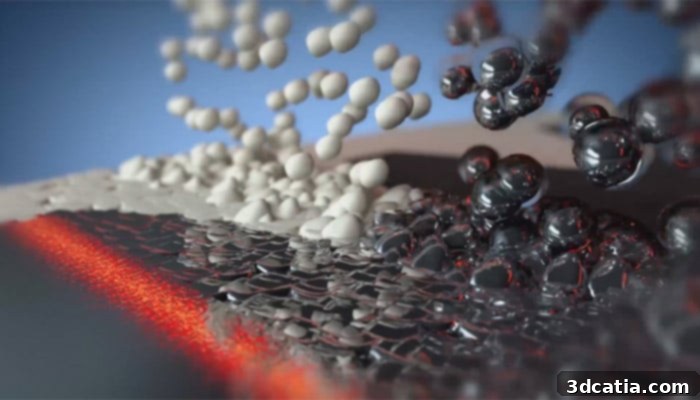
Illustration of the NanoParticle Jetting technology developed by XJet
Conclusion: The Future of High-Fidelity 3D Printing
Material Jetting stands as a cornerstone of advanced additive manufacturing, offering unparalleled precision, exceptional surface finish, and remarkable capabilities for multi-material and multi-color part creation. From accelerating product development cycles with ultra-realistic prototypes to revolutionizing medical training and enabling new artistic expressions, its impact across industries is profound and continues to grow. While it may have limitations in terms of build volume and post-processing, its strengths in detail, aesthetic quality, and material versatility make it an indispensable tool for engineers, designers, and manufacturers pushing the boundaries of innovation. As technologies like XJet’s NanoParticle Jetting further expand the material possibilities, Material Jetting is poised to play an even more critical role in the future of high-performance, high-fidelity 3D printing.
Was this comprehensive guide useful for understanding Material Jetting? We welcome your thoughts and questions! Feel free to leave a comment in the section below or connect with us on our Facebook and Twitter pages. For all the latest news and insights in the world of 3D printing, sign up for our free weekly Newsletter, delivered straight to your inbox!