
GRACE: Revolutionizing Bioprinting with AI-Powered 3D Printers That See and Think
Imagine a 3D printer that doesn’t just follow instructions but actively understands and adapts to the material it’s printing. What if your bioprinter had “eyes” to see where cells are located and a “brain” powered by artificial intelligence to design structures around them? This groundbreaking concept is now a reality thanks to GRACE, an innovative 3D bioprinting technique developed by a dedicated team at Utrecht University in the Netherlands. GRACE represents a significant leap forward in the field, combining the precision of volumetric printing with the intelligence of AI to allow the machine to actively participate in the design phase, leading to more functional and viable biological constructs.
The potential impact of GRACE, which stands for Generative, Adaptive, Context-Aware 3D printing, is particularly profound for the medical field, even though the technology is still in its nascent stages. One of the most critical and challenging aspects of tissue engineering and bioprinting today is the creation of functional blood vessel networks. These intricate systems are essential for delivering vital oxygen and nutrients to cells, allowing larger and more complex tissues to survive and thrive. Traditional bioprinting methods often require researchers to design these vascular networks upfront, without precise knowledge of the cells’ exact location within the bio-ink. This blind approach makes it incredibly difficult to adequately support living structures, resulting in limitations on the size and complexity of printed tissues.
Daily advancements in bio-printing are undeniable. The progress, along with the persistent obstacles and remarkable breakthroughs, is frequently highlighted in scientific news. While researchers have made incredible strides, the challenge of creating robust and functional vascularization remains paramount. Current techniques struggle to integrate efficient nutrient delivery systems because they cannot dynamically adapt to the biological environment during the printing process. This is precisely where GRACE introduces a paradigm shift. By allowing the printer to “see” the cells and “think” about the best structural design in real-time, it addresses a fundamental limitation that has hindered the development of truly complex and viable bioprinted organs and tissues. The ability to understand the precise location of cells within the bio-ink and then design supporting structures accordingly is a game-changer for supporting these delicate living constructs.
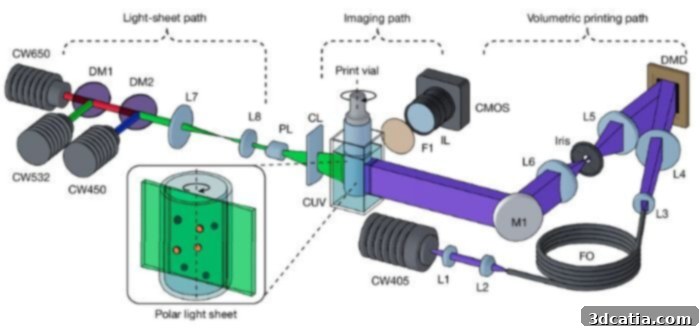
The GRACE process
At the forefront of this innovation is Riccardo Levato, a distinguished professor at Utrecht University and the esteemed leader of the Levato Lab, the very team responsible for developing the GRACE process. Professor Levato and his team embarked on a mission to create a bioprinting solution that was not only more efficient but also inherently more intelligent and reliable than anything previously available. Their journey led them to embrace volumetric printing as a core methodology. Unlike traditional layer-by-layer techniques, which can be time-consuming and potentially damaging to delicate cells, volumetric printing allows for the solidification of an entire 3D structure in a single, rapid step.
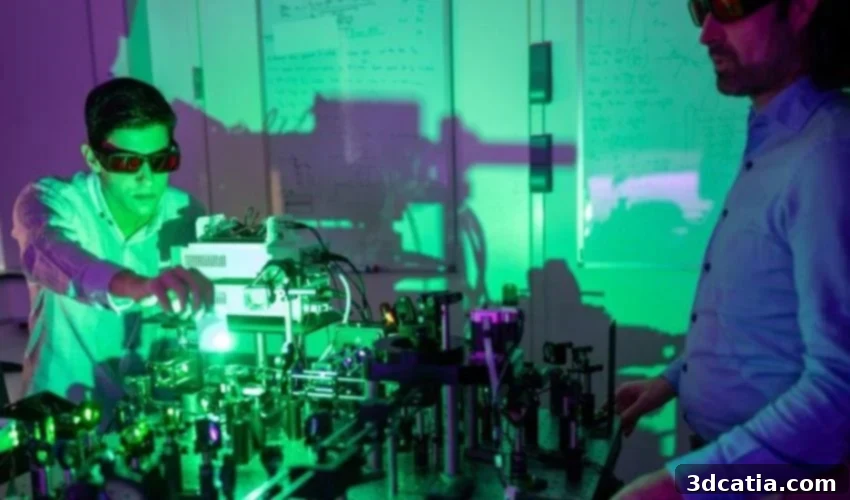
Riccardo Levato eloquently explains the mechanics of this sophisticated process: “To build a structure, we project a series of light patterns into a spinning tube filled with light-sensitive gel and cells. Where the light beams converge, the material solidifies. This creates a full 3D object in one go, without having to touch the cells.” This approach offers several critical advantages: it is significantly faster, dramatically reducing the overall printing time, and crucially, it is less harmful to the embedded cells. By minimizing mechanical stress and exposure time, volumetric printing inherently increases cell viability, which is paramount for creating functional biological tissues.
However, even with the speed and reduced cell damage of volumetric printing, achieving optimal results – especially when preserving and integrating living cells – demands precise knowledge of their exact location. This is where GRACE’s intelligence truly shines. The team at Utrecht University ingeniously developed a sophisticated system that employs a laser light to map the chemical and structural composition of the material being printed in real-time. This advanced imaging capability provides the “eyes” for the printer, gathering crucial data about the cellular landscape within the bio-ink. Once this information is acquired, the machine, powered by an intricate artificial intelligence framework, processes the data to select and generate the optimal geometry for the structure. This intelligent feedback loop ensures the best possible print outcome while preserving the delicate cells.
The GRACE process is a marvel of interdisciplinary science, leveraging cutting-edge advancements in artificial intelligence in 3D printing, high-resolution 3D imaging, computer vision, and parametric modeling. Sammy Florczak, a dedicated PhD student in the Levato Lab, played a pivotal role in the development of this revolutionary process. He articulates the transformative nature of GRACE, stating, “In the past, printing always depended on the designer’s blueprint. Now, GRACE contributes to the design itself. The printer ‘sees’ what kind of cells are in the material, and where they are. Then, using AI tools, it creates a matching design for the object to be printed. This new printer essentially has its own ‘eyes,’ the laser-based imaging, and ‘brain,’ the new AI software. That level of customization leads to tissues that survive and function better.” This ability to dynamically adapt the design based on real-time feedback from the bio-ink represents a monumental shift from static, pre-programmed printing to intelligent, adaptive manufacturing.
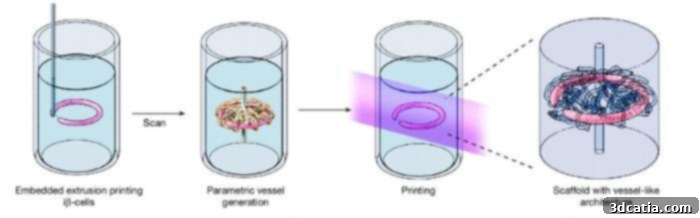
Formation of the blood vessel network based on the presence of cells in the bio-ink
The innovative capabilities of GRACE extend far beyond merely creating blood vessels. While the ability to dynamically design vascular networks around cells addresses a major bottleneck in tissue engineering, its applications are incredibly diverse and promising. Consider the pharmaceutical industry, for example. GRACE could be instrumental in designing and printing complex drug delivery systems capable of releasing precisely dosed medications over specific timeframes or in response to biological cues. This level of control could revolutionize personalized medicine and drug development, allowing for highly customized therapeutic approaches.
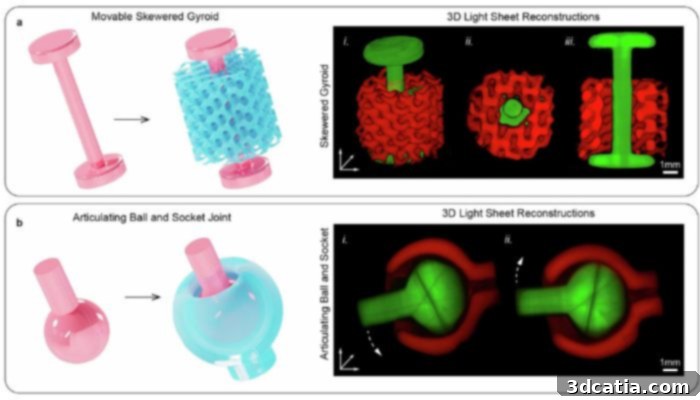
The team has also successfully explored creating intricate bone models with integrated cartilage. In a compelling demonstration of GRACE’s versatility, a femur was 3D printed within a specialized gel containing cells derived from articular cartilage and bone marrow stem cells. Once the initial structure was formed, GRACE autonomously positioned and printed the cartilage specifically around the femoral head, demonstrating an unprecedented level of precision and biological integration. This showcases the system’s capacity for creating multi-tissue constructs with complex interfaces, paving the way for advanced regenerative therapies for orthopedic injuries and degenerative diseases.
The implications for regenerative medicine are vast. With GRACE’s ability to create more viable and functional tissues, researchers can develop more accurate disease models for drug testing, potentially reducing the need for animal testing and accelerating drug discovery. Furthermore, it opens new avenues for creating personalized implants and prosthetics that are biologically integrated, minimizing rejection and improving patient outcomes. The combination of volumetric printing’s speed and AI’s adaptive design capabilities ensures that GRACE is not just printing structures, but actively engineering living tissues with optimized functionality.
Riccardo Levato remains optimistic about the future of GRACE, emphasizing that “This first work on GRACE is just the beginning. We are currently working on increasing the number of cells that can be printed so that we can also print other tissues such as the heart and liver. Additionally, we want to make this technique accessible to other labs so they can apply it to their own printing methods.” This vision highlights the commitment to scaling the technology, not only in terms of the complexity and size of tissues that can be fabricated but also in democratizing its use across the scientific community. The ability to print larger, more complex organs like the heart and liver would represent a monumental achievement in solving the organ donor shortage and transforming transplant medicine.
Looking even further ahead, the applications of GRACE may extend beyond the confines of medicine. Its intelligent, adaptive manufacturing principles could find relevance in various industries requiring the precise, context-aware fabrication of complex, multi-material structures. The foundational research supporting GRACE offers a compelling glimpse into a future where 3D printers are not merely tools but intelligent collaborators in the design and manufacturing process. You can find the full research and delve deeper into the scientific details of this groundbreaking work HERE.
What are your thoughts on this revolutionary GRACE process and its potential to transform 3D bioprinting? We invite you to share your insights in a comment below or join the conversation on our LinkedIn or Facebook pages! Don’t miss out on the latest advancements in additive manufacturing – be sure to sign up for our free weekly Newsletter to receive the most current 3D printing news directly in your inbox. For more visual content and in-depth discussions, explore all our videos on our YouTube channel.
*All Photo Credits: Riccardo Levato