
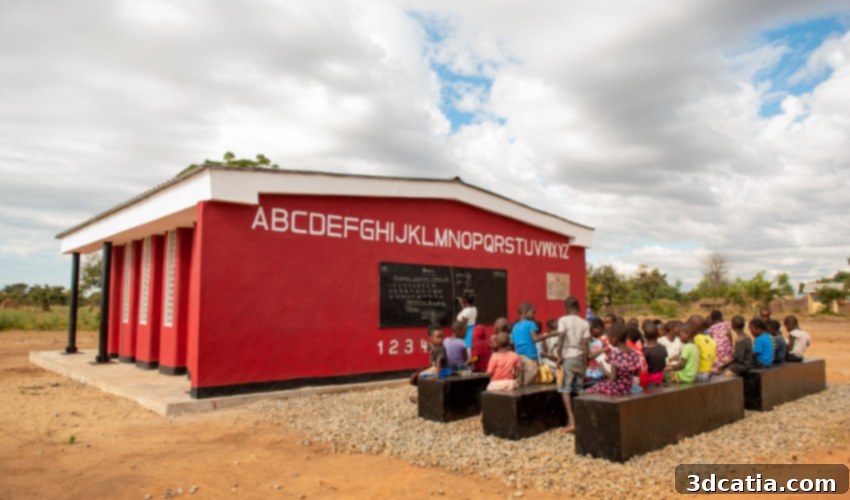
Transforming Education: Malawi’s First 3D-Printed School Paves the Way for Sustainable Development
In a groundbreaking stride towards sustainable development and accessible education, the world’s first 3D-printed school has officially opened its doors in Malawi. This innovative educational facility stands as a beacon of progress, demonstrating the immense potential of additive manufacturing in addressing critical infrastructure needs globally. The school was meticulously constructed by 14Trees, an impactful joint venture forged between global building materials leader Holcim and the UK’s CDC Group. Their choice of technology, the advanced BOD2 printer from Danish 3D construction robot pioneer COBOD, proved instrumental in achieving a build that is not only robust but also remarkably efficient.
The adoption of 3D printing technology for this vital project brought about a paradigm shift in traditional construction methodologies. Its application resulted in a significant reduction in several key areas: cost, time, and materials—factors that typically present substantial barriers to rapid infrastructure development. Beyond these immediate benefits, the project also boasts an impressive environmental footprint, demonstrating a reduction of over 50% compared to conventional building techniques. This commitment to sustainability underscores the project’s alignment with broader global environmental goals. Juliana Kuphanga Chikandila, the Primary Education Advisor and a representative for Malawi’s Director of Education, Youth, and Sports, expressed profound admiration for the new facility. “I am very impressed by the new building – its durability and design provide the space and facilities that students did not have before. This school will attract more students, and those learners that had left will return to education,” she remarked, highlighting the transformative impact on the local community and educational landscape.
This pioneering school embodies a tangible commitment to the United Nations’ Sustainable Development Goals (SDGs). These global goals, established to tackle humanity’s most pressing challenges—including poverty, inequality, climate change, and environmental degradation—found a powerful ally in this construction initiative. The school was conceived and built with the explicit aim of accelerating the provision of affordable housing and educational infrastructure across the African continent. This particular 3D-printed school serves as a compelling testament to the broader potential for the application of 3D printing for education infrastructure globally, especially in regions grappling with rapid population growth and resource constraints. Moreover, this new technological frontier opens up exciting opportunities for local empowerment. It facilitates the training of local people as skilled 3D machine operators and specialists, thereby fostering the creation of highly skilled jobs and contributing to economic upliftment within the community.

14Trees (Photo Credit: Bennie Khanyizira/LafargeHolcim)
Revolutionizing Construction: The Power of 3D Printing Technology
The field of 3D printing in construction is rapidly evolving, offering a diverse array of advanced machines tailored for building various structures. Among these, polar machines, gantry-mounted printers, and mobile robots represent some of the leading varieties of 3D printers used in the construction of buildings. These sophisticated machines are engineered with the capability to precisely extrude specialized concrete mixtures, allowing for the rapid and efficient construction of diverse structures—ranging from residential homes to intricate bridges, and accommodating varying levels of complexity in design and scale. One of the most significant advantages of deploying 3D printers in construction lies in their unparalleled ability to facilitate access to and construction within areas that are typically challenging for the deployment of traditional equipment and personnel. This includes remote geographic locations, environments with difficult terrain, or even areas impacted by conflict or natural disasters, where conventional construction methods are often impractical or too slow.
The school building in Malawi, encompassing a total area of 56 square meters, serves as a prime example of this technology’s efficacy. It was constructed using a BOD2 model 4-4-2 from COBOD, a robust and versatile printer renowned for its capabilities. This specific model is designed to print concrete structures up to an impressive 10 meters in both length and width, and up to 3 meters in height, offering considerable flexibility for various architectural designs. The BOD2 printer by COBOD is not merely a single-project wonder; its reliability and precision have been proven across multiple significant global projects. Notably, the very same BOD2 printer used to build this school was also instrumental in constructing the first 3D-printed concrete wind turbine tower for GE, a project that pushed the boundaries of renewable energy infrastructure. Furthermore, COBOD’s technology has been deployed in several other pioneering 3D-printed buildings across the United States, India, and various locations across Europe, solidifying its reputation as a leader in industrial-scale construction 3D printing.
The urgency of this innovative approach is underscored by alarming statistics. According to UNICEF’s estimations, Malawi faces a critical shortage of approximately 36,000 classrooms. Addressing this deficit using traditional build methods would be a monumental undertaking, projected to take a staggering 70 years to complete. Such a timeline presents an insurmountable hurdle for a nation striving to improve its educational outcomes and provide opportunities for its youth. However, the joint venture 14Trees offers a transformative solution. Their estimates suggest that this formidable infrastructure gap could be bridged in as little as ten years by widely adopting 3D printing technology. This dramatic acceleration in construction time has profound implications for educational access, allowing generations of children to benefit from proper learning environments much sooner.
Miljan Gutovic, Region Head of Europe, Middle East, and Africa at Holcim Group, emphasized the broader vision behind this pioneering project. “Now that we’ve proven the concept in Malawi, we look forward to scaling up this technology across the broader region, with projects already in the pipeline in Kenya and Zimbabwe,” he stated. This strategic outlook indicates that the Malawi school is not an isolated experiment but rather a blueprint for regional expansion, promising to bring efficient, sustainable, and rapid construction solutions to other African nations facing similar developmental challenges. The success in Malawi provides a compelling case study, demonstrating how advanced technology can directly contribute to achieving critical social development goals, fostering education, and improving living standards for countless individuals.
The implementation of 3D printing in construction offers a multitude of long-term benefits beyond just speed and cost. It allows for greater design flexibility, enabling architects to create innovative and contextually appropriate structures that are optimized for local conditions. Furthermore, the localized training and job creation associated with operating these advanced machines contribute significantly to the local economy, nurturing a new generation of skilled workers in cutting-edge technologies. This transfer of knowledge and capability empowers communities, making them more resilient and self-sufficient in addressing their future infrastructure needs. By drastically cutting down construction timelines and material waste, 3D printing positions itself as a cornerstone for future urban development, particularly in emerging economies where resources are often stretched thin. Learn more about this transformative 3D-printed school HERE.
We invite you to share your thoughts on the world’s first 3D-printed school and the remarkable capabilities of the BOD2 printer by COBOD. How do you see construction 3D printing shaping the future of education and sustainable development? Let us know your insights and opinions in a comment below, or engage with us on our Facebook and Twitter pages. To stay abreast of all the latest advancements, news, and breakthroughs in the dynamic world of 3D printing, don’t forget to sign up for our free weekly newsletter, delivered straight to your inbox!
Cover Photo Credit: Bennie Khanyizira/COBOD