
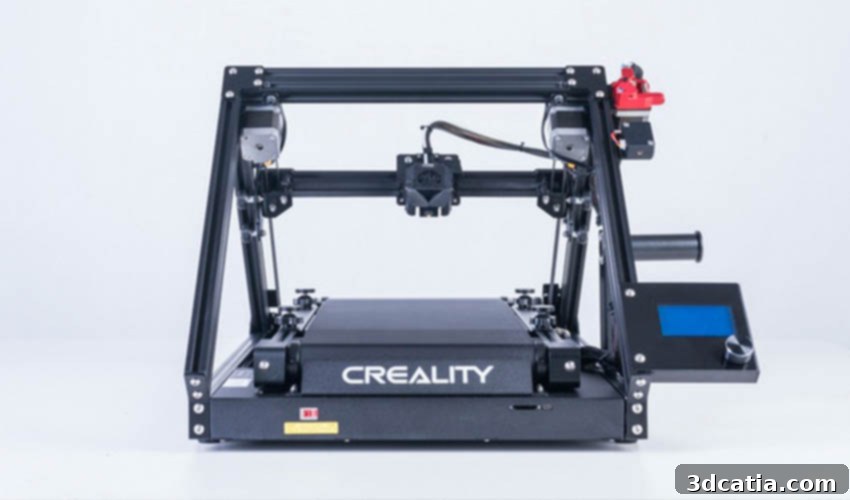
Creality 3DPrintMill: Revolutionizing Continuous 3D Printing with Infinite Z-Axis and Open-Source Potential
Since its establishment in 2014, Creality has rapidly ascended to become a leading force in the 3D printing industry. The company’s core mission revolves around the design, research, and production of innovative 3D printers and related products, encompassing a wide array of technologies including Fused Deposition Modeling (FDM) and resin-based (SLA/DLP) 3D printing. Creality is particularly renowned for its highly affordable and accessible FDM solutions, which have democratized 3D printing for hobbyists and professionals alike. These acclaimed machines are primarily organized into three distinct series: the popular Ender series, the robust CR series, and the specialized CP series. Continuing its legacy of innovation, Creality has unveiled a groundbreaking addition to its CR-series: the 3DPrintMill. This revolutionary device blurs the lines between a traditional 3D printer and an industrial conveyor belt system, promising an entirely new approach to additive manufacturing. Conceived and brought to life in close collaboration with the influential hardware developer Naomi Wu, the 3DPrintMill represents a bold vision realized through Creality’s significant R&D investment and unparalleled engineering expertise.
The Shenzhen-based company’s confidence in this pioneering product was immediately validated by its recent Kickstarter campaign. The 3DPrintMill project achieved phenomenal success, surpassing its initial funding goal of HK$1,000,000 (approximately US$130,000) within an astonishing 24 hours of its launch. This rapid achievement underscores the immense interest and demand within the 3D printing community for such an innovative solution. Furthermore, Creality has made an exciting commitment: if the 3DPrintMill crowdfunding campaign reaches an impressive US$5 million, the entire machine – including all CAD files, the Bill of Materials (BOM), firmware, and schematics – will be made fully Open Source. This pledges full transparency and empowerment to the community, allowing anyone to access the foundational designs, develop their own modifications, iterate on existing features, and contribute to the printer’s evolution. This commitment to open source is a testament to Creality’s belief in collaborative innovation and the power of the global maker community. But what exactly are the core features that make the 3DPrintMill so compelling?

The Transformative Benefits of an Integrated Conveyor Belt
At first glance, the integration of a conveyor belt into a 3D printer might seem unconventional. However, Creality’s ingenious design for the 3DPrintMill leverages this feature to unlock unprecedented capabilities, primarily enabling continuous, unattended part printing. This functionality dramatically redefines the workflow of 3D printing, especially for batch production or rapid prototyping scenarios. As parts are successfully 3D printed, the heated nylon belt, which serves as the build plate, automatically advances. This continuous motion allows the completed parts to naturally detach from the printing surface and gently fall into a collection bin. This innovative mechanism eliminates the need for manual intervention between print jobs, removing the crucial bottleneck of physically removing printed objects from the heated bed before initiating a new print. Consequently, the 3DPrintMill can autonomously process an entire 1, 5, or even 10-kilogram spool of plastic filament, fabricating numerous plastic parts without requiring any human supervision. The durable nylon conveyor belt is engineered for longevity, expected to withstand years of regular, rigorous use, ensuring sustained performance and reliability for long-term production needs.
Beyond mere automation, the conveyor belt system introduces another monumental advantage: a theoretically infinite Z-axis build volume. This is achieved through a cleverly designed 45-degree tilted print bed. By inclining the print bed, the printer can continuously extrude material onto the advancing belt, allowing the back end of an object to move away from the print head as the front end is still being printed. This means that instead of being limited by the physical height of a traditional build plate, objects can be extruded to virtually any length along the conveyor belt. This breakthrough opens up possibilities for producing incredibly long, single-piece structures that would be impossible on conventional FDM printers. To date, the most impressive demonstration of this capability has been the continuous printing of a remarkable 20-foot (approximately 6-meter) long bar in a single, uninterrupted print job. This ‘infinite Z’ capability makes the 3DPrintMill an invaluable tool for applications requiring large-scale, continuous-flow production, or the creation of exceptionally elongated prototypes and functional parts.
Detailed 3D Printer Specifications and Performance
The Creality 3DPrintMill is thoughtfully designed for both functionality and practicality. Measuring 535 x 656 x 410 mm and weighing in at a manageable 16.5 kg, this printer offers a significant build volume despite its relatively compact footprint. Its core strength lies in its expansive build volume of 200 x 170 x ∞ mm, clearly highlighting the revolutionary “infinite Z-axis” capability. Operating on well-established FDM (Fused Deposition Modeling) technology, the printer is equipped with a standard 0.4mm nozzle diameter. This configuration allows for a commendable printing accuracy of ±0.1 mm, ensuring that even intricate details are rendered with precision. The nozzle itself can reach temperatures of up to 240 degrees Celsius, providing ample thermal capacity for a wide range of common filaments. Complementing this, the heated bed can attain temperatures of up to 100 degrees Celsius. This dual heating capability makes the 3DPrintMill highly compatible with popular thermoplastic filaments such as PLA (Polylactic Acid), TPU (Thermoplastic Polyurethane), and PETG (Polyethylene Terephthalate Glycol). To streamline the printing process, the machine comes bundled with its dedicated slicing software, aptly named Crealitybelt, specifically optimized to prepare 3D models for printing on its unique conveyor belt system.
In addition to its innovative hardware, the 3DPrintMill incorporates essential smart features designed to enhance reliability and user convenience. These include an advanced print resume function and a sophisticated filament interruption detection system. The print resume feature is invaluable; should your 3DPrintMill experience an unexpected power outage, it intelligently records the print progress. Upon restoration of power, the printer can seamlessly resume printing exactly from where it left off, preventing the loss of valuable print time and filament. This capability is critical for long, unattended print jobs. Similarly, the integrated filament sensor actively monitors the material supply. If the filament breaks or runs out during a print, the sensor immediately detects the issue and automatically pauses the printing process. This allows users to load new filament without disrupting the print. Once fresh filament is supplied, the 3DPrintMill resumes its task, typically leaving no discernible mark or defect on the final printed object. These intelligent features significantly reduce the risk of print failures, minimize material waste, and ensure a more reliable and user-friendly experience, making continuous printing truly worry-free.
Ideal Users and Revolutionary Applications
Creality envisions the 3DPrintMill appealing to a broad spectrum of users. Fundamentally, it’s designed for anyone who enjoys the creative aspects of 3D printing but finds the repetitive, manual tasks of bed leveling and print removal tedious and time-consuming. This includes hobbyists and makers who want to spend more time designing and less time managing their printer. Beyond individual users, the 3DPrintMill presents a transformative solution for small to medium-sized businesses looking to establish or expand a “3D printer farm.” Traditional printer farms demand constant human labor for changing build plates, detaching finished parts, and initiating new print jobs. The 3DPrintMill dramatically reduces these associated labor costs, offering a highly automated production line that can run efficiently with minimal supervision. This makes it an incredibly cost-effective option for rapid prototyping, small-batch manufacturing, or even custom part production on demand. Furthermore, its user-friendly, automated nature makes it perfectly suitable for individuals with compromised dexterity or limited movements, providing an accessible pathway into additive manufacturing. Educational institutions, particularly for school projects involving children, will also find the 3DPrintMill invaluable. It allows students to focus on design and iterative creation without getting bogged down by manual printer operation, fostering innovation in a practical and engaging manner. Whether for personal projects, professional production, or educational endeavors, the 3DPrintMill promises to simplify and accelerate the 3D printing experience. You can find more comprehensive information and support the project on its official Kickstarter page HERE.
The Promise of Open Source and Community Collaboration
The pledge to make the 3DPrintMill fully open source upon reaching the US$5 million crowdfunding target is not merely a marketing gimmick; it’s a profound commitment that could have a lasting impact on the 3D printing ecosystem. Open-sourcing the CAD files, BOM, firmware, and schematics empowers a global community of developers, engineers, and enthusiasts. This means that users won’t just be consumers of the technology but active participants in its evolution. They can modify the hardware, write custom firmware, develop specialized accessories, and even build their own versions of the printer from scratch. This collaborative model accelerates innovation, fosters transparency, and builds a robust, resilient ecosystem around the product. It’s a move that aligns perfectly with Naomi Wu’s ethos and Creality’s dedication to making 3D printing accessible and adaptable. The potential for community-driven enhancements, optimizations, and new applications for the 3DPrintMill is virtually limitless, ensuring the printer remains at the forefront of continuous 3D printing technology for years to come.
The Creality 3DPrintMill, with its unique conveyor belt system, infinite Z-axis, and exciting open-source potential championed by Naomi Wu, stands poised to redefine expectations for FDM 3D printing. It addresses fundamental pain points in traditional printing workflows, offering an automated, efficient, and versatile solution for creators of all levels. We are eager to hear your thoughts on this innovative machine from Creality and Naomi Wu. Please share your opinions in the comment section below or engage with us on our Facebook and Twitter pages! Don’t miss out on the latest advancements and news in the world of 3D printing; remember to sign up for our free weekly Newsletter, delivered directly to your inbox!