
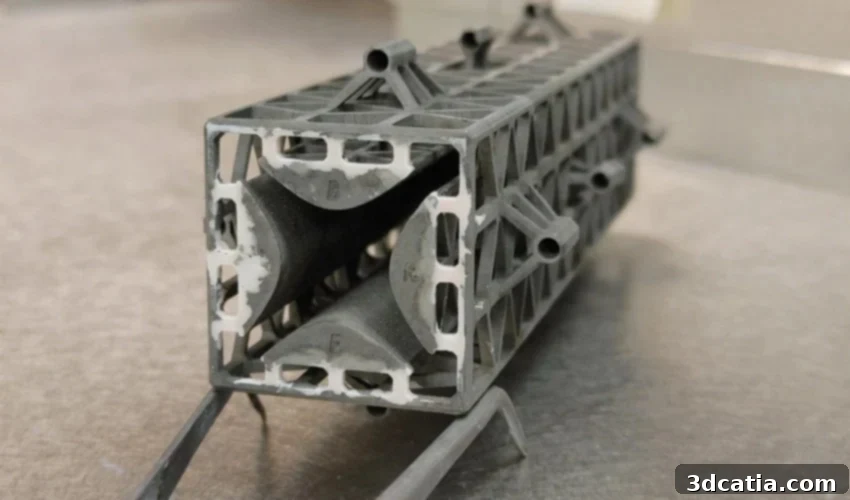
MIT Pioneers 3D Printed Mass Spectrometer Filters for Enhanced Portability and Performance
At the Massachusetts Institute of Technology (MIT), a groundbreaking team of researchers, spearheaded by the visionary Fernando Velásquez-García, has achieved a significant breakthrough in analytical instrumentation: the development of a 3D printed filter for mass spectrometers. This innovative device, central to the precise detection and identification of molecular structures by measuring their mass-to-charge ratio, has traditionally been characterized by its substantial bulk, inherent fragility, and significant cost. Consequently, its deployment in demanding or remote environments has always posed considerable logistical challenges. Leveraging advanced photopolymerization techniques and a specially formulated, heat-resistant glass-ceramic resin, the MIT team successfully produced the device’s critical filter component, more commonly known as a quadrupole. This pioneering application of additive manufacturing has enabled a dramatic reduction in the filter’s production time, manufacturing cost, and overall weight, heralding a new era for mass spectrometry.
Mass spectrometry, a powerful analytical technique, first emerged in the early 20th century. Its initial applications were primarily focused on the identification and separation of isotopes of various chemical elements. Over the decades, the technology has undergone continuous refinement and perfection, expanding its utility across a vast array of scientific disciplines. Today, mass spectrometry is indispensable in fields such as chemistry, physics, biology, geology, environmental science, and even space exploration, providing critical insights into the composition of matter. A typical mass spectrometer comprises four essential parts: the inlet system, the ion source, the mass analyzer, and the detector. The analyzer, crucial for separating ions based on their mass-to-charge ratio, can be either high-resolution or low-resolution. In the context of low-resolution analysis, a quadrupole serves as the primary mass filter. This component precisely controls the trajectories of ions through oscillating electric fields, allowing only ions of a specific mass-to-charge ratio to pass through to the detector. Traditionally, quadrupoles are laboriously machined and assembled over weeks, incurring costs of thousands of dollars. The MIT team’s ability to produce this complex component using additive manufacturing in mere hours and for just a few dollars represents a monumental leap forward in accessibility and efficiency.
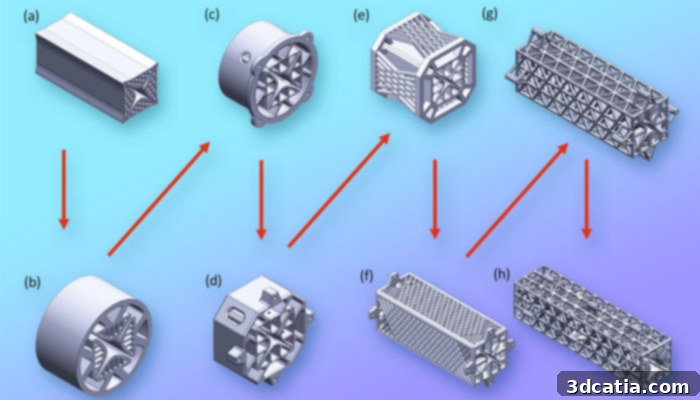
Additive manufacturing makes it possible to imagine a wide range of shapes and iterations, crucial for optimizing spectrometer performance.
Revolutionizing Mass Spectrometer Design with 3D Printing
The component in question was meticulously 3D printed using a high-precision resin 3D printer, specifically employing a photopolymerization process. The research team detailed their method, explaining that they utilized a proprietary glass-ceramic resin, which was cured layer by layer through precise exposure to multiple ultraviolet LEDs. This additive manufacturing approach allows for the creation of the miniaturized quadrupole in a single, continuous operation. This “monolithic” printing process inherently eliminates the numerous assembly steps that are typically required in traditional manufacturing. These conventional assembly procedures are not only time-consuming and costly but also introduce potential points of failure or misalignment, which can critically compromise the quality, precision, and performance of the final component. By consolidating the manufacturing into one seamless print, the MIT team has significantly enhanced the structural integrity and functional accuracy of their 3D printed quadrupoles.
Fernando Velásquez-García, the lead researcher, emphasized the significance of their achievement: “We are not the first ones to try to do this. But we are the first ones who succeeded at doing this. There are other miniaturized quadrupole filters, but they are not comparable with professional-grade mass filters. There are a lot of possibilities for this hardware if the size and cost could be smaller without adversely affecting the performance.” This statement underscores the critical distinction of their work: while attempts at miniaturizing mass spectrometer components have been made previously, the MIT team is the first to produce a 3D printed quadrupole that not only matches but potentially exceeds the performance standards of conventional, professional-grade mass filters. This breakthrough has profound implications, suggesting that the long-sought goal of truly portable, high-performance mass spectrometry is now within reach.
The adoption of additive manufacturing offered a multitude of compelling advantages to the MIT team, extending far beyond simple cost and time reductions. As previously highlighted, it has been instrumental in dramatically reducing the overall size and weight of the mass spectrometer’s critical components, thereby shrinking the entire device. This miniaturization effect profoundly widens the field of possible applications for mass spectrometry. The research team enthusiastically explains that this newfound portability will enable the deployment of these sophisticated analytical instruments in more remote, challenging, and previously inaccessible areas, facilitating quicker and more efficient analyses in situ. Imagine a mass spectrometer robust enough to operate in the dense, humid environment of a rainforest, identifying novel biochemicals or monitoring environmental pollutants. Consider its potential in space exploration, where a compact, lightweight device could analyze atmospheric chemicals on distant planets or assess the composition of celestial bodies without the need for cumbersome and costly sample return missions. These are just a few examples of the transformative impact this technology is poised to have.
Furthermore, the inherent design freedom offered by 3D printing allowed the MIT team to re-imagine the fundamental geometry of their quadrupoles, leading to significant performance enhancements. Departing from traditional designs, they engineered a device featuring hyperbolic rods. Unlike the rounded rods typically found in conventional quadrupoles, which can introduce field inhomogeneities and negatively impact ion trajectory control, hyperbolic rods are theoretically ideal for creating uniform electric fields, thereby optimizing mass filtering precision and sensitivity. Building on this improved geometry, the researchers strategically incorporated intricate lattice structures around the rods. These lattice designs were not arbitrary; they were meticulously optimized to maximize the component’s strength and durability without adding significant weight, leveraging the material efficiency unique to additive manufacturing. The final crucial step involved a sophisticated post-treatment process to render the glass-ceramic rods conductive. This was achieved through electroplating, a technique where a thin, uniform film of metal (such as gold or nickel) was safely and precisely applied to the surface of the printed rods. The result of this innovative design and manufacturing process? Highly efficient quadrupoles, approximately 12 cm in length, which are astonishingly four times less dense than their traditional stainless steel counterparts, yet capable of delivering superior analytical performance.
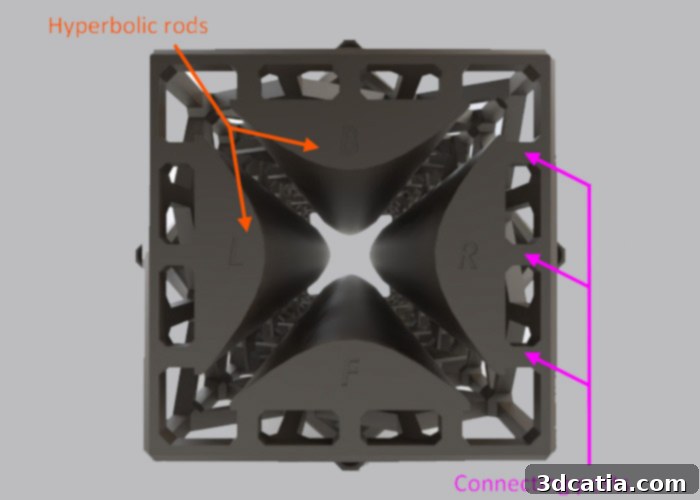
Researchers design a quadrupole with hyperbolic rods, a geometry that enhances field uniformity and analytical precision.
Looking ahead, the ambitious MIT team plans to continue refining their 3D printed mass spectrometer components. A key objective for the future is to extend the length of these advanced filters, which would enable even more precise and high-resolution analyses. Fernando Velásquez-García articulated the team’s overarching vision: “Our vision is to make a mass spectrometer where all the key components can be 3D printed, contributing to a device with much less weight and cost without sacrificing performance. There is still a lot of work to do, but this is a great start.” This long-term goal signifies a complete paradigm shift in the manufacturing of analytical instrumentation, promising fully integrated, lightweight, and cost-effective mass spectrometers that could revolutionize scientific research, industrial quality control, and field-based diagnostics across countless sectors. The journey may be extensive, but this foundational work represents an exceptionally promising beginning. For those interested in delving deeper into this exciting research, more detailed information can be found in MIT’s official press release HERE.
What are your thoughts on this revolutionary 3D printed spectrometer and its potential to democratize advanced chemical analysis? We encourage you to share your insights and comments below, or engage with us on our social media platforms: connect with us on LinkedIn, follow us on Facebook, and join the conversation on Twitter! Don’t miss out on the latest advancements and breaking news in additive manufacturing – be sure to sign up for our free weekly Newsletter here, delivering the most relevant 3D printing news directly to your inbox! Additionally, you can explore all our engaging videos and exclusive content on our dedicated YouTube channel.
*Photo Credits: MIT