
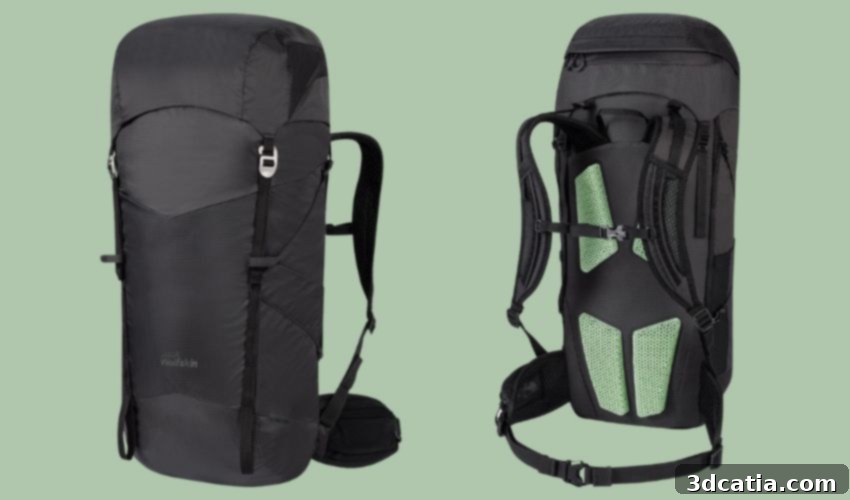
Revolutionizing Outdoor Gear: Jack Wolfskin’s Aerorise Backpack Leverages 3D Printing for Unprecedented Comfort and Ventilation
The landscape of manufacturing is continually being reshaped by technological advancements, and few innovations have made as profound an impact as 3D printing, or additive manufacturing (AM). Its capabilities, once limited to prototyping, now extend to creating functional components for a vast array of applications, from intricate rocket engine parts to specialized footwear. Among the most exciting frontiers for this technology is consumer goods, particularly within the sports and outdoor equipment sectors. Here, 3D printing truly shines, offering unparalleled customization, improved performance, and enhanced comfort for athletes and outdoor enthusiasts alike. Even prominent organizations such as the NHL, NFL, and the Olympics have begun integrating these cutting-edge technologies into their gear. A prime example of this transformative trend is Jack Wolfskin’s Aerorise backpack, a product born from a collaborative effort with 3D printing pioneers Carbon and manufacturing experts OECHSLER, aimed at fundamentally rethinking backpack design for superior user experience.
Jack Wolfskin, a venerable German producer of outdoor wear and equipment, boasts a nearly 40-year legacy of innovation. While well-established in Europe, the company has recently expanded its footprint into the North American market, bringing its philosophy of creating highly effective, eco-conscious products to a broader audience. Their commitment to leveraging innovative, sustainable technologies in real-world conditions led them to explore additive manufacturing for their latest product. The core challenge they sought to overcome was a common pain point for hikers and backpackers: ventilation issues in traditional backpack padding. Conventional backpack designs typically incorporate dense padding at pressure points to distribute heavy loads and ensure comfort. However, as any seasoned hiker will attest, this often comes at the cost of significant back sweat, leading to discomfort and reduced performance during strenuous activity. Jack Wolfskin recognized that a truly innovative solution was needed to address this long-standing issue without compromising on support or durability.
Jack Wolfskin utilized 3D printing to engineer superior padding for their Aerorise backpack, prioritizing optimal airflow and comfort (photo credits: Jack Wolfskin)
Through the strategic integration of additive manufacturing, Jack Wolfskin, in close partnership with Carbon and OECHSLER, has successfully developed a backpack that masterfully combines optimal load distribution with exceptional ventilation. The innovative cushioning system featured in the Aerorise backpack is meticulously designed to provide an ergonomic fit that evenly distributes weight and pressure across the wearer’s back, while simultaneously facilitating continuous airflow. This dual benefit is largely attributable to Carbon’s advanced dual-cure elastomer, EPU 41 material, which played a pivotal role in the development process. Richard Collier, CEO of Jack Wolfskin, emphasized the significance of this material advancement, stating, “It’s not every day that material advancements come along that make such a difference. Aerorise addresses all of the primary challenges of backpacks – ventilation, support, and comfort – through a single technology advancement. Our customers are going to love this product.” This sentiment underscores the transformative potential of combining cutting-edge materials with sophisticated 3D printing techniques to resolve long-standing design dilemmas in outdoor gear.
Creating the Aerorise Backpack: A Deep Dive into Additive Innovation
The journey to create the Aerorise backpack began with Jack Wolfskin’s decision to adopt Carbon’s comprehensive Idea-to-Production platform, powered by its proprietary Carbon Digital Light Synthesis™ (DLS™) technology. Despite being new to 3D printing design, Jack Wolfskin was keenly aware of the opportunities that additive manufacturing (AM) and Design for Additive Manufacturing (DfAM) offered. These included not only significant performance enhancements but also a substantial reduction in material waste, aligning perfectly with the company’s eco-conscious ethos. For the Aerorise backpack, Jack Wolfskin outlined several critical requirements: paramount among them was providing superior lower back ventilation for the user, coupled with precisely engineered zonal cushioning to minimize pressure points. All this had to be achieved while maintaining a lightweight and exceptionally durable structure.
Beyond comfort and ventilation, specific mechanical qualities were indispensable, including optimal elasticity and robust structural support. These requirements naturally led to the selection of Carbon EPU 41, an advanced elastomeric material renowned for its high resiliency and excellent rebound properties. The choice of EPU 41 ensured that the final product would be highly abrasion-resistant, capable of enduring the rigors of outdoor use. Furthermore, its inherent properties allowed for the creation of intricate lattice structures that are exceptionally breathable. The material also provided a surface finish with the ideal degree of grip, ensuring stability against the wearer’s back, while remaining remarkably easy to clean – a crucial factor for outdoor equipment. However, the superior material was only one piece of the puzzle; the intricate design of the 3D printed panels was equally critical to achieving the desired improvements.
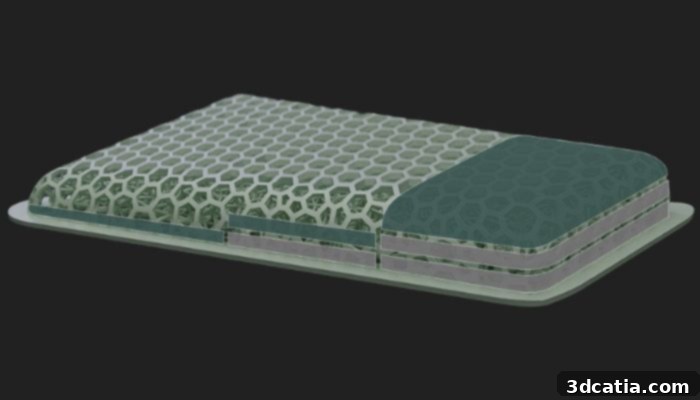
Carbon’s profound expertise in design played an instrumental role in developing a solution that seamlessly integrated durability, lightness, comfort, and ventilation. A key tool in this process was Carbon Design Engine™ software, a proprietary solution that empowers designers to rapidly translate an initial concept into a fully functional, latticed part within a matter of hours. Lattice structures are a hallmark of DfAM and have become exceptionally popular due to their numerous advantages, particularly in applications where traditional manufacturing methods struggle with such geometric complexity. For instance, these intricate internal geometries significantly reduce material usage while simultaneously enhancing cushioning, dampening, and, critically for the Aerorise backpack, increasing breathability. In this specific application, the open-cell lattice structures were instrumental in vastly improving air circulation, maintaining consistent comfort across the back panel, and optimizing load control by adapting to the wearer’s movements. Moreover, the precision afforded by 3D printing allowed Jack Wolfskin’s engineers to integrate varying degrees of horizontal and vertical cushioning within a single, monolithic piece, tailoring support precisely where it was needed most.
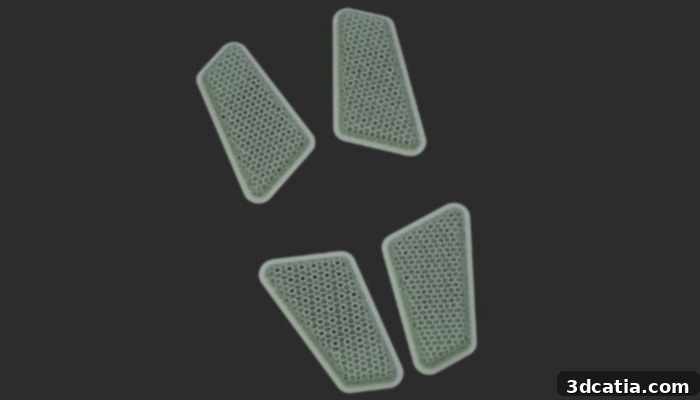
The innovative lattice structures were fundamental to achieving highly ventilated yet supremely comfortable padding in the Aerorise backpack (photo credits: Carbon)
Beyond the material science and sophisticated design, the additive manufacturing process itself was undeniably essential to the successful creation of the Aerorise backpack. For industrial-scale production, Jack Wolfskin found an ideal partner in OECHSLER. This choice was driven not only by OECHSLER’s German roots, which perfectly complemented Jack Wolfskin’s enduring ethos of “Engineered in Germany/Proven in the Wild,” but more significantly, by their extensive and proven experience in industrial additive manufacturing. OECHSLER expertly navigated two primary considerations set forth by Jack Wolfskin: uncompromising print quality and maintaining an industrialization process that was as lean and efficient as possible. Their engineering team made critical optimizations, such as adding strategic struts for reinforcement in high-stress areas and reducing the part height to substantially shorten print times. These meticulous adjustments allowed the company to significantly decrease the overall printing time from the prototyping phase to full serial production by an impressive 40%, demonstrating the power of optimized additive manufacturing in bringing innovative products to market efficiently.
Durability, Lightness, Comfort, and Ventilation: The Aerorise Advantage
The initial reception to the Aerorise backpack has been overwhelmingly positive, with enthusiastic feedback from internal testing and early adopters. Gerold Ringsdorf, Head of Development of Backpacks for Jack Wolfskin, enthusiastically remarked on the product’s unique strengths, noting that its superior combination of ventilation, cushioning, and support makes it unparalleled in the current market. The Aerorise backpack strikes an exceptional balance between being soft yet supportive, snug yet flexible, delivering a level of comfort and load control previously unattainable. This innovation represents a true testament to the power of collaborative effort; all three companies involved — Jack Wolfskin, Carbon, and OECHSLER — agree that this partnership enabled breakthroughs that would have been impossible for any single entity to achieve alone. This successful venture is widely regarded as merely the beginning of Jack Wolfskin’s exciting journey into the realm of additive manufacturing, hinting at a future where 3D printing plays an even larger role in their product development.
Magdalen Hamel, Category Manager of Equipment at Jack Wolfskin, eloquently summarizes the project’s impact: “Comfort, load control, and ventilation are age-old challenges in pack design. The technology presented in Aerorise directly benefits hikers on the trail and takes the industry in a new direction. The design is really impressive from an engineering perspective and further supports our belief that together, in cooperation with partners, we can make a notable difference and take the industry a step forward.” This collaboration showcases not only a significant leap forward in outdoor gear but also the vast potential of inter-company synergy in driving innovation. For those interested in delving deeper into the specifics of this groundbreaking partnership and the Aerorise project, additional information can be found on Carbon’s official website HERE.
What are your thoughts on the revolutionary use of 3D printing in the creation of Jack Wolfskin’s new Aerorise backpack? Have you had the opportunity to experience one of their innovative solutions firsthand? Share your insights and opinions in a comment below or join the conversation on our LinkedIn, Facebook, and Twitter pages! Don’t miss out on the latest 3D printing news and innovations – remember to sign up for our free weekly Newsletter here, delivered directly to your inbox! You can also explore all our insightful videos and interviews on our YouTube channel.
*Cover Photo Credits: Jack Wolfskin