
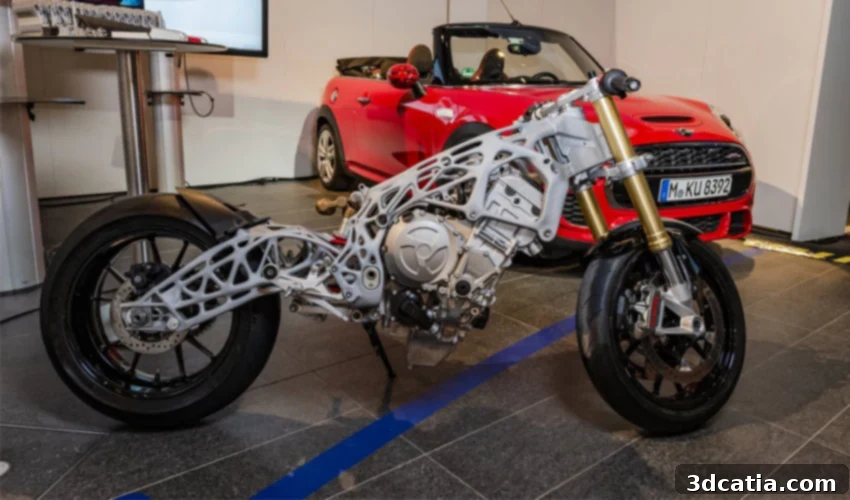
BMW Pioneers Motorcycle Innovation: The S1000RR Prototype Featuring 3D Printed Frame and Swingarm
BMW Motorrad is pushing the boundaries of motorcycle engineering with the unveiling of its S1000RR prototype, a groundbreaking project showcasing the extensive capabilities of additive manufacturing. This innovative prototype features a revolutionary 3D printed frame and a topologically optimized swingarm, both meticulously designed and produced using cutting-edge 3D technologies. This ambitious initiative underscores BMW’s commitment to leveraging advanced manufacturing processes to achieve unprecedented levels of speed and efficiency in automotive development – two critical factors in the highly competitive sector. The S1000RR prototype is poised to join a growing lineage of BMW vehicles that integrate 3D printed components, demonstrating significant performance enhancements and paving the way for future production models.
The German automotive giant’s foray into advanced additive manufacturing is not new. Just recently, BMW announced the establishment of a state-of-the-art new center dedicated exclusively to additive manufacturing, representing a substantial investment of 10 million euros. This significant commitment aims to fully integrate 3D printing technology into every facet of their production cycle, from prototyping to end-use parts. BMW’s strategic investment in additive manufacturing began notably in 2016 with the acquisition of an HP Multi Jet Fusion 3D printer, a move that initiated a profound re-imagination of their vehicle designs. Models like the i8 Roadster have already benefited from intricate 3D printed components, enabling BMW to pursue more complex, intricate designs while simultaneously achieving remarkable weight reductions – a dual benefit critical for both performance and sustainability.
The 3D printed frame of the motorcycle (photo credits: Visor Down)
The S1000RR Prototype: Merging Advanced Technology with Organic Design
The S1000RR motorcycle prototype made its highly anticipated debut at the Digital Day event, organized by the BMW Group in Spain. Still in its developmental stage, this prototype represents a significant leap forward in manufacturing philosophy. BMW engineers elaborated on the sophisticated technology employed, specifically a powder-based selective laser melting (SLM) process, which was crucial for fabricating both the intricate frame and the robust swingarm. This advanced manufacturing technique allows for unparalleled design freedom and material efficiency.
A cornerstone of the S1000RR’s innovative design is the application of topological optimization. This sophisticated computational design method rigorously analyzes the forces and stresses on a component, then intelligently removes any material not essential for structural integrity or performance. The result is a component that is not only incredibly strong but also remarkably lightweight, utilizing the absolute minimum amount of material necessary. This optimization directly translates into substantial material reductions and significant cost savings during production. The prototype’s aesthetic, characterized by its fluid, almost organic lines, strikingly echoes the design principles seen in the Light Rider – a motorcycle developed by APWorks that also achieved drastic weight reduction through additive manufacturing. This shared design philosophy imbues the S1000RR with a distinctly futuristic and avant-garde appearance.
The Unrivaled Advantages of Additive Manufacturing for Automotive
BMW consistently highlights the transformative power of additive manufacturing. As they eloquently put it, “three-dimensional parts made from plastic or metal take shape layer by layer. Additively manufactured parts offer a high degree of freedom in terms of their design, and they can be produced quickly and to the requisite quality.” This statement encapsulates the core benefits that make 3D printing a game-changer. The ability to create complex geometries that are impossible or prohibitively expensive with traditional manufacturing methods allows engineers to design for optimal performance without the constraints of conventional tooling. Furthermore, the rapid production capabilities significantly accelerate development cycles, reducing time-to-market for new innovations.
One of the most significant advantages is the elimination of traditional production tools such as presses or casting molds. In additive manufacturing, “the geometry of the parts is determined entirely by a digital dataset.” This digital workflow streamlines the entire process, making design iterations faster and more cost-effective. While BMW may not yet be ready to launch a fully 3D printed motorcycle for mass production, their conviction in the technology’s immense potential is unwavering. This conviction extends particularly to the realm of vehicle personalization, a strategy already successfully implemented with their MINI brand, where custom 3D printed components offer customers unique customization options, transforming the vehicle ownership experience.
Expanding the Horizon: BMW’s Broader Vision for 3D Printing
Beyond motorcycle frames and swingarms, BMW’s application of additive manufacturing spans a wide spectrum within their operations. The technology is indispensable for rapid prototyping, enabling engineers to quickly test and refine designs with functional prototypes. It’s also proving invaluable for creating specialized tooling and fixtures, improving assembly line efficiency and ergonomics. For small-batch production runs, especially for high-performance or limited-edition models, 3D printing offers a flexible and cost-effective solution. Furthermore, the ability to produce on-demand spare parts minimizes inventory requirements and supports older vehicle models with components that might otherwise be obsolete.
BMW’s strategic adoption of additive manufacturing is a testament to its belief in the technology’s ability to drive innovation, improve sustainability, and enhance customer value. The design freedom afforded by 3D printing allows for optimized geometries that lead to lighter components, contributing to improved fuel efficiency for internal combustion engine vehicles and extended range for electric vehicles. This focus on lightweighting, coupled with the potential for on-demand manufacturing, also aligns with broader environmental goals by reducing material waste and streamlining global supply chains. The future for BMW, as demonstrated by the S1000RR prototype, is one where digital manufacturing plays an increasingly central role in shaping the ultimate driving and riding experience.
Photo credits: Visor Down
The Transformative Impact on the Automotive Industry
The pioneering efforts of BMW with projects like the S1000RR prototype are indicative of a broader revolution sweeping across the entire automotive industry. Additive manufacturing is fundamentally changing how vehicles are designed, engineered, and produced. Its benefits extend far beyond individual components, influencing research and development cycles, production efficiencies, and even the end-consumer experience. Companies can now iterate designs much faster, reducing the time and cost associated with traditional prototyping methods. This agility is crucial in an industry constantly striving for innovation and rapid technological advancements.
The ability to create highly complex internal geometries, such as cooling channels within engine components or intricate lattice structures for lightweighting, was once unthinkable but is now routine with 3D printing. This capability unlocks new levels of performance, efficiency, and safety. However, the journey is not without its challenges. Material selection, though rapidly expanding, still presents limitations for certain high-stress applications in mass production. Furthermore, the speed of additive manufacturing, while excellent for prototyping and small batches, needs to scale further to meet the demands of high-volume automotive production lines. Despite these hurdles, ongoing advancements in materials science and printer technology are continuously expanding the practical applications of 3D printing in the automotive sector, promising an even more integrated future.
Conclusion: BMW’s Vision for the Future of Mobility
BMW’s S1000RR prototype, with its meticulously 3D printed frame and swingarm, stands as a powerful testament to the brand’s pioneering spirit and its unwavering commitment to integrating cutting-edge additive manufacturing into its core operations. This project not only showcases the immediate benefits of 3D printing – faster development, increased efficiency, and unparalleled design freedom – but also provides a glimpse into the future of automotive engineering. As BMW continues to invest in and refine its additive manufacturing capabilities, we can anticipate even more innovative vehicles that push the boundaries of performance, design, and customization. The S1000RR prototype is more than just a bike; it’s a statement about the future of mobility, shaped layer by layer by advanced technology.
Find out more by visiting their official website here.
What are your thoughts on BMW’s revolutionary 3D printed motorcycle prototype and the future of additive manufacturing in the automotive sector? We encourage you to share your insights in a comment below or join the conversation on our Facebook and Twitter pages! Don’t forget to sign up for our free weekly Newsletter, delivering all the latest advancements and news in 3D printing directly to your inbox!