
Revolutionizing Construction: AUC Pioneers Sustainable 3D Printed Clay Bricks in North Africa
The landscape of global construction is undergoing a profound transformation, with 3D printed structures and housing projects steadily expanding in both scale and scope across the world. This innovative approach offers a compelling array of advantages over traditional building methods, particularly when leveraging carefully selected materials. Benefits include enhanced fire resistance, the utilization of local or recyclable materials, significant reductions in overall project costs, and critically, substantially shorter build times. This accelerated construction capability is becoming increasingly vital for addressing global population growth and the urgent need for affordable, accessible housing. Amidst this global shift, The American University in Cairo (AUC) has emerged as a beacon of innovation, with its researchers tirelessly working to develop a proprietary additive manufacturing-based construction system. Their pioneering system places a strong emphasis on integrating local construction materials, advanced robotic fabrication techniques, and a resolute commitment to achieving carbon-zero manufacturing processes. The remarkable outcome of their efforts is the successful development of 3D printed clay bricks, marking a historic achievement as the first of its kind in North Africa. This breakthrough not only highlights the immense potential of additive manufacturing in the region but also sets a new benchmark for sustainable and efficient building practices.
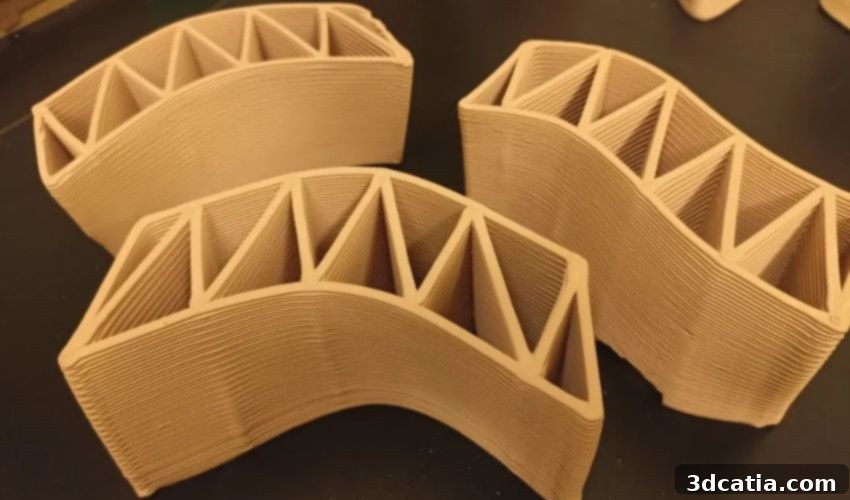
The AUC research team operates from one of only three specialized laboratories currently dedicated to experimenting with clay bricks for 3D printing applications across the entire African and Middle Eastern continents. Their unique additive manufacturing method, which combines elements of metal and clay material processing, was forged through a synergistic collaboration between the AUC’s Additive Manufacturing Centennial Lab (AMCL) and the Robotic Fabrication Lab (RFL). This cutting-edge process harnesses the precision and power of robotic arms to construct intricate and complex structures. Crucially, it achieves this feat at a mere fraction of the energy consumption, time expenditure, and carbon emissions typically associated with conventional construction practices. Diverging from the widely adopted concrete mixtures prevalent in many AM construction projects, the AUC team has deliberately chosen to work with a specialized material they refer to as “red fire clay.” This particular clay stands apart from normal clay due to its distinct chemical composition, which incorporates a rich blend of minerals such as feldspar, quartz, and kaolin. These natural constituents imbue the clay with superior durability and exceptional resistance to heat, making it an ideal candidate for robust and sustainable building. Once prepared, this specialized clay mixture can be effortlessly extruded into a myriad of desired shapes using the team’s custom-engineered large-scale robotic 3D printing apparatus, allowing for unparalleled design flexibility and structural integrity.

The 3D printed clay is more resistant to heat and able to hold complex shapes (photo credits: The American University in Cairo RFL)
The strategic decision to utilize clay as the primary building material is central to the AUC team’s overarching vision and their unwavering commitment to sustainability. Operating from Egypt, a nation with a rich historical legacy of using natural resources, the researchers are acutely aware of the abundant availability of clay, and the raw materials required for its production, within the region. Traditionally produced clay bricks have been a cornerstone of local construction for millennia, a testament to the material’s enduring properties and accessibility. This natural abundance provides the AUC team with a consistent and reliable supply of local materials, ensuring that their projects can proceed on an as-needed basis without reliance on costly or environmentally intensive imports. The positive ramifications of this approach extend far beyond environmental benefits. The team has enthusiastically highlighted the potential socio-economic impacts, predicting that this groundbreaking technology will serve as a powerful catalyst for stimulating the local economy. This stimulation could manifest through the creation of new jobs, the fostering of local industries, and the reduction of dependence on foreign construction materials. Moreover, by utilizing readily available and cost-effective local resources, the technology promises to deliver more affordable housing solutions to communities in need, addressing a critical social imperative with an innovative, sustainable solution.
Professor Hanadi Salem, who chairs the AUC Department of Mechanical Engineering, offers profound insights into the transformative potential of additive manufacturing (AM) within the construction sector. She articulates a vision where AM does not seek to replace traditional manufacturing entirely, but rather to integrate seamlessly with it, acting as a powerful complement. This symbiotic relationship allows for the best of both worlds – the proven reliability of traditional methods enhanced by the agility and innovation of AM. Professor Salem emphasizes that AM inherently grants unparalleled freedom in design, liberating architects and engineers from conventional constraints and fostering an environment ripe for innovation. This design flexibility not only inspires creative solutions but also promises to positively impact society in a demonstrably eco-friendly manner. By enabling localized production and reducing waste, AM significantly lowers the environmental footprint of construction. Furthermore, she points out a crucial economic benefit for countries like Egypt: the reduction of the “drain of [foreign] currency.” By relying more on local materials and localized production capabilities, nations can decrease their dependence on imported goods and technologies, thereby strengthening domestic economies. Finally, Professor Salem highlights how AM empowers companies to limit outsourcing to third parties. By developing concepts and producing components in-house, businesses can gain a significant competitive advantage by drastically shortening the product development cycle, enhancing control over quality, and retaining intellectual property within their own operations.
More Value, Less Waste: The Sustainable Advantages of 3D Printed Clay
Beyond its aesthetic appeal, allowing for visually pleasing structures with graceful curves and intricate geometric patterns, the specialized red fire clay possesses a multitude of inherent benefits that position it as an ideal material for the burgeoning field of green construction. These advantages are further amplified when the material is combined with the precision and efficiency of additive manufacturing techniques. Professor Sherif Abdelmohsen, director of the RFL, elaborates on these crucial benefits. He explains that 3D printing with clay is “much more efficient in producing bricks compared to traditional methods, as it eliminates the need for manual molding and firing.” This automation not only speeds up the production process but also significantly reduces the labor intensity and potential for human error. A key environmental advantage, as Professor Abdelmohsen points out, is the dramatic reduction in waste generation. He states, “It also generates less waste, as any unused or scrap material can be easily recycled and reused.” This inherent recyclability supports a circular economy model, where materials are kept in use for as long as possible, minimizing environmental impact and resource depletion. Furthermore, additive manufacturing provides an unprecedented degree of control over the entire production process. This meticulous control results in “bricks with consistent quality, strength, and durability,” ensuring that every unit meets stringent performance standards. This consistency is vital for structural integrity and long-term resilience, contributing to safer and more sustainable buildings.
The tangible results of the AUC team’s pioneering work were prominently featured last November at the prestigious 2022 United Nations Climate Change Conference, more commonly known as COP27. This international forum, hosted in Sharm El Sheikh, Egypt, provided an invaluable platform for the researchers to showcase their innovative clay bricks and other diverse pieces produced through their advanced 3D printing system. The exhibits at COP27, and subsequent presentations in the intervening period, have powerfully underscored both the unique design capabilities and the profound potential of this sustainable construction material. By demonstrating functional and aesthetically appealing structures made from 3D printed clay, the AUC team has sent a clear message about the viability and scalability of their carbon-zero focused approach. Their presence at such a high-profile event not only brought international recognition to their efforts but also sparked crucial conversations about adopting more environmentally responsible building practices on a global scale. For those interested in delving deeper into the groundbreaking research and various ongoing projects at The American University in Cairo’s Robotic Fabrication Lab, further information and resources are readily available on their official website, which can be accessed HERE.
The pioneering work by The American University in Cairo marks a significant stride towards a more sustainable and efficient future for construction, particularly in regions rich with natural resources like clay. Their commitment to leveraging local materials, embracing robotic fabrication for efficiency, and pushing towards carbon-zero manufacturing principles provides a compelling model for global innovation. This initiative not only promises to address critical housing shortages but also aims to bolster local economies and reduce the environmental footprint of the building industry. As the world grapples with climate change and the demand for rapid, sustainable development, AUC’s 3D printed clay bricks offer a tangible, replicable solution with far-reaching implications.
What are your thoughts on the future of 3D printed construction materials and their potential to transform our built environment? We invite you to share your insights in a comment below or join the conversation on our LinkedIn, Facebook, and Twitter pages! For the very latest news and developments in the world of 3D printing, don’t forget to sign up for our free weekly Newsletter here, delivered straight to your inbox! You can also explore all our engaging video content on our dedicated YouTube channel.
*Cover Photo Credits: American University in Cairo RFL