

Revolutionizing High-Performance Vehicles: The McLaren 720S and the Power of 3D Printing
The automotive industry is in the midst of a profound transformation, with additive manufacturing emerging as a pivotal technology driving innovation. From prototyping to end-use parts, 3D printing is reshaping how vehicles are designed, produced, and customized. One of its most significant impacts is enabling unparalleled customization for high-end vehicles, a crucial factor for discerning buyers seeking a truly bespoke driving experience. Historically, parts manufacturing for custom automobiles faced numerous limitations, including high costs, lengthy lead times, and design constraints. However, rapid advancements in 3D printing technologies have dramatically improved part quality, reduced production times, and opened up new avenues for design freedom and performance optimization. The McLaren 720S stands as a prime example of this paradigm shift, showcasing how 3D printing can push the boundaries of automotive engineering and aesthetics.
The unveiling of the McLaren 720S, featuring several prominent 3D printed components, sent ripples through the automotive and additive manufacturing communities. This groundbreaking vehicle development was made possible through the ingenious application of technology by 1016 Industries, a Miami-based company renowned for its engineering prowess in the sports car segment. In a strategic partnership with Abushi, the project saw an intense four-month period dedicated to the design and production of its primary custom elements. The successful launch of this enhanced sports car is anticipated to have a lasting impact on the automotive industry, not only setting new benchmarks for customization and performance but also drawing significant attention to the growing capabilities and potential of large format 3D printing in automotive applications.

The majority of the body parts were produced using 3D printing | Credits: 1016 Industries
Unpacking the 3D Printed Components of the McLaren 720S
The manufacturing of complex automotive body parts has traditionally been an arduous and time-consuming process, often involving expensive tooling and multiple iterations. Recognizing this challenge, the engineers behind the McLaren 720S project leveraged advanced additive manufacturing techniques to streamline production and enhance design capabilities. They specifically utilized a resin 3D printer, a technology celebrated for its ability to produce parts with exceptional surface finish and intricate details, crucial for aesthetic and aerodynamic components. What truly set this project apart was the printer’s impressive maximum construction volume of 1.2 x 1.5 x 1.8 meters. This substantial build envelope allowed for the production of large, single-piece components or multiple parts simultaneously, significantly reducing the overall assembly time and complexity.
Through this innovative approach, all individual components for the McLaren 720S were printed within a remarkable 140 hours. This speed is a testament to the efficiency of large-format resin 3D printing, drastically cutting down lead times compared to conventional manufacturing methods. Design optimization was paramount for a high-performance sports car, and 1016 Industries employed sophisticated Computational Fluid Dynamics (CFD) simulations to engineer each part. CFD is a powerful tool that uses numerical methods and algorithms to analyze and solve problems involving fluid flows, providing invaluable insights into aerodynamic performance. By integrating CFD into their design workflow, the team ensured that every printed part contributed to optimal ergonomics and aerodynamic efficiency, directly impacting the car’s speed, stability, and handling.
For critical aerodynamic sections of the McLaren 720S, many original factory parts were strategically replaced by their 3D printed counterparts. This included key components such as the rear wing, the hood, the outer door wings, and the bumper. Each of these parts underwent rigorous design and optimization using CFD, ensuring that the 3D printed versions not only matched but often surpassed the performance characteristics of their traditionally manufactured predecessors. The ability to rapidly iterate on these designs, test their aerodynamic properties virtually, and then produce them quickly through 3D printing afforded the engineers an unprecedented level of flexibility and precision, contributing significantly to the vehicle’s enhanced performance and distinctive aesthetic.
The Strategic Vision of 1016 Industries: Redefining Automotive Manufacturing
Additive manufacturing played a truly pivotal role throughout the development process of the McLaren 720S, influencing both the conceptualization and the final production of intricate end-use parts. This innovative approach has clearly demonstrated its cost-efficiency and transformative potential, a sentiment strongly echoed by Peter Northrop, the visionary founder of 1016 Industries. He articulated the company’s commitment: “Our approach to this project was to explore how we can use 3D printing in the automotive world, and the results achieved with these McLaren 720S parts are impressive. The 3D printing process has not only allowed us to produce faster and more efficiently, but has also improved quality. 3D printing has enabled us to make every part at 1016 Industries more accurate, with every part printed at full scale to validate our CAD and CFD work.”
Northrop’s statement highlights several critical advantages that 3D printing brings to the high-performance automotive sector. The ability to produce parts “faster and more efficiently” translates into significantly shorter product development cycles. Traditional manufacturing often requires extensive and costly tooling, which can take weeks or months to produce. With 3D printing, designs can be iterated rapidly, tested, and produced without the need for bespoke molds or dies, drastically accelerating the time-to-market for new components and custom enhancements. This agility is invaluable in a highly competitive industry where rapid innovation is key.
Furthermore, the emphasis on “improved quality” and “more accurate” parts speaks to the precision and consistency that modern 3D printing technologies offer. Unlike conventional methods that might introduce variations, 3D printing allows for exact replication of complex digital designs. This precision is vital for aerodynamic components where even minor discrepancies can affect performance. The capability to print every part at full scale to validate CAD (Computer-Aided Design) and CFD work is a game-changer. This real-world validation process, conducted early in the development phase, significantly reduces risks and potential costly rework later on, ensuring that the theoretical advantages identified during simulation translate directly into tangible performance gains on the vehicle.
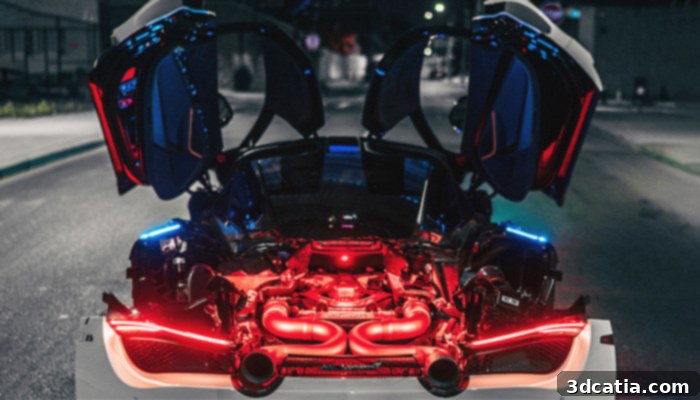
Custom aerodynamic parts enhancing performance | Credits: 1016 Industries
Beyond the 720S: Additive Manufacturing’s Broader Impact on the Automotive Industry
The American company, 1016 Industries, is not merely looking at the present; it is actively shaping the future. Their overarching goal is to leverage the unparalleled capabilities of 3D printing to tailor future automotive models even more precisely to the unique wishes and evolving needs of customers. This vision represents a profound innovation for the entire automotive industry, moving towards a paradigm of mass customization where individual preferences can be accommodated with unprecedented ease and efficiency. Imagine a future where vehicles are truly personal extensions of their owners, designed and built with specific aesthetic and performance demands in mind, all facilitated by the flexibility of additive manufacturing.
Beyond custom body kits for luxury sports cars, additive manufacturing is finding applications across the entire automotive value chain. It’s revolutionizing prototyping by dramatically reducing the time and cost associated with developing new components. Engineers can quickly print multiple design iterations, test them, and refine them in days rather than weeks. This acceleration of the R&D process allows for faster innovation and quicker deployment of new features and technologies. Furthermore, 3D printing is enabling the production of lightweight components with complex internal structures that are impossible to achieve with traditional manufacturing methods. These lighter parts contribute to improved fuel efficiency and reduced emissions, aligning with growing sustainability goals within the industry.
Several other automotive giants are also heavily investing in 3D printing, recognizing its transformative potential. Manufacturers like BMW, Porsche, Ford, and General Motors are utilizing additive manufacturing for various applications, including specialized tooling, jigs, and fixtures for assembly lines, and even producing functional end-use parts for their production vehicles. For instance, BMW has integrated 3D printed components into series production cars, such as specific interior brackets and exterior trim pieces. Porsche has explored 3D printing for classic car spare parts, ensuring the longevity of heritage vehicles. The ability to produce parts on demand, without the need for extensive inventory, holds significant implications for supply chain management and the future of spare parts logistics.
The journey of the McLaren 720S with 3D printed components is more than just a case study; it’s a powerful demonstration of what is possible when cutting-edge technology meets visionary engineering. It heralds an era where vehicle design is less constrained by manufacturing limitations and more driven by creative possibility and individual demand. As additive manufacturing technologies continue to evolve, become faster, and utilize an expanding array of advanced materials, their integration into mainstream automotive production will only deepen, promising a future of smarter, more efficient, and truly personalized vehicles. For more detailed information on the McLaren 720S body kits and the innovative work of 1016 Industries, you can explore their offerings HERE.
What are your thoughts on the groundbreaking use of 3D printing in high-performance vehicles like the new McLaren 720S? We’d love to hear your insights! Share your comments below or join the conversation on our Facebook and Twitter pages. To stay updated with all the latest advancements, innovations, and news in the world of 3D printing, make sure to sign up for our free weekly Newsletter, delivered straight to your inbox!