
MELD Manufacturing: Pioneering Solid-State Metal 3D Printing Beyond Traditional Fusion
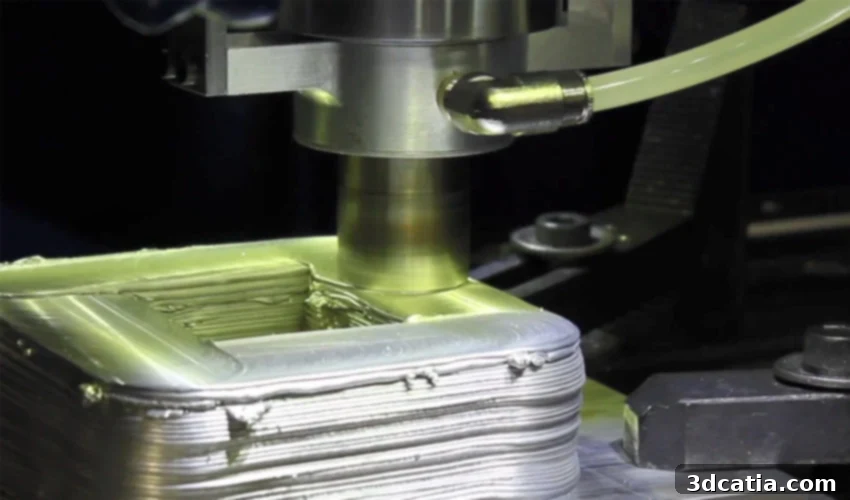
Established in 2018, MELD Manufacturing has emerged as a groundbreaking force in the additive manufacturing industry, introducing a unique metal 3D printer that radically departs from conventional approaches. While the vast majority of existing metal additive solutions rely on fusion processes – essentially melting metal powders or wires together with lasers or electron beams – MELD’s innovative technology operates through a fundamentally different mechanism: it harnesses the power of controlled friction and pressure to make metal malleable, shaping it without ever reaching its melting point. This solid-state process allows for the deposition of material layer by layer in the open air, completely eliminating the complexities and limitations associated with closed, inert gas-filled chambers that are typical for fusion-based systems. Beyond creating new parts, MELD technology offers significant capabilities for repairing existing components (similar to Directed Energy Deposition techniques), adding new features to an existing structure, or even re-coating surfaces. This versatility expands compatibility with a much broader range of metals and paves the way for the manufacturing of significantly larger parts than previously achievable. To delve deeper into this transformative process, we had the privilege of speaking with the company’s visionary founder and CEO, Nanci Hardwick.
3DN: Can you introduce yourself and elaborate on your journey within additive manufacturing?
Hello, I’m Nanci Hardwick, and my journey in additive manufacturing, specifically with the technology that became MELD, spans over a decade. I’ve been an entrepreneur dedicated to developing and refining what we now know as MELD technology. While the foundational research and development took many years, I officially launched MELD Manufacturing as a company two years ago to bring this revolutionary process to the market. My connection to additive manufacturing is rooted in the belief that there’s a more efficient, sustainable, and versatile way to work with metals, and MELD is the culmination of that pursuit.
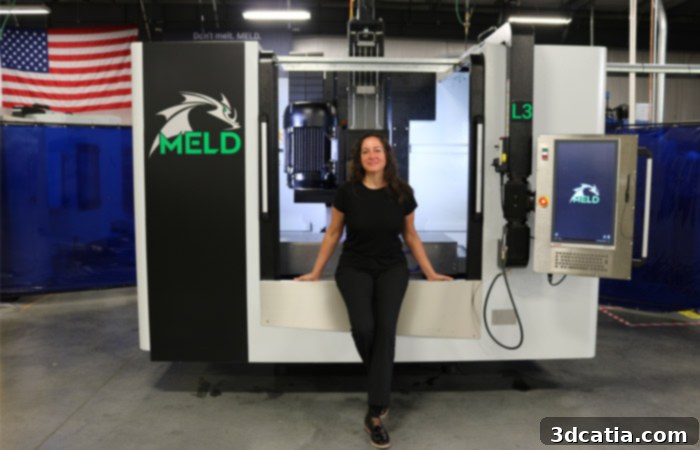
Nanci Hardwick in front of the MELD machine (photo credits: MELD Manufacturing)
3DN: What was your primary motivation behind establishing MELD Manufacturing?
My core belief is that MELD possesses the inherent capability to fundamentally redefine how we approach manufacturing across various industries. A significant driving force behind establishing the company was the profound potential MELD has to contribute to a genuine circular economy. Traditional manufacturing often generates substantial waste, leading to the discardment of valuable materials and parts. MELD directly addresses this by significantly reducing manufacturing waste and, crucially, enabling the reuse and repair of materials and components that would otherwise be deemed obsolete and sent to landfills. This focus on material efficiency and longevity is central to our mission. With MELD, we are actively advancing environmentally friendly manufacturing practices; our process is highly energy-efficient, minimizes material waste, and, perhaps most importantly, operates effectively in the open air, negating the need for energy-intensive and costly inert atmospheres. This all contributes to a more sustainable industrial future.
3DN: Can you explain the fundamental workings of your metal 3D printing technology?
MELD stands apart from virtually every other additive manufacturing process available today, establishing its own distinct category precisely because it does not melt metal. This is the critical differentiator. Instead, MELD relies on a sophisticated thermo-mechanical process that generates very high levels of pressure and friction at the interface of the material being deposited and the existing substrate. These precisely controlled forces induce plastic deformation in both the extruded material and the surface it’s being applied to. To clarify, plastic deformation refers to the irreversible structural transformation of a material, occurring through the rearrangement of its atomic lattice without changing its state from solid to liquid. This solid-state bonding ensures superior material properties. The versatility of MELD technology is truly remarkable because it can effectively utilize virtually any metal, from aluminum to titanium and steel, without the concerns of cracking or porosity often associated with melting-based methods. This inherent simplicity translates into highly predictable and consistent results, making it a robust and reliable manufacturing solution. Furthermore, MELD is incredibly fast, capable of printing large, complex parts at speeds far exceeding many traditional additive methods. Its singular ability to repair existing, often high-value, components is another testament to its unique and powerful capabilities, extending part lifespans and reducing operational costs significantly.
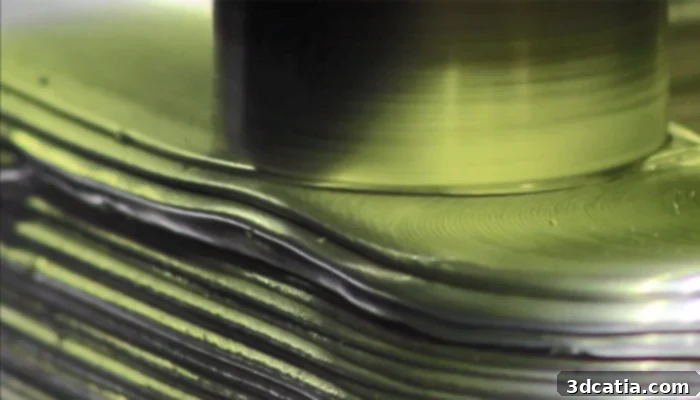
Photo Credits: MELD Manufacturing
3DN: What are the significant challenges associated with large-format metal 3D printing, and how does MELD overcome them?
The primary and most formidable obstacle to large-format metal 3D printing, which MELD has successfully and definitively overcome, revolves around the printing environment itself. For conventional fusion-based processes, a highly controlled and often expensive environment is non-negotiable. These methods necessitate specialized chambers filled with inert gases, such as argon, to protect the molten metal from oxidation and contamination as the part is being built. This requirement imposes severe limitations: beyond the substantial capital cost of these large, sealed chambers and the ongoing expense of inert gas, the sheer physical size of the chamber dictates the maximum dimensions of the parts that can be fabricated. This severely restricts the feasibility and scalability of producing very large metal components. In stark contrast, MELD technology completely sidesteps this melting process. Since the metal remains in a solid state throughout the deposition, there is no molten pool to protect from oxygen. Consequently, MELD can operate entirely in the open air, under ambient conditions. This fundamental difference makes our technology inherently scalable, allowing for the construction of parts that are only limited by the size of the machine’s gantry and work envelope, not by an expensive, environmentally controlled chamber. This open-air operation unlocks unprecedented possibilities for truly industrial-scale metal additive manufacturing, making large-format metal parts more accessible and cost-effective than ever before.
3DN: For what types of applications is MELD Manufacturing particularly well-suited?
MELD machines are designed for extreme versatility, capable of producing very large and complex parts using a comprehensive range of metals. This makes the technology suitable for a diverse array of applications across numerous industries. Whether users are looking to enhance existing components by adding critical features such as bosses, flanges, or reinforcing ribs, or are engaged in building entirely new, complex parts from scratch, MELD offers a robust solution. Furthermore, its unparalleled ability to repair and restore high-value components — from aerospace parts to heavy industrial equipment — is a game-changer. The beauty of the MELD system is that a single machine can seamlessly address all these varied needs: fabrication of new components, enhancement of existing ones, and critical repair operations. This multi-functional capability significantly streamlines manufacturing workflows and maximizes equipment utilization, offering immense value to industries seeking flexibility and efficiency in metal processing. From energy to defense, marine, and aerospace sectors, MELD’s broad applicability is revolutionizing how these industries think about metal part production and maintenance.
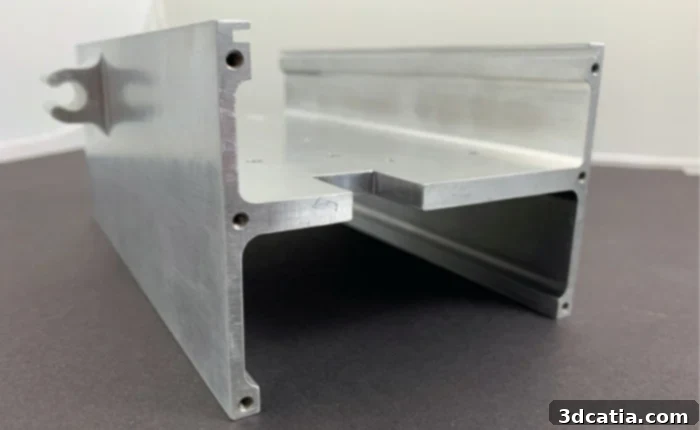
A 3D printed part made with MELD technology (photo credits: MELD Manufacturing)
3DN: Who is your machine designed for, and what are its key advantages for specific materials?
MELD technology offers substantial benefits for a wide array of industries, but some of the most profound advantages are realized when printing light, high-strength metals. Take titanium, for example, a material renowned for its excellent strength-to-weight ratio and corrosion resistance, making it indispensable in aerospace, medical, and defense sectors. However, titanium is notoriously expensive, and traditional manufacturing methods, especially those involving subtractive processes like machining, generate immense waste. It’s common for up to 90% of the initial titanium billet to be machined away to create a final part – an astounding 90% waste of a very costly material. By utilizing MELD to print these same titanium parts, we employ an additive approach where material is only deposited where it’s needed. This drastically reduces material consumption and, consequently, the associated costs. For instance, Ti64 (Titanium 6-4 alloy) parts printed with MELD technology consistently exceed the ASTM standards for equivalent forged materials. This means that parts previously only achievable through the complex, time-consuming, and expensive forging process can now be produced additively, often with superior properties. Beyond the material savings, the impact on manufacturing lead times is revolutionary. Industries currently face lead times of two years or more for certain large forged titanium components. With MELD, these timelines can be compressed from years to mere hours or days, delivering an unparalleled combination of reduced cost, minimized waste, and dramatically accelerated production. This represents a monumental shift for supply chains reliant on these critical, high-performance metals.
3DN: What are MELD Manufacturing’s key future projects and strategic directions?
Looking ahead, MELD Manufacturing is actively engaged in several exciting future projects and strategic initiatives designed to expand our impact and capabilities. A significant area of focus involves further development with other high-value materials. Many of these specialized metals present significant challenges, or are entirely incompatible, with traditional fusion-based additive manufacturing processes due to issues like cracking, residual stress, or oxidation. MELD’s solid-state process circumvents these issues, unlocking new possibilities for materials that were previously deemed “unprintable” in an additive context. We are committed to pushing the boundaries of material science and application. Furthermore, a major strategic objective for 2021 and beyond is to substantially expand our international distribution network. We recognize the global demand for a more efficient and sustainable metal manufacturing solution, and we are working to make MELD technology accessible to a broader international customer base. Alongside this, we plan to continually enhance and add to our equipment offering, introducing new machine models and capabilities that address evolving industry needs and application demands. This involves ongoing research and development to improve machine performance, expand build volumes, and enhance automation, ensuring MELD remains at the forefront of metal additive manufacturing innovation.
3DN: Do you have any final thoughts or words of advice for our readers?
While the incredible part size capabilities and the exceptional material performance achieved with MELD technology are undoubtedly exciting, I want to re-emphasize and underscore the profound importance of MELD’s ability to repair existing parts. In a world increasingly focused on sustainability and resource conservation, the concept of reuse is not merely beneficial; it is absolutely essential for our environment and for fostering a truly circular economy. Beyond the ecological imperative, there’s a significant economic advantage. The ability to add just a few millimeters of material to a worn or damaged, high-value component can literally save hundreds of thousands, if not millions, of dollars by avoiding the costly replacement of entire assemblies. This repair capability transforms what would be scrap into valuable, operational assets, extending their lifespan and reducing overall operational expenditures. We encourage everyone to explore this game-changing technology further and discover its full potential. You can find more comprehensive information about MELD Manufacturing and our innovative solutions HERE.
What are your thoughts on MELD’s distinctive solid-state metal manufacturing technique and its implications for the future of industrial production? We’d love to hear your insights! Please share your comments below or engage with us on our Facebook, Twitter, and LinkedIn pages. Don’t forget to sign up for our free weekly Newsletter here to receive the latest 3D printing news directly in your inbox!