
Renishaw and Sandvik Unite to Qualify Next-Generation Additive Manufacturing Materials for Production
In a significant move poised to accelerate industrial adoption of advanced manufacturing techniques, Renishaw, a leading UK-based engineering company renowned for its precision measurement and additive manufacturing (AM) systems, is embarking on a strategic collaboration with Sandvik Additive Manufacturing. This partnership focuses on the crucial task of qualifying new, high-performance additive manufacturing materials for robust production applications. Sandvik, a global leader in materials technology, has been making headlines throughout the year, notably with the unveiling of the world’s first 3D printed diamond composite material at Rapid + TCT in May. The recent announcement solidifies their joint effort to qualify innovative alloy compositions specifically optimized for Laser Powder Bed Fusion (LPBF) technology, promising to push the boundaries of metal 3D printing.
This synergistic alliance is not a new venture for these industry pioneers. Sandvik has been actively utilizing Renishaw’s advanced AM systems at its state-of-the-art Additive Manufacturing Centre in Sandviken, Sweden, since 2018. Over this period, the companies have cultivated a close working relationship, channeling their combined expertise into the meticulous development of precise process parameters for a diverse array of Sandvik’s high-quality metal powders. This extensive research and development has encompassed essential materials such as various stainless steels, high-strength maraging steels, and the very latest iterations of Osprey nickel-based superalloys. The ongoing collaboration is a testament to their shared commitment to material innovation and process optimization within the rapidly evolving additive manufacturing landscape.
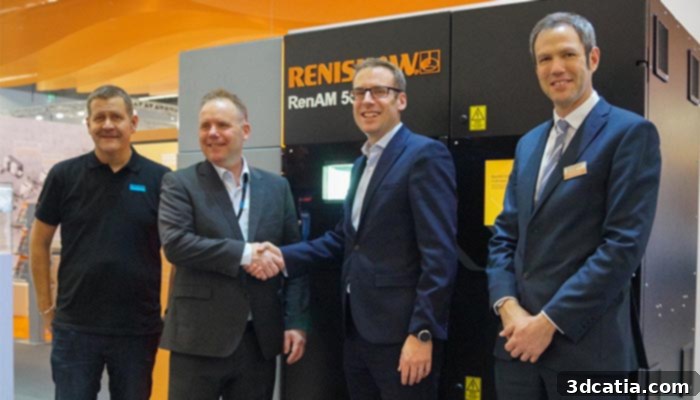
The Sandvik and Renishaw partnership | Credits: Renishaw
Mikael Schuisky, VP R&D and Operations at Sandvik Additive Manufacturing, articulated the profound impact of this collaboration, stating: “Sandvik now offers the widest range of AM materials to the market. Renishaw’s open machines have enabled us to rapidly optimise process parameters for our alloys for use in many different applications.” This emphasis on “open machines” highlights a critical advantage in accelerating material development. Renishaw’s systems provide the flexibility necessary for engineers and material scientists to fine-tune parameters, which include laser power, scan speed, layer thickness, and powder bed temperature, without proprietary restrictions. This openness allows Sandvik to conduct extensive experimentation and optimization, ultimately leading to superior mechanical properties in the LPBF components. Notable achievements stemming from this collaborative optimization include a maraging steel exhibiting significantly enhanced strength and hardness, along with a groundbreaking crack-free Osprey HX nickel superalloy – a material often challenging to process without defects, showcasing a true advancement in metal AM capabilities.
The ability to precisely control these process parameters is paramount for the successful application of Laser Powder Bed Fusion (LPBF). This additive manufacturing technique works by selectively melting layers of metal powder using a high-power laser, fusing them together to build complex three-dimensional parts layer by layer. The quality and performance of the final component are highly dependent on the interplay between the material properties of the metal powder and the precise control of the LPBF process. For critical industrial applications, achieving consistent, repeatable mechanical properties – such as tensile strength, ductility, fatigue resistance, and hardness – is non-negotiable. This is where the deep metallurgical expertise of Sandvik, combined with the precision engineering of Renishaw’s AM systems, creates a powerful synergy, enabling the development of materials and processes that meet the stringent demands of aerospace, medical, automotive, and other high-tech sectors.
It is an undeniable truth that materials are just as, if not more, critical as the hardware itself for the widespread adoption and advancement of additive manufacturing. This segment of the AM industry is currently experiencing a significant boom, a trend meticulously documented and highlighted by the influential Wohlers Report, a global benchmark for the additive manufacturing industry, published in March 2019. Stephen Crownshaw, AM Business Manager at Renishaw, aptly summarized this evolving landscape: “Much of the innovation in AM in the next few years will come from the pairing of enhanced machine performance with improved alloys. Better alloys mean better material properties, enabling the manufacture of AM components that are even more efficient and cost-effective. The consistency of Renishaw’s latest AM systems, combined with Sandvik’s material expertise, provides tremendous opportunities to advance AM processes and to make a stronger business case for AM.” This sentiment underscores the strategic importance of material science in driving the next wave of additive manufacturing applications. The ability to tailor materials to specific performance requirements unlocks unprecedented design freedom and manufacturing efficiencies, moving AM beyond prototyping into high-volume, critical part production.
Renishaw’s commitment to developing highly consistent and reliable AM systems plays a pivotal role in this equation. Repeatability and accuracy are fundamental to achieving predictable material properties and ensuring that components manufactured at different times or on different machines perform identically. This consistency is crucial for industries where component failure can have severe consequences, such as in aerospace engines or medical implants. By providing a stable and precise platform, Renishaw enables Sandvik to focus on innovating material compositions and processing parameters, knowing that the machine itself will execute the build with utmost fidelity. This synergy between advanced machine technology and cutting-edge material science is precisely what is needed to transition additive manufacturing from niche applications to mainstream industrial production.
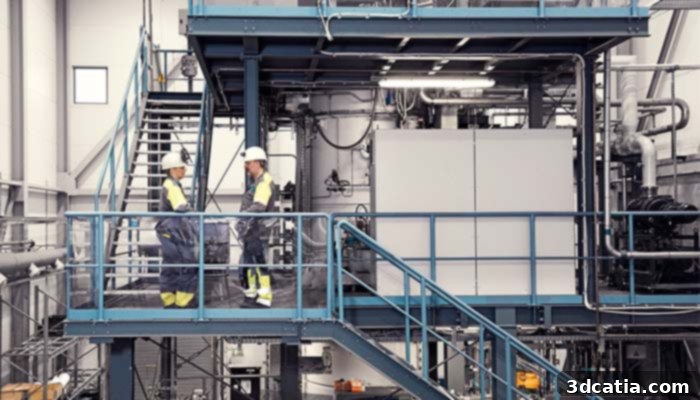
Sandvik metal powder plant in Sandviken | Credits: Renishaw
Beyond merely qualifying materials for sale to other manufacturers, Sandvik is leveraging this expertise to develop its own range of innovative additive production applications. A prime example of this internal application is the creation of advanced AM variants of its renowned cutting tools. One particularly compelling instance is the Sandvik Coromant’s lightweight CoroMill® 390 milling cutter, manufactured from titanium. This revolutionary tool boasts an impressive 80% weight reduction compared to a conventional tool of similar function. Such a significant reduction in mass translates directly into substantial productivity gains in metal-cutting operations, with improvements reaching up to 200%. This is achieved through higher spindle speeds, reduced vibration, and longer tool life, all contributing to more efficient and cost-effective machining processes. This innovative product has successfully transitioned into series production on the RenAM 500Q system, a high-productivity multi-laser AM machine, and was officially launched on the market in April of this year, demonstrating the tangible industrial impact of the Renishaw-Sandvik collaboration.
The success of the CoroMill® 390 milling cutter serves as a powerful case study for the broader potential of metal additive manufacturing when coupled with material science innovation. It showcases how design freedom, enabled by 3D printing, combined with optimized material properties, can lead to products that are not just incrementally better, but fundamentally transformative. The lightweighting achieved with titanium through LPBF allows for tools that can operate at higher performance levels, reduce energy consumption, and extend the lifespan of machinery, thereby offering significant economic and environmental benefits. This capability is especially critical for industries constantly seeking to reduce operational costs and improve throughput while maintaining or enhancing product quality. The collaboration between Renishaw and Sandvik is thus not just about developing new materials; it’s about pioneering new manufacturing paradigms that deliver unprecedented value across various industrial sectors.
This partnership symbolizes a vital step forward for the entire additive manufacturing ecosystem. By systematically qualifying and optimizing new alloys for LPBF technology, Renishaw and Sandvik are addressing one of the most significant barriers to AM adoption: the availability of robust, thoroughly characterized materials suitable for demanding end-use applications. Their joint efforts are paving the way for a future where advanced metal components, custom-designed and perfectly tailored to their function, can be produced efficiently, reliably, and cost-effectively, fundamentally changing how industries approach design, production, and supply chains.
You can find more information about Renishaw’s innovative solutions and technologies HERE.
What are your thoughts on this groundbreaking collaboration and its potential impact on the future of industrial additive manufacturing? We invite you to share your insights in a comment below or join the discussion on our Facebook and Twitter page! Don’t forget to sign up for our free weekly Newsletter to receive all the latest news and developments in 3D printing delivered straight to your inbox!