
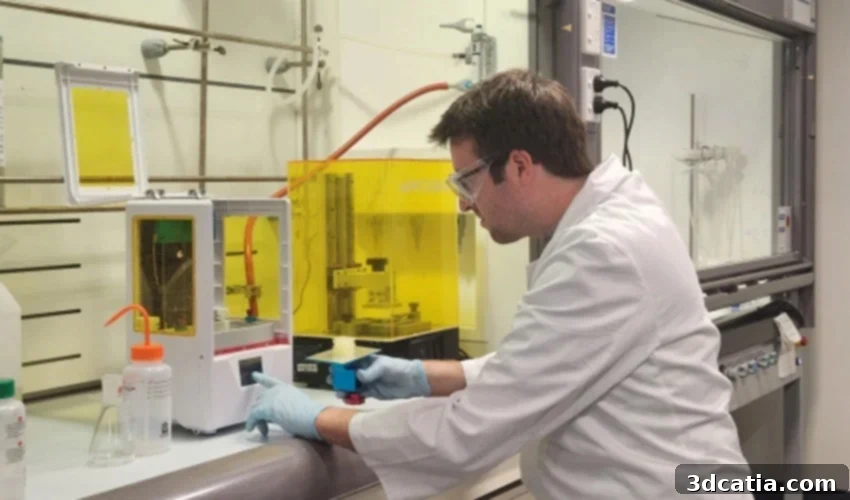
Pioneering Energy Storage: UNSW Achieves World-First 3D Printing of Solid-State Polymer Electrolytes
In a groundbreaking development that promises to revolutionize energy storage, a dedicated team of researchers at the University of New South Wales (UNSW) in Sydney, Australia, has successfully 3D printed solid-state polymer electrolytes. This remarkable achievement, accomplished using a standard desktop 3D printer, allows for the creation of custom-shaped electrolytes with unprecedented control over their properties. This innovation holds immense potential for a wide array of advanced applications, particularly in compact electronic and medical devices, as well as critical aerospace components, where efficient and reliable energy storage is paramount. The resulting electrolytes are not only expected to exhibit superior conductivity but also impressive mechanical strength, overcoming a long-standing trade-off in material science.
To fully appreciate the significance of this breakthrough, it’s essential to understand the fundamental role of an electrolyte. At its core, an electrolyte is a substance, which can be either liquid or solid, capable of conducting an electric charge through the movement of ions—either positive or negative. In the context of batteries, electrolytes act as the medium through which ions travel between the anode and cathode, facilitating the flow of electricity. Polymer electrolytes, such as those utilized in this pioneering study, are characterized by a matrix of organic polymers embedded with mobile ions. They are crucial components in modern lithium batteries, primarily because they contribute to enhanced energy density and significantly improve battery safety by mitigating the risks associated with flammable liquid electrolytes. The ability to 3D print these sophisticated materials opens up a world of possibilities, enabling UNSW researchers to design and produce electrolytes in virtually any complex shape, thus catering to even the most intricate and demanding applications.
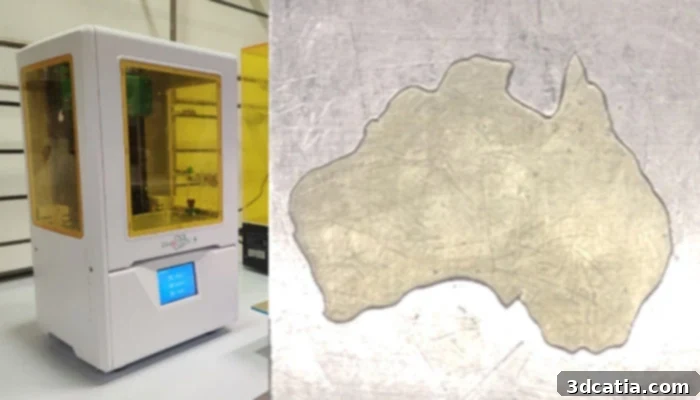
A map of Australia made of 3D printed solid polymer electrolytes (photo credit: Dr. Corrigan)
This achievement is undeniably a world first in the field of additive manufacturing and materials science. Kenny Lee, one of the key researchers involved in the UNSW team, articulated the magnitude of their accomplishment, stating, “Nobody has 3D printed solid polymer electrolytes before. Traditionally they have been made using a mould, but previous processes did not offer the ability to control the strength of the material, or to form it into complex shapes.” Lee further emphasized the critical challenge they overcame: “With existing solid-state electrolytes when you increase the mechanical strength of the material, you sacrifice a lot of the conductivity. If you want higher conductivity the material is much less robust. What we have achieved is a simultaneous combination of both, which can be 3D printed into sophisticated geometries.” This statement highlights the core of the breakthrough: successfully developing a solid polymer electrolyte that simultaneously boasts high ion conductivity for efficient energy transfer and robust mechanical strength for durability and practical application. This dual benefit addresses a fundamental trade-off that has historically hampered the development and widespread adoption of solid-state battery technologies.
While specific details about the exact model of the 3D printer remain limited, the researchers have indicated that the process was carried out on a desktop resin 3D printer, underscoring the accessibility and replicability of their method. The material itself is described as a rigid, cross-linked polymer matrix designed to incorporate highly efficient nanoscale ion-conducting channels. These minute channels are critical for facilitating the rapid and efficient movement of ions, which is essential for high conductivity in the solid state. To rigorously test the mechanical integrity and electrochemical performance of this novel development, the UNSW team embarked on a creative and highly visible demonstration: they 3D printed a map of Australia using these advanced electrolytes. This intricate map was then put to the test as an actual energy storage device. The results, as reported by Dr. Corrigan, another integral member of the research team, were nothing short of excellent, far exceeding expectations.
Dr. Corrigan elaborated on a crucial performance metric, cycling stability, which is vital for the longevity and reliability of any energy storage system. She explained, “One of the other benefits of this SPE in energy storage devices is the fact it increases the cycling stability – that is the number of charging and discharging cycles until its capacity is reduced to a certain amount. In our paper, we show that this material is very stable and has the ability to charge and discharge over thousands of cycles. After 3000 cycles there was only roughly a 10 per cent drop.” This remarkable stability signifies a major leap forward for battery technology, as it implies significantly extended lifespan for devices powered by these electrolytes. For consumers, this translates to longer-lasting batteries in their electronics, while for industrial and mission-critical applications, it means enhanced reliability and reduced maintenance. The minimal degradation after thousands of cycles positions these 3D printed solid-state polymer electrolytes as a highly promising candidate for next-generation energy storage solutions.
The implications of this research are far-reaching. The ability to precisely control the shape, strength, and conductivity of electrolytes through 3D printing offers unparalleled design freedom. This means that battery components can now be custom-tailored to fit within highly constrained spaces, enabling more compact and ergonomically designed devices. For small electronic gadgets, wearables, and sensors, this could lead to sleeker designs and improved functionality. In the medical field, implantable devices and portable diagnostic tools could benefit from safer, more durable, and custom-fit energy sources. The aerospace industry, constantly seeking lightweight yet robust components, could integrate these custom-shaped electrolytes into aircraft and spacecraft, optimizing both performance and safety under extreme conditions. Furthermore, the inherent safety advantages of solid-state electrolytes, eliminating the risk of leakage and flammability associated with liquid electrolytes, make them ideal for sensitive applications where failure is not an option.
Looking ahead, the UNSW team’s ultimate goal is to further enhance the storage density of these 3D printed electrolytes. Achieving even higher energy densities would dramatically expand the realm of possibilities and associated applications, potentially paving the way for revolutionary advancements in larger-scale energy storage solutions, including electric vehicles and grid-level storage, although the immediate focus remains on smaller devices. This ongoing research underscores UNSW’s commitment to pushing the boundaries of materials science and additive manufacturing, positioning Australia at the forefront of sustainable energy innovation. This breakthrough serves as a testament to the power of interdisciplinary research and the transformative potential of 3D printing in developing advanced materials for a more energy-efficient and safer future.
What are your thoughts on these pioneering 3D printed solid-state electrolytes and their potential to transform energy storage? We encourage you to share your insights and engage with our community by leaving a comment below or connecting with us on our LinkedIn, Facebook, and Twitter pages! Don’t miss out on the latest advancements in additive manufacturing—sign up for our free weekly Newsletter here to receive the most current 3D printing news directly in your inbox. You can also explore all our informative videos and content on our YouTube channel for more in-depth coverage.
*Cover Photo Credits: Dr. Corrigan