
Unveiling the Future: Top 5 Groundbreaking 3D Printing Innovations This Week
Welcome to our weekly dive into the most fascinating advancements in the world of additive manufacturing. This week’s Top 5 Videos showcase a remarkable spectrum of 3D printing applications, featuring pioneering work from industry leaders like Stratasys, HP, and Michelin, among others. These captivating visuals demonstrate how 3D printing is not just a technology of the future but a transformative force actively reshaping critical sectors such as healthcare, personal safety, and even the culinary arts. From life-saving surgical planning to eco-friendly tire innovations and personalized consumer products, the versatility and impact of 3D printing continue to astound. Make sure to check back every Sunday for a fresh compilation of the latest and most impactful 3D printing news and developments!
1 – Stratasys: Revolutionizing Surgical Planning with 3D Printing
The medical field is experiencing a profound paradigm shift thanks to the capabilities of 3D printing, and this video from Stratasys powerfully illustrates its life-changing potential. Historically, aspiring surgeons, especially those at the junior level, faced significant hurdles in gaining practical experience with complex anatomies before performing real-life procedures. The inability to effectively create realistic, patient-specific models of organs meant that initial surgeries often carried higher risks due to limited hands-on preparation. Surgeons were often less skilled and prepared for situations where the stakes were literally life and death.
Enter 3D printing. This revolutionary technology empowers medical professionals to fabricate highly accurate, tactile replicas of human organs and anatomical structures directly from patient scan data (CT, MRI). These intricate models provide an unparalleled opportunity for surgical teams to thoroughly plan complex procedures, anticipate potential challenges, and practice intricate maneuvers in a risk-free environment. For junior surgeons, this translates into invaluable pre-operative training, allowing them to hone their skills, understand spatial relationships, and develop muscle memory before stepping into the operating room. The result is better-prepared surgeons, reduced operative times, minimized intraoperative complications, and ultimately, a significant decrease in patient fatalities and improved outcomes in surgical procedures. This innovation underscores 3D printing’s critical role in advancing medical education, personalized patient care, and enhancing overall surgical safety.
2 – Sculpteo & HP: Redefining Personal Safety with 3D Printed Bike Helmets
In a remarkable collaboration that pushes the boundaries of personal safety and product customization, Syncro Innovation and Sculpteo have partnered with HP to completely reimagine the traditional bike helmet. Leveraging HP’s advanced Multi Jet Fusion (MJF) additive manufacturing technologies, they are introducing a new era of bike helmets that are not only safer but also custom-fitted to each individual’s head geometry. Traditional helmets often offer a one-size-fits-most approach, leading to compromises in fit, comfort, and ultimately, protection. This standardization can result in gaps between the helmet and the head, reducing impact absorption effectiveness and causing discomfort during long rides.
The innovation here lies in creating truly personalized helmets. By using sophisticated scanning techniques to capture a rider’s unique head shape, Syncro Innovation and Sculpteo can generate a digital model that is then precisely manufactured using HP’s MJF technology. This allows for a myriad of benefits: a superior, snugger fit that dramatically enhances safety by ensuring optimal impact distribution; improved comfort through better ventilation and reduced pressure points; and even better hygiene, as materials and designs can be optimized for breathability and ease of cleaning. Furthermore, the design freedom offered by 3D printing means complex internal lattice structures can be engineered for superior energy absorption and lighter weight. This project exemplifies how additive manufacturing is revolutionizing protective gear, moving beyond mass-produced items to offer highly personalized, performance-optimized solutions for consumers, setting a new standard for safety and comfort in active lifestyles.
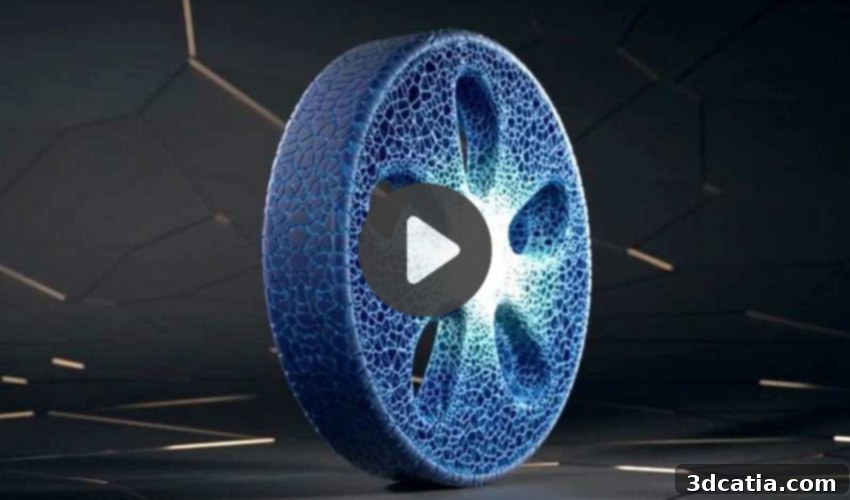
3 – Michelin’s Visionary 3D Printed Airless Tires: A Leap Towards Sustainable Mobility
This video offers an awe-inspiring glimpse into the future of automotive technology and sustainable engineering, showcasing Michelin’s groundbreaking 3D printed airless tires. Conventional pneumatic tires, while ubiquitous, present several challenges: they are susceptible to punctures and flats, require regular pressure checks, and their disposal contributes significantly to landfill waste at the end of their relatively short lifespan. Michelin’s innovative approach addresses these issues head-on, presenting a vision of transportation that is safer, more efficient, and environmentally conscious.
These revolutionary tires are designed to be airless, completely eliminating the risk of flats and punctures, thereby enhancing driver safety and convenience. What’s even more impressive is their composition: they are crafted from advanced biodegradable materials, signifying a major step towards reducing the ecological footprint of the automotive industry. Moreover, these 3D printed tires are engineered for exceptional durability, boasting an estimated lifespan of around five years – significantly longer than traditional tires. Their design also allows for easy retreading and customization of tread patterns based on driving conditions, extending their utility and further reducing waste. This forward-thinking design, often associated with Michelin’s VISION concept, envisions a future where tires are not just replaceable parts, but smart, sustainable, and connected components of a vehicle, offering unparalleled performance and contributing positively to a circular economy. This innovation is not merely about a new product; it’s a testament to how additive manufacturing can drive profound changes in sustainability and redefine our relationship with critical vehicle components.
4 – Migo 3D Printer: Democratizing Additive Manufacturing for the Masses
The Migo 3D printer by Makex represents a pivotal moment in the consumer 3D printing market, embodying the ideals of accessibility and affordability. This video highlights its core strengths: a design focused on being cheap, versatile, and incredibly simple to use, positioning it as a potential game-changer for everyday consumers. For many years, 3D printing remained a niche technology, often perceived as complex and expensive, limited to industrial applications or dedicated hobbyists with technical expertise. The Migo printer seeks to dismantle these barriers.
With an astonishing price point of just $149, the Migo 3D printer makes additive manufacturing attainable for a much broader audience. Its user-friendly interface and plug-and-play functionality mean that even novices can quickly get started. Consumers can simply plug it in, load their favorite designs from online repositories or personal creations, and embark on their printing journey. This ease of use, combined with its compact size and competitive pricing, makes the Migo an ideal tool for households, students, educators, and small businesses looking to experiment with 3D printing without a substantial financial commitment or steep learning curve. The ability to easily print prototypes, custom parts, educational models, artistic creations, or even small household repairs opens up a world of creative possibilities. The Migo 3D printer is poised to democratize access to personal fabrication, fostering innovation and a DIY spirit across the consumer market, and potentially inspiring a new generation of makers and designers.
5 – The Art of Edible Innovation: Exploring 3D Printed Desserts
Prepare for a tantalizing experience, as this video is almost guaranteed to awaken your sweet tooth! We’ve previously reported on the incredible work of a 3D printing pastry chef, and this latest feature showcases yet another delightful facet of 3D printed edibles. The realm of culinary arts is being dramatically transformed by additive manufacturing, offering unprecedented levels of precision, customization, and artistic expression, especially within the world of desserts. Imagine chocolates, candies, and other sweet treats being crafted with intricate geometries and delicate textures that are nearly impossible to achieve through traditional hand molding or automated processes.
This video highlights how various confections can be precisely 3D printed, allowing for their creation with remarkable autonomy and extreme accuracy. From complex chocolate sculptures to personalized sugar decorations and multi-layered gel desserts, the capabilities are vast. 3D food printers operate by extruding food-grade materials layer by layer, enabling designers and chefs to produce bespoke designs, control portion sizes, and even experiment with novel flavor combinations and textural experiences. This technology offers significant advantages for high-end restaurants seeking to create unique dining experiences, for personalized gifts, and for specialized dietary requirements. The automation aspect not only streamlines production but also ensures consistency and reduces manual labor. We confidently predict that 3D printed desserts and other edible innovations will become increasingly common in the culinary landscape over the next few years, transforming how we perceive and consume food, and pushing the boundaries of gastronomic artistry and personalization.
The innovations highlighted in these videos are just a small glimpse into the rapidly evolving landscape of 3D printing. From critical advancements in healthcare and personal safety to revolutionary strides in sustainable transportation and delightful culinary creations, additive manufacturing continues to prove its immense potential across diverse industries. The ability to rapidly prototype, customize, and produce complex geometries is driving progress that was unimaginable just a few years ago. We are excited to witness how these technologies will continue to shape our future, making processes more efficient, products more personalized, and our world more sustainable.
Do you have any thoughts on these incredible 3D printing applications, or perhaps opinions on the current intellectual property state surrounding additive manufacturing? We’d love to hear from you! Share your insights in a comment below, or connect with us on our Facebook and Twitter pages. And for those who want to stay at the forefront of this dynamic industry, don’t forget to sign up for our free Newsletter. Get all the latest news, breakthrough innovations, and exclusive insights in 3D printing delivered straight to your inbox every week!