
Carbon L1: The Future of Large-Scale 3D Printing Powers Adidas Futurecraft and Riddell Custom Helmets
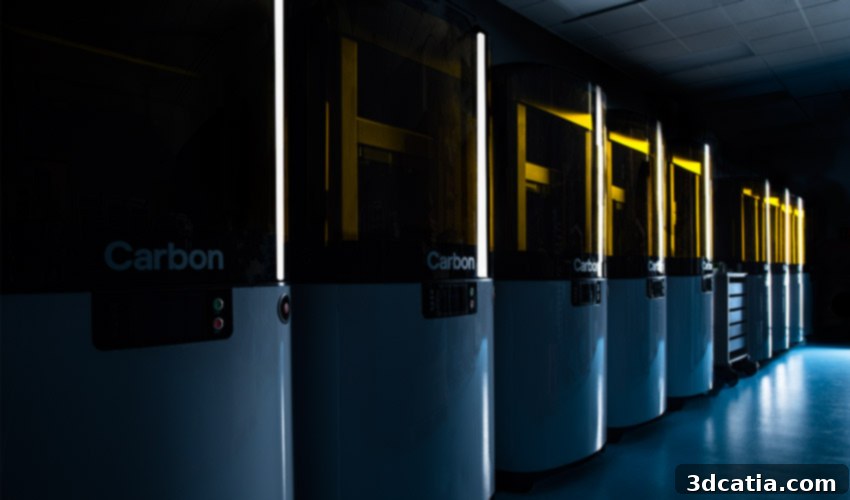
The landscape of additive manufacturing is continually evolving, driven by innovations that push the boundaries of production scale and material capabilities. Leading this charge, the pioneering manufacturer Carbon has officially unveiled its latest advancement in industrial 3D printing: the L1. This groundbreaking large-scale 3D printer marks a significant leap forward from its predecessors, the M1 and M2, building upon the same foundational Digital Light Synthesis (DLS) technology that has established Carbon as a leader in the field. The L1 boasts an impressive build area, expanding approximately five times that of the M2 and a staggering ten times that of the original M1. This exponential increase in production capacity is strategically designed to meet the escalating demands of industrial partners seeking high-volume manufacturing solutions, paving the way for unprecedented scalability in digital fabrication across various sectors.
Carbon’s Revolutionary Digital Light Synthesis (DLS) Technology Explained
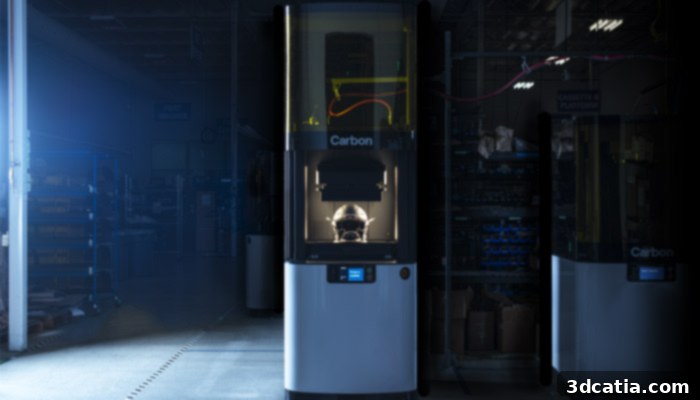
At the heart of Carbon’s innovative additive manufacturing platform lies its proprietary Digital Light Synthesis (DLS) technology, which combines two critical components: Continuous Liquid Interface Production (CLIP) and specialized resin materials. Unlike traditional layer-by-layer 3D printing methods, CLIP utilizes a continuous process that rapidly converts a liquid resin into solid parts. This is achieved by carefully balancing UV light, which cures the resin, and oxygen, which creates a “dead zone” or unreactive interface below the printed part. This allows the part to be pulled continuously from the resin bath, resulting in exceptionally smooth surfaces, isotropic mechanical properties, and significantly faster production speeds.
The American manufacturer’s DLS technology has captivated numerous industries due to its ability to produce functional, end-use parts with engineering-grade materials at speeds and qualities previously unattainable with other additive manufacturing processes. This unique combination of speed, material versatility, and part performance has already attracted major global players. Notably, sports giants Adidas and Riddell have leveraged the capabilities of Carbon’s DLS technology, demonstrating its transformative potential in product design and manufacturing. Their early adoption of Carbon’s platform, including the new L1, showcases how digital manufacturing is revolutionizing product development cycles and enabling mass customization.
The Carbon L1: Scaling Up Industrial 3D Printing for High-Volume Production
The introduction of the Carbon L1 represents a monumental stride in scaling additive manufacturing for true industrial production. While the M1 and M2 printers proved the viability of Carbon’s DLS technology for professional applications and mid-volume runs, the L1 is engineered for a different league entirely – high-volume, mass customization. Its dramatically expanded build volume allows manufacturers to produce larger parts or a significantly greater quantity of smaller parts in a single print run, thereby enhancing throughput and reducing per-part costs. This capability is paramount for companies looking to transition from traditional manufacturing methods to more agile and digitally-driven production lines.
Carbon emphasizes that the L1 is more than just a larger printer; it’s an integral part of an end-to-end digital manufacturing platform. This comprehensive ecosystem seamlessly integrates Carbon’s advanced software, robust hardware, and proprietary resin materials. This holistic approach ensures optimized performance, streamlined workflows, and consistent quality across all stages of production, from initial design and simulation to final part fabrication. For instance, in the case of Riddell’s pioneering application, the L1 platform facilitates the creation of highly customized components, demonstrating the true power of this integrated workflow for specialized industrial needs.
Transforming Sports Footwear: Adidas and the Futurecraft 4D Midsoles
One of the most prominent success stories demonstrating the power of Carbon’s DLS technology is its ongoing partnership with Adidas. The global sportswear innovator has leveraged Carbon’s printers, including the L1, to produce the distinctive Futurecraft 4D midsoles. These revolutionary midsoles are a testament to the potential of additive manufacturing for mass customization in consumer goods. In 2018 alone, Adidas produced an impressive 100,000 pairs of these advanced midsoles, a feat that would be incredibly challenging, if not impossible, with conventional manufacturing techniques. The inherent advantages of Carbon’s technology – precision, speed, and the ability to create complex lattice structures – are perfectly suited for footwear applications, allowing for the design of midsoles that offer optimized cushioning, stability, and energy return tailored to individual athlete needs.
The Futurecraft 4D project goes beyond mere aesthetics; it represents a paradigm shift in how performance footwear can be designed and manufactured. By utilizing Carbon’s DLS process, Adidas can rapidly iterate designs and produce intricate lattice structures that are lightweight yet incredibly durable and responsive. This level of customization and performance optimization was previously unimaginable at scale. Looking ahead, Adidas has ambitious plans to significantly expand production, aiming for millions of pairs in the coming years. This mass production goal is precisely where the larger capacity of the Carbon L1 becomes critical, enabling Adidas to bring highly personalized, performance-enhancing footwear to a broader global market.
Enhancing Athlete Safety: Riddell’s Custom Helmet Liners
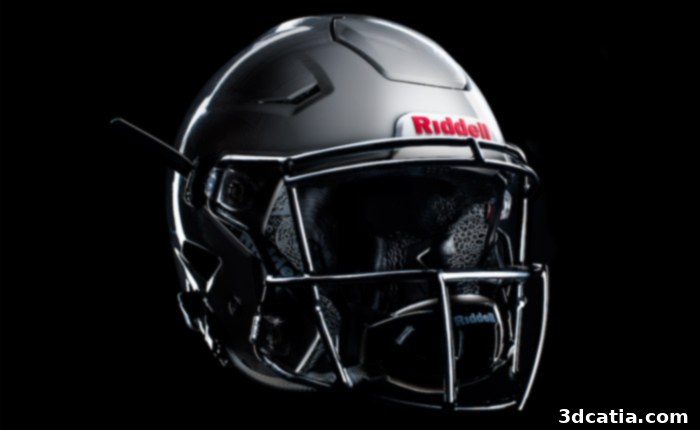
Another trailblazing application of Carbon’s L1 Digital Light Synthesis technology is its collaboration with Riddell, the renowned leader in football protective gear. In a pioneering move for the 2018 season, Riddell utilized the L1 to create highly customized helmet liners for select NFL players. This innovation underpins Riddell’s new Diamond helmet, where each liner is meticulously crafted to precisely fit the unique head geometry of an individual athlete. This level of personalization dramatically enhances both comfort and, more importantly, protection – critical factors in high-impact sports like football.
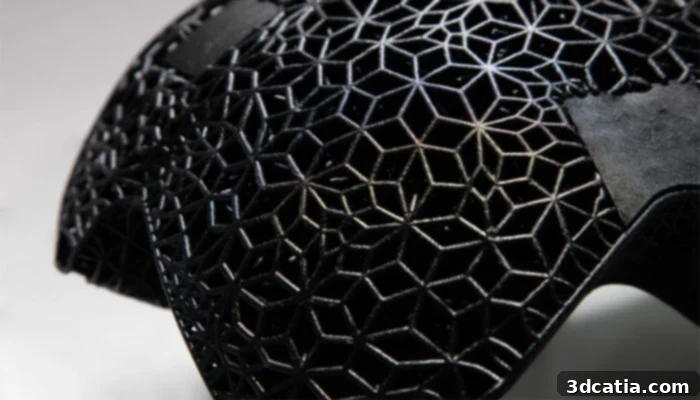
The core of this groundbreaking protective equipment lies in a custom-designed, highly damping elastomer material provided by Carbon. This material is precisely formed into an intricate lattice structure, which is optimized to absorb and dissipate impact forces effectively. The unique lattice design is not arbitrary; it is generated using Carbon’s sophisticated Lattice Engine software. This powerful software employs advanced physical simulation and optimization techniques to maximize the structural performance of the helmet liner, ensuring superior energy management and protection. Such tailored solutions represent a significant leap forward in athlete safety, moving beyond one-size-fits-all approaches to highly individualized protective gear. Riddell announced that these customized helmets would be commercially available on a limited basis starting in 2019, marking a new era for sports equipment manufacturing.
A Vision for the Future: Carbon’s Leadership in Digital Manufacturing
The leadership at Carbon is deeply invested in harnessing technology to drive innovation across industries. Joseph DeSimone, Carbon CEO and co-founder, articulated this vision, stating, “At Carbon, we believe in using the power of technology to advance innovation. Our platform enables companies like Riddell to make products that were never thought possible. With this partnership, Riddell becomes one of the largest users of 3D printers in the world. We are proud to be at the forefront of digital manufacturing of protective equipment.” This statement underscores Carbon’s commitment not only to developing cutting-edge hardware but also to fostering partnerships that translate technological prowess into tangible, life-improving products. The collaboration with Riddell exemplifies how digital manufacturing can lead to significant advancements in safety and performance, setting new benchmarks for protective gear.
Riddell’s Commitment to Innovation and Player Protection
Riddell’s dedication to player safety and continuous innovation is evident in their strategic adoption of Carbon’s advanced manufacturing capabilities. The company’s Senior Vice President of Research and Product Development emphasized, “Riddell is known for head protection leadership. Our partnership with Carbon reinforces our commitment to advancing on-field protection for football players. As the first to use digital manufacturing in football helmets, Riddell continues our industry leadership by embracing promising new technologies and advancing our innovation roadmap today and into the future.” This sentiment highlights a forward-thinking approach, where companies actively seek out and integrate disruptive technologies to maintain their competitive edge and fulfill their core mission. The move to 3D printed components represents a bold step, positioning Riddell at the vanguard of sports equipment evolution, prioritizing enhanced protection and performance for athletes.
The Broader Impact of Large-Scale 3D Printing and Digital Manufacturing
The introduction of the Carbon L1 and its successful applications with industry leaders like Adidas and Riddell signify a broader shift towards widespread digital manufacturing. This transition promises to redefine supply chains, enable unprecedented levels of product customization, and accelerate innovation cycles across diverse sectors. Large-scale 3D printing platforms like the L1 make it feasible to produce industrial quantities of complex parts without the need for expensive tooling or long lead times associated with traditional manufacturing. This flexibility opens doors for on-demand production, localized manufacturing, and highly agile responses to market changes. From medical devices and automotive components to consumer electronics and aerospace parts, the potential for Carbon’s technology to revolutionize product development and mass production is immense, driving efficiency, reducing waste, and enabling entirely new product categories that were once confined to concept stages. The era of true mass customization and high-volume additive manufacturing is now a reality, powered by innovations like the Carbon L1.
For more comprehensive details regarding the Carbon L1 technology and Riddell’s pioneering utilization of this platform, you can explore further information HERE. We invite your thoughts on the new Carbon L1 printer and its implications for the future of manufacturing! Share your insights in a comment on our Facebook and Twitter pages. Don’t miss out on the latest advancements and news in 3D printing; sign up for our free weekly Newsletter, delivered straight to your inbox!