
Strategic Alliance: Ford Drives Automotive Innovation with Desktop Metal’s Next-Gen P-1 and P-50 Metal 3D Printers
Ford Motor Company, a recognized leader in leveraging additive manufacturing within the automotive sector, continues to solidify its pioneering position by embracing cutting-edge technologies. Demonstrating its unwavering commitment to innovation, the American automotive giant has confirmed its order for the P-1, Desktop Metal’s latest and highly anticipated metal 3D printer. This strategic acquisition positions Ford among the initial users of this groundbreaking machine, signaling a significant leap forward in the adoption of industrial-scale additive manufacturing for automotive applications.
Desktop Metal, a company that recently made headlines with a remarkable IPO following its business combination with Trine Acquisition Corp, is poised for extraordinary growth. With the planned introduction of two pivotal machines in 2021—the P-1 and the flagship P-50—the Massachusetts-based company is not merely expanding its product line; it’s redefining the landscape of metal additive manufacturing. These new printers are central to Desktop Metal’s vision of “Additive Manufacturing 2.0,” aiming to transform the industry through unparalleled speed, cost-effectiveness, and scalability in metal part production. Ford’s early adoption of the P-1 underscores the market’s confidence in Desktop Metal’s innovative trajectory and its potential to revolutionize manufacturing processes.
Unveiling Single Pass Jetting (SPJ) Technology: The Core Innovation
Both the P-1 and the upcoming P-50 are powered by Desktop Metal’s proprietary and soon-to-be-patented SPJ (Single Pass Jetting) technology. This innovative process represents a paradigm shift in binder jetting, enabling incredibly rapid and efficient metal part fabrication. SPJ works by swiftly depositing and compressing a thin layer of metal powder, which is then selectively bound by a jetting agent, all completed in a matter of seconds. This high-speed, single-pass operation significantly reduces print times and increases throughput, addressing one of the primary hurdles to widespread industrial adoption of metal 3D printing.
While some emerging technologies often face initial skepticism, Ford’s endorsement speaks volumes about the functionality and potential of SPJ. Cynthia Flanigan, Ford’s esteemed Director of Automotive Research and Technology, articulated the company’s long-standing dedication to additive manufacturing: “Ford has been active in 3D printing since 1988 with the acquisition of the third commercially available stereolithography system (SLA); we are very pleased to be the first to adopt the P-1.” This statement not only highlights Ford’s deep historical involvement in 3D printing but also their forward-thinking approach to embracing the latest advancements, positioning them at the forefront of automotive manufacturing evolution.
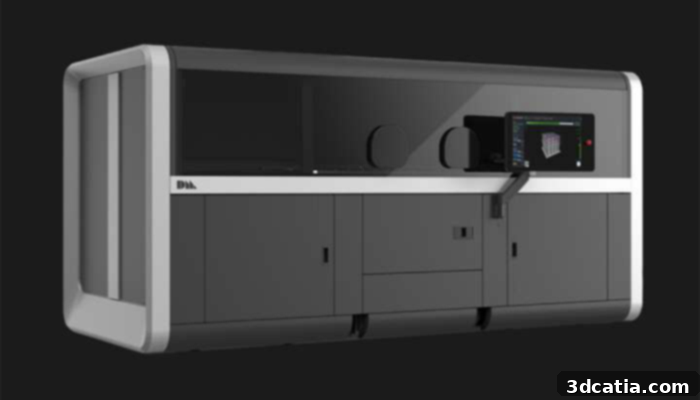
The P-50, Desktop Metal’s flagship production system, which will be available in the second half of 2021 | Photo Credit: Desktop Metal
The P-1: Accelerating Automotive Material and Process Development
The P-1 is meticulously engineered to familiarize users with the revolutionary SPJ technology, serving as a vital preparatory step for the ultimate arrival of the P-50, Desktop Metal’s future flagship production machine. Operating on a Binder Jetting process, the P-1 achieves remarkable speeds, printing each layer in less than three seconds. Beyond its impressive speed, the machine boasts a high resolution of 1200 dpi and features a versatile printhead system capable of utilizing a wide array of materials. These specifications make the P-1 an exceptionally powerful tool for research and development, particularly for an automotive giant like Ford.
Ford’s keen interest in the P-1 is not merely about trying new technology; it’s a strategic move to unlock new manufacturing capabilities. Cynthia Flanigan further elaborated on Ford’s aspirations: “We hope that this new system will be an important tool in the development of our future advanced process and alloy implementation, enabling our researchers to investigate additional production opportunities of metal binder jetting at Ford Motor Company.” This statement reveals Ford’s intention to leverage the P-1 for in-depth material science research and advanced process validation. By experimenting with novel alloys and optimizing manufacturing parameters on the P-1, Ford aims to develop innovative parts and components that can then be scaled up for mass production on the P-50 machine. This staged approach allows for meticulous refinement and validation, ensuring that future production-scale applications are robust, reliable, and cost-effective.
The Anticipated Arrival of the P-50: Ushering in Mass Production
While the P-1 is currently enabling groundbreaking research, the industry eagerly awaits the commercial availability of the P-50, Desktop Metal’s ultimate production system. Ric Fulop, CEO and co-founder of Desktop Metal, acknowledges the immense excitement surrounding his company’s future machine: “We know that industrial companies around the world are eager to start working with the P-50 production system and to benefit from the fastest and most cost-effective way to manufacture metal parts of all levels of complexity to scale.” This anticipation is well-founded, as the P-50 is designed to deliver unprecedented performance.
Desktop Metal claims that the P-50 will incorporate bi-directional printing capabilities, a feature poised to dramatically enhance production speeds. This innovative approach is expected to enable the P-50 to achieve speeds up to 100 times faster than conventional LPBF (Laser Powder Bed Fusion) 3D printers. Such a monumental increase in speed, combined with the inherent benefits of binder jetting—which include lower material costs and the ability to process a wide range of metal powders—positions the P-50 as a truly disruptive force in industrial manufacturing. For the automotive industry, where speed, cost-efficiency, and scalability are paramount, the P-50 promises to unlock new possibilities for manufacturing complex, high-performance metal components at mass production volumes.
P-1 as a Strategic Stepping Stone for Widespread SPJ Adoption
In the interim period leading up to the full commercialization of the P-50, additive manufacturing users, particularly those with a forward-looking vision like Ford, will leverage the P-1 to thoroughly test and validate the transformative SPJ technology. This strategic phased introduction ensures that manufacturers can gain invaluable experience, optimize processes, and understand the full capabilities of Desktop Metal’s platform before committing to large-scale production with the P-50.
Ric Fulop further emphasizes the critical role of the P-1: “Many companies and research institutions are interested in exploiting the economy and quality of SPJ technology for medium volume mass production, making the P-1 an ideal solution and an excellent springboard for wide adoption of the technology and Desktop Metal’s flagship P-50 printer.” This dual approach—offering the P-1 for immediate R&D and medium-volume applications while preparing for the P-50’s full-scale production capabilities—demonstrates a shrewd market strategy. It allows businesses to integrate SPJ technology into their workflows incrementally, building expertise and confidence, ultimately accelerating the widespread industrial adoption of metal binder jetting. The P-1 not only facilitates experimentation with advanced materials and complex geometries but also provides a tangible pathway for manufacturers to transition towards high-volume, cost-effective additive manufacturing, truly embodying the promise of Additive Manufacturing 2.0.
Ford’s proactive engagement with Desktop Metal’s P-1 and its anticipation of the P-50 are strong indicators of the automotive industry’s readiness to embrace metal additive manufacturing for end-part production. This partnership is set to drive significant advancements in vehicle design, performance, and manufacturing efficiency. For more in-depth information about Desktop Metal’s vision and recent developments, you can visit their official press release HERE.
The Broader Impact: Reshaping Automotive Manufacturing
The adoption of Desktop Metal’s SPJ technology by a prominent player like Ford transcends a mere technological upgrade; it signifies a pivotal moment in the evolution of automotive manufacturing. This collaboration highlights a broader industry trend towards integrating advanced additive manufacturing processes not just for prototyping, but for critical, end-use parts. The ability to quickly and affordably produce complex metal components offers numerous advantages for Ford, including significant opportunities for lightweighting vehicles, consolidating multiple parts into single, more robust designs, and optimizing supply chain logistics. These factors directly contribute to enhanced vehicle performance, improved fuel efficiency, and reduced manufacturing costs, all of which are crucial in today’s competitive automotive market.
Ford’s enduring commitment to 3D printing, evidenced by their 1988 acquisition of an SLA system, illustrates a long-term strategic vision that continuously seeks out innovative production methods. Their embrace of Desktop Metal’s P-1 and P-50 systems reinforces this legacy, demonstrating a proactive stance in exploring new materials and advanced manufacturing processes. As the automotive industry navigates challenges such as electrification, autonomous driving, and increasing consumer demand for personalization, the flexibility and efficiency offered by metal binder jetting become increasingly valuable. This technology empowers engineers to design parts previously impossible to manufacture with traditional methods, paving the way for revolutionary product development and accelerating time to market for future vehicle platforms.
The future landscape of metal additive manufacturing, significantly shaped by collaborations like that between Ford and Desktop Metal, promises an era of unprecedented innovation. As companies scale up their binder jetting capabilities, we can anticipate a diversification of printable materials, further automation in post-processing, and even more sophisticated design for additive manufacturing (DfAM) methodologies. The P-1 acts as a crucial enabler, allowing Ford’s researchers to push the boundaries of material science and process optimization, laying the groundwork for the P-50 to deliver those innovations at an industrial scale. This synergy is not just beneficial for Ford or Desktop Metal; it sets a benchmark for the entire manufacturing sector, demonstrating how strategic investments in advanced additive technologies can unlock transformative potential across industries.
What are your thoughts on Desktop Metal’s expanding presence in the metal additive manufacturing market and Ford’s strategic adoption of these advanced technologies? We invite you to share your insights and comments below, or engage with us on our Facebook and Twitter pages! To stay updated with the very latest developments and news in 3D printing, sign up for our free weekly Newsletter here, delivered straight to your inbox!