

Ford’s Electric Revolution: Accelerating the New Electric Explorer’s Development with Formlabs 3D Printing
Ford, a global automotive giant, is making an assertive move towards a sustainable future, targeting an entirely electric passenger vehicle lineup in the European Union by 2030. This ambitious commitment underscores a significant shift in the company’s manufacturing and design philosophy. At the forefront of this electrification initiative stands the groundbreaking new Ford Electric Explorer, a vehicle emblematic of Ford’s innovative drive. Crucially, the rapid development and meticulous prototyping of this flagship electric SUV were significantly aided by advanced SLS and SLA 3D printers from industry leader Formlabs, demonstrating a powerful synergy between traditional automotive manufacturing and cutting-edge additive manufacturing.
The integration of 3D printing technology was primarily centered at Ford’s PD Merkenich Rapid Technology Center. This state-of-the-art facility is pivotal to Ford’s European operations, bearing the responsibility for the innovative design and engineering of many of Ford’s popular passenger car models, including the Fiesta, Focus, and Kuga. Within this center, the prototyping phase, a critical step in automotive development, has been revolutionized by additive manufacturing. For the development of the Electric Explorer, Ford leveraged a range of Formlabs solutions, notably the high-speed Form 4 and the large-format Form 3L. This strategic deployment allowed engineers to utilize diverse printing processes and a wide array of materials to produce highly detailed and functional prototypes. Components such as intricate mirror housings, ergonomic door handles, secure charging ports, and various dashboard elements were rapidly iterated, enabling quicker design verification and functional testing.
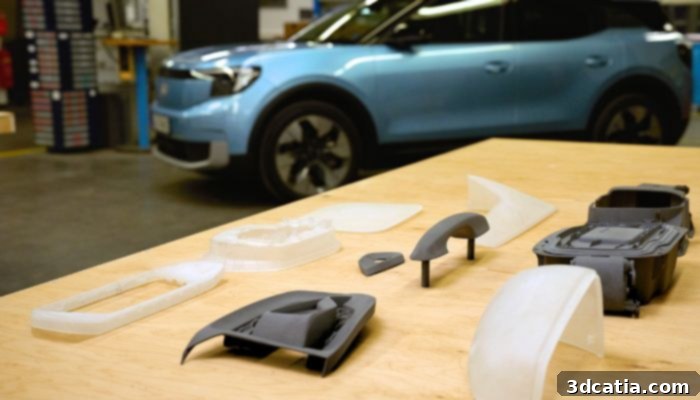
The 3D printed parts
Ford’s Rapid Technology Center is equipped to produce full-size prototypes, a capability that necessitates a comprehensive suite of advanced manufacturing machines. This expansive toolkit includes traditional injection molding machines, sophisticated forming tools, various subtractive machining tools, and, critically, an extensive fleet of 3D printers. Ford’s journey with additive manufacturing at this facility is a long and distinguished one, dating back to 1994 when it became the first Ford plant globally to be outfitted with an SLA printer. Since then, the adoption and integration of additive manufacturing technologies have expanded exponentially, embracing a broad spectrum of processes including Fused Deposition Modeling (FDM), Stereolithography (SLA), Selective Laser Sintering (SLS), and even advanced metal 3D printing. This continuous investment highlights Ford’s deep-rooted belief in the transformative power of 3D printing. The center’s Formlabs journey began with the reliable Form 2, followed by the integration of more advanced desktop printers, the larger format Form 3L for expansive components, and culminating with the cutting-edge Form 4 MSLA printer, each addition enhancing their prototyping capabilities.
Leveraging 3D Printing for the Ford Electric Explorer: A Formlabs Partnership
The collaboration between Ford and Formlabs proved to be exceptionally fruitful, particularly with the introduction of the Form 4. Ford engineers were notably impressed by the unprecedented speed offered by the Form 4. This rapid prototyping solution drastically reduced lead times, enabling the production and delivery of prototypes at an accelerated pace. This efficiency allowed the team to process a greater number of design requests, often within less than a day, which is a game-changer in the fast-paced automotive development cycle. Bruno Alves, a Development Engineer specializing in Additive Manufacturing (AM) and Injection Molding (IM) at Ford Motor Company, elaborated on the impact: “Form 4’s speed and materials versatility enable us to create multiple prototypes and manufacturing aids every day. The printer has already changed the way we design and produce parts, helping us drive efficiency in our product development.” This sentiment underscores how critical rapid iteration is for optimizing designs and significantly shortening the overall product development timeline for the Electric Explorer.
Beyond the Form 4, Ford strategically utilized other advanced Formlabs 3D printers to address specific prototyping needs for the Electric Explorer. The Form 3L, with its generous build volume, was indispensable for producing larger components, including significant parts for the vehicle’s exterior body. This capability allowed Ford to test aesthetic and aerodynamic elements more effectively. Additionally, the Fuse 1+ SLS 3D printer was employed for its remarkable speed and ease of use in fabricating a variety of robust mechanical parts and complex assemblies. The ability to print durable, functional prototypes in engineering-grade materials was crucial for testing real-world performance. Complementing these printing solutions, Ford also rigorously tested the Fuse Blast-SLS Workflow, an automated cleaning and polishing solution specifically designed for SLS parts. This automation significantly streamlined the post-processing stage, further enhancing overall production efficiency and consistency, which are vital for a project of the Electric Explorer’s scale and complexity.
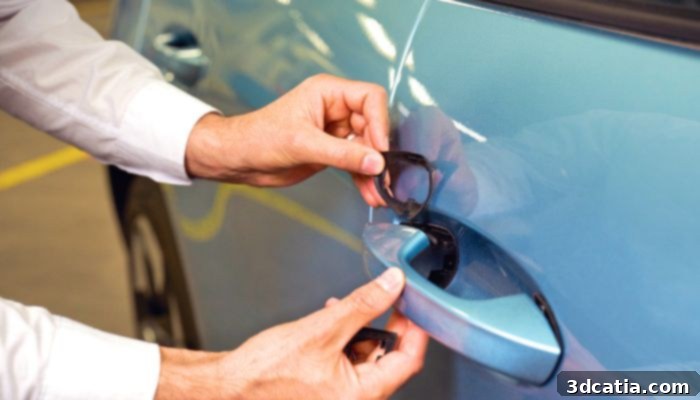
Each door handle has two rubber components for damping and insulation
Indeed, 3D printing has become an indispensable and integral part of the Ford Electric Explorer’s development process. In one notable instance, engineers determined that a crucial component – the intricate charging cover – could only be reliably manufactured using the Fuse 1+ with its 300W laser. This particular part presented a significant design challenge due to its complex internal mechanisms and the requirement for precise fit and functional integrity. Bruno Alves further emphasized the necessity of SLS technology for this component: “For this charging cover it was important to use SLS, based on the fact that we needed a functional part that would enable us to test the mechanisms. It’s a really complex design that we are not able to produce in any other way. We cannot mill this part. We cannot use injection molding to produce just some samples. So the best way is to print in a material that we can test physically.” This highlights the unparalleled design freedom and material properties offered by SLS, enabling the creation of functional prototypes that accurately represent the final product and withstand rigorous testing, something traditional manufacturing methods simply could not achieve at the prototyping stage.
Ford’s approach to innovation extends beyond purely additive manufacturing. The company adeptly combines traditional manufacturing methods with 3D-printed tools and components. This hybrid strategy allows Ford to select the most optimal process for each specific application, ensuring maximized material utilization, cost-effectiveness, enhanced efficiency, and accelerated development speeds. A prime example of this integrated methodology is the production of the rubber components for the Electric Explorer’s door handle assembly. Instead of expensive and time-consuming traditional tooling, these vital rubber parts were manufactured using 3D-printed mold inserts in conjunction with conventional injection molding. This innovative approach significantly reduced tooling lead times and costs, showcasing how additive manufacturing can augment and improve existing production processes, particularly during the critical pre-production and prototyping phases.
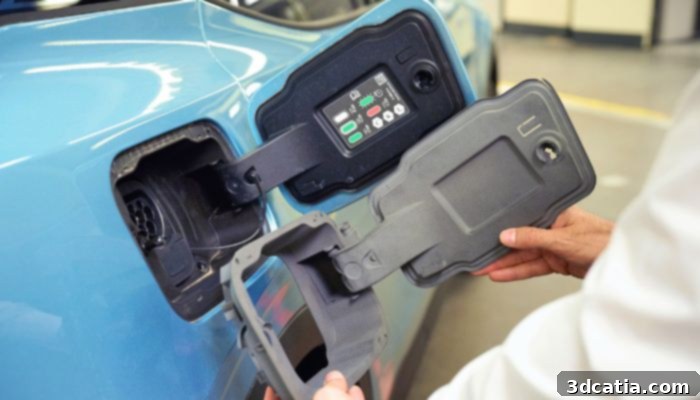
The charging port is too complex to prototype using any other method
Looking ahead, Ford remains committed to continuously exploring and testing new injection molding technologies and processes. This ongoing research includes evaluating novel materials, refining existing manufacturing methods, and integrating advanced machinery. In an intensely competitive automotive landscape where rival manufacturers are constantly striving to accelerate their development cycles, Ford recognizes the imperative to produce faster, innovate more rapidly, and bring new vehicles to market with unprecedented agility. In this dynamic environment, additive manufacturing plays an undeniably crucial role. By significantly shortening development times, facilitating rapid design iterations, and enabling the creation of complex, functional prototypes early in the design process, 3D printing empowers Ford to maintain its competitive edge and achieve its ambitious goals for electrification and market leadership. It represents not just a tool, but a strategic advantage in the race towards the future of mobility, ensuring that vehicles like the Electric Explorer are brought to consumers with optimal design, performance, and efficiency.
What are your thoughts on Ford’s innovative use of additive manufacturing for the new Electric Explorer? We’d love to hear your perspective in a comment below or join the conversation on our LinkedIn, Facebook, and Twitter pages! Don’t miss out on the latest advancements in 3D printing; remember to sign up for our free weekly newsletter here for direct updates to your inbox! You can also explore our comprehensive video library on our YouTube channel.
*All Photo Credits: Ford/Formlabs