
Breaking the Mold: The Future of Metal 3D Printing and Advanced Stainless Steel
For many years, the mention of 3D printing instantly brought to mind images of plastic prototypes and consumer-grade trinkets. However, the landscape of additive manufacturing is rapidly evolving, with a significant and growing trend towards the use of metals as a primary material. This shift is not merely incremental; it represents a fundamental change in what 3D printing can achieve, pushing the boundaries of engineering and design. The increasing visibility and legitimacy of metal 3D printing have been further bolstered by major industry announcements, including HP’s plans to enter the metal 3D printing market, joining innovative players like Markforged and Desktop Metal. These developments signal a maturing market and a clear indicator that metal additive manufacturing is poised to revolutionize industrial production across various sectors.
Understanding Metal Additive Manufacturing Technologies
Metal 3D printing, often referred to as metal additive manufacturing, encompasses a range of technologies that build three-dimensional metal parts layer by layer from digital designs. Unlike traditional subtractive manufacturing methods, which remove material from a larger block, additive processes create minimal waste and offer unparalleled design freedom. Key technologies in this exciting field include Direct Metal Laser Sintering (DMLS), Selective Laser Melting (SLM), Electron Beam Melting (EBM), Binder Jetting, and the focus of our discussion: Selective Laser Sintering (SLS).
While originally developed for plastics, the principles of Selective Laser Sintering (SLS) have been adapted for metals, often known by proprietary names such as Direct Metal Laser Sintering (DMLS) or Selective Laser Melting (SLM). At its core, SLS involves using a high-powered laser to fuse particles of metal powder together, layer by layer, based on a digital 3D model. This process allows for the creation of incredibly complex geometries and intricate internal structures that would be impossible or prohibitively expensive to produce with conventional methods. However, working with metals presents unique challenges compared to plastics. Achieving the desired material properties, particularly the delicate balance between strength and ductility, has historically been a significant hurdle for metal 3D printing, especially when dealing with alloys like stainless steel.
Innovations in Stainless Steel 3D Printing
Stainless steel is a cornerstone material in countless industries due to its corrosion resistance, strength, and durability. However, a fundamental challenge in metallurgy, particularly when working with steel, is the inherent trade-off between hardness and ductility. Generally, as you increase the hardness of steel, its ductility—the ability to deform without fracturing—decreases. This can lead to brittle materials that are prone to cracking or sudden failure under stress, limiting their application in critical components where both strength and resilience are paramount. For years, engineers and material scientists have grappled with this “strength-ductility dilemma,” striving to push these limits further.
Traditional manufacturing methods often struggle to achieve the fine-tuned control over microstructures necessary to overcome this dilemma effectively. While laser sintering offers remarkable capabilities for creating intricate metal pieces, it has historically faced difficulties in precisely printing the microstructures required to produce truly resilient and high-performance metal parts. Microstructures, the arrangement of phases and defects at a microscopic level, dictate a material’s macroscopic properties. Without precise control over these structures during the additive process, printed metal parts might exhibit porosity, internal stresses, or an unfavorable grain structure, all of which compromise their mechanical performance.
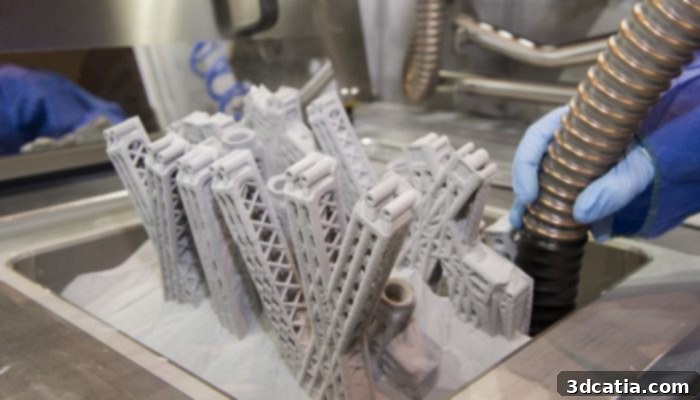
Metal 3D printed part at Airbus, demonstrating industrial application of the technology.
A significant breakthrough in this area has come from a research team at the Californian Lawrence Livermore National Laboratory (LLNL). In collaboration with engineers from the Ames National Laboratory, the Georgia Institute of Technology, and Oregon State University, this team has made strides in proving that metal products can be significantly improved through innovative 3D printing techniques. Their groundbreaking work focused on a common industrial-grade material: low-carbon 316L stainless steel, known for its excellent corrosion resistance and weldability, but often limited by its strength-ductility balance.
The LLNL team successfully printed a grade of 316L steel robust enough for use in demanding applications, including military components. Their new method represents a paradigm shift: it allows 316L steel to be created with enhanced properties using what they describe as a standard metal 3D printer. The key to their success lies in meticulous control over the heat and fusion processes during printing, which prevents the material from becoming porous and allows for the formation of a superior microstructure. By precisely managing the laser’s power and scan speed, they could manipulate the solidification and cooling rates, guiding the formation of fine-grained structures that contribute to both strength and ductility simultaneously.
Morris Wang, an LLNL materials scientist and lead author of the research, underscored the significance of their findings: “This microstructure we have developed breaks the traditional force-ductility dilemma. Historically, if you wanted to make steel stronger, you inevitably lost ductility; you simply could not have both. But with 3D printing, we can move that limit further.” This statement highlights the revolutionary potential of additive manufacturing not just to replicate existing materials, but to engineer entirely new material properties that were previously unattainable through conventional means. By leveraging the layer-by-layer control inherent in 3D printing, scientists can design and build materials from the ground up, manipulating their internal architecture to optimize performance.
During their experiments, the engineers explored various laser powders and thin metal plates to refine their printing parameters. The results were astounding: under specific conditions, the strength of the 3D-printed stainless steel tripled. This dramatic improvement in mechanical properties was a surprise even to the scientists themselves, demonstrating the profound and perhaps underestimated potential of combining advanced additive manufacturing techniques with meticulous material science. Such a leap in strength, while maintaining or even enhancing ductility, opens vast possibilities for component design and application, particularly in industries where material performance is absolutely critical.
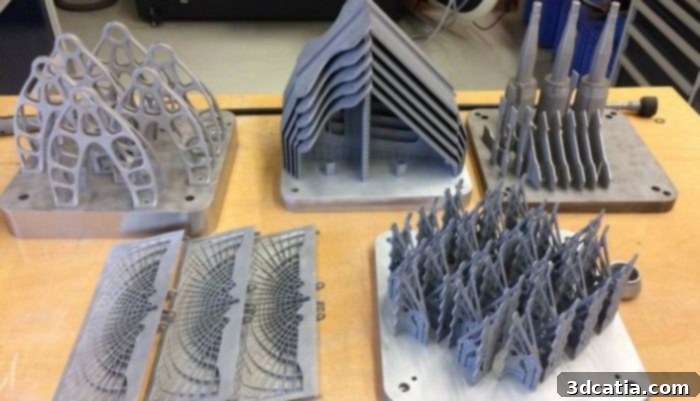
Intricate 3D printed airplane parts developed through advanced metal additive manufacturing.
Transformative Impact on Industries and Businesses
While it may be premature to quantify the full short-term economic impact, this discovery is undeniably one of the most promising advancements in additive manufacturing. As the capability to 3D print harder, stronger, and more ductile materials becomes more refined and accessible, we are poised to witness a significant expansion in the widespread adoption of metal 3D printing technology across a multitude of sectors. The implications of being able to produce stainless steel parts with triple the strength, without sacrificing flexibility, are enormous and far-reaching.
Aerospace and Defense
The ability to create high-strength, lightweight components is critical for aerospace and defense. Stronger 316L stainless steel could lead to lighter aircraft parts, increasing fuel efficiency and payload capacity. For defense applications, it means more resilient armor, more durable weapon components, and mission-critical parts that can withstand extreme conditions, as the LLNL research specifically aimed for military use. Design freedom also allows for part consolidation, reducing assembly time and potential points of failure.
Medical Industry
In the medical field, customized implants, surgical instruments, and prosthetic components could greatly benefit. Biocompatible stainless steel with enhanced mechanical properties could lead to longer-lasting implants, reducing the need for revision surgeries and improving patient outcomes. The ability to tailor properties to individual patient needs and specific biomechanical requirements represents a significant leap forward in personalized medicine.
Automotive Sector
The automotive industry can leverage these advancements for high-performance vehicles, creating stronger, lighter engine components, chassis parts, or specialized tooling. This could contribute to fuel efficiency, improved safety, and enable more aggressive design parameters for next-generation vehicles.
Tooling, Manufacturing, and Energy
For general manufacturing, improved stainless steel means more durable jigs, fixtures, and molds, leading to longer operational lifespans and reduced downtime. In the energy sector, particularly for harsh environments like offshore oil and gas or nuclear power plants, components requiring exceptional corrosion resistance and mechanical integrity could be produced with unprecedented performance characteristics. The enhanced durability and material integrity could lead to increased operational safety and efficiency.
Beyond specific applications, the broader business impact includes accelerated product development cycles, enabling rapid prototyping and iteration of complex designs. It offers unparalleled design freedom, allowing engineers to create optimized geometries that are impossible with traditional methods, leading to parts that are not only stronger but also potentially lighter and more efficient. Furthermore, metal 3D printing supports more resilient supply chains by enabling on-demand, localized production of critical parts, reducing reliance on complex global logistics. While challenges such as initial investment costs, process speed, and material certification still exist, the continuous breakthroughs like those from LLNL are steadily making metal additive manufacturing a more viable and indispensable technology for the future of industrial production.
The research on advanced stainless steel 3D printing is a testament to the ongoing innovation within additive manufacturing. It underscores the potential for this technology to not only replicate but fundamentally improve the properties of well-known materials. As engineers and scientists continue to unravel the complexities of material behavior at the microscopic level and refine printing processes, the “limits” of what is possible are continually being redefined. This evolution promises a future where materials are not just selected from a catalog, but precisely engineered and fabricated to meet the exact demands of their application, paving the way for a new era of high-performance components and manufacturing resilience.
How important do you think these advancements in metal 3D printing are for the future of manufacturing and innovation? We’d love to hear your thoughts! Let us know in a comment below or connect with us on our Facebook and Twitter pages! Don’t miss out on the latest 3D printing news and insights. Sign up for our free weekly Newsletter here, delivered straight to your inbox!