
Transforming Drug Delivery: Multiply Labs Pioneers Personalized 3D Printed Capsules for Enhanced Patient Care
The landscape of modern healthcare is undergoing a profound transformation, driven by innovative technologies like additive manufacturing. This pivotal technology is opening doors to truly unique and personalized therapeutic approaches, fundamentally altering how patients receive treatment. This exciting convergence towards personalized healthcare promises a future where medical interventions are meticulously tailored to individual patient needs, effectively moving beyond the conventional “one-size-fits-all” model. Advocates of this paradigm shift frequently highlight its myriad benefits, including significant improvements in the ease of use for patients, which in turn leads to enhanced treatment adherence and, ultimately, superior health outcomes. At the forefront of this revolutionary movement is Multiply Labs, a pioneering company deeply committed to realizing the vision of personalized pharmaceutical solutions.
Leveraging a strong foundation in robotics and a keen understanding of advanced pharmaceutical technologies, Multiply Labs has successfully harnessed the power of 3D printing to create groundbreaking personalized capsules. These advanced capsules are ingeniously designed to deliver all necessary medication to patients throughout the day in a precisely controlled and programmed manner, ensuring optimal efficacy and convenience. This level of customization in drug delivery holds immense potential for improving patient lives and transforming the pharmaceutical industry. To delve deeper into their groundbreaking technology, innovative approach, and forward-thinking philosophy, we recently had the valuable opportunity to speak with Fred Parietti, the insightful co-founder and CEO of Multiply Labs, for an exclusive interview.
3DN: Could you introduce yourself and tell us more about Multiply Labs?
“I am Fred Parietti, the CEO and co-founder of Multiply Labs. Our company represents a completely new paradigm in the field of personalized pharmaceuticals. While we are currently not involved in the direct fabrication of active pharmaceutical ingredients (APIs), our core innovation lies in the development and production of sophisticated, 3D printed capsules. These capsules are meticulously engineered to release pharmaceutical ingredients in a precisely controlled and programmed fashion, offering unprecedented control over drug delivery kinetics. Our initial foray into the market focused strategically on personalized supplement pills. This enabled us to establish our market presence, rigorously refine our complex manufacturing processes, and develop the highly specialized machines and pharmaceutical-grade filaments essential for creating these advanced 3D printed drug delivery systems. This foundational work was absolutely crucial for proving the viability, precision, and regulatory compliance of our additive manufacturing approach within the pharmaceutical sector.
“Building upon the success and learnings from our initial personalized supplement products, we are now actively working on an exciting new range of prescription pharmaceutical products. A key area of focus for us currently is the development of specialized capsules designed for HIV treatment. Through Multiply Labs’ innovative technology, we envision a future where every patient can take a single, tailor-made capsule that precisely contains all the necessary supplements or prescribed drugs they require for their specific medical condition. This advanced approach not only simplifies potentially complex medication regimens, which can often involve multiple pills taken at different times, but also significantly improves patient compliance and overall treatment effectiveness. The ability to customize each capsule to individual patient needs opens up unprecedented possibilities for optimizing therapeutic outcomes across a wide spectrum of medical conditions, leading to better health and quality of life for patients globally.”
3DN: What is the underlying technology that powers Multiply Labs’ personalized capsules?
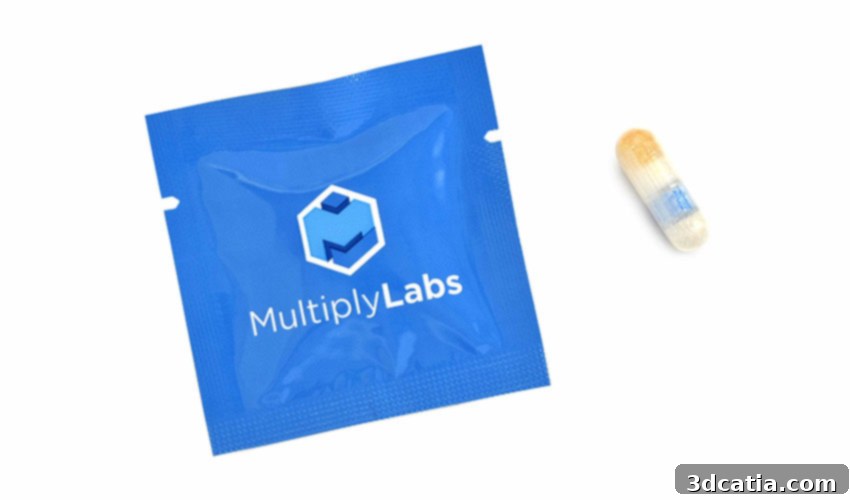
“At Multiply Labs, our proprietary technology revolves around the sophisticated application of advanced 3D printing techniques to the manufacturing of pharmaceutical products. Specifically, we focus intensely on the capsule itself, which serves as an intelligent and highly customizable delivery vehicle for the active ingredients. These are far from ordinary capsules; what truly sets them apart is their intricate internal design. We engineer separate, distinct compartments within each capsule, meticulously crafted with varying wall thicknesses. Each of these compartments is designed to contain different supplements or active pharmaceutical ingredients (APIs), and crucially, these compartments are programmed to release their contents at precise, predetermined times. For instance, we can 3D print a compartment with an ultra-thin wall, ensuring that the encapsulated product is released rapidly, often within 30 minutes of ingestion. This is ideal for medications requiring an immediate effect.
“Concurrently, within the very same personalized capsule, we can incorporate another compartment featuring a much thicker wall. This specific design allows it to retain and protect the supplement or medication for a significantly extended period, perhaps two hours, four hours, or even longer, before dissolving and releasing its contents. This staggered release capability is vital for maintaining consistent drug levels over time or for administering drugs that require different absorption windows. Our advanced 3D printing technology enables us to integrate up to four or five distinct compartments within a single personalized capsule, offering unparalleled flexibility and complexity in designing diverse drug delivery schedules and combination therapies. This capability is particularly beneficial for patients managing multiple conditions or complex daily medication regimens, as it consolidates several doses into one convenient capsule, drastically simplifying adherence and improving overall treatment efficacy.
“The physical structure of our capsules is produced from a very specific, pharmaceutical-grade polymer, ensuring biocompatibility and safety. Once the capsule shell is precisely 3D printed using our specialized methods, we then introduce the medication or supplement, typically in powder form, into its various compartments. The core 3D printing technology we primarily employ is Fused Deposition Modeling (FDM), a well-established additive manufacturing technique. We made a deliberate and critical choice to separate the 3D printing process, which involves heat and extrusion of the polymer, from the introduction of the actual drug or supplement. This separation is paramount because many pharmaceutical ingredients are highly sensitive to heat and could degrade significantly if exposed to the elevated temperatures inherent in the FDM printing process. By printing the empty capsule shells first and then accurately filling them with the active ingredients in a post-processing step, we ensure the stability, integrity, and therapeutic efficacy of the medication, thereby providing a robust, safe, and highly effective drug delivery system for patients.”
3DN: Could you elaborate on your pharmaceutical filament and the specific technology you utilize for printing it?
“Currently, we primarily work with one specific polymer known as Hydroxypropyl cellulose, or HPC for short. HPC is an ideal material for our applications because it is a water-soluble polymer that is entirely safe for human consumption and dissolves naturally and predictably within the human body. Its excellent biocompatibility and well-understood degradation profile make it a perfect candidate for oral drug delivery systems. We source this high-quality HPC in powder form from a trusted external supplier. Upon receiving this raw material, we then undertake a proprietary, in-house process to convert it into the precise 3D printing filament required for our specialized FDM machines. This in-house filament production allows us to maintain stringent quality control over all material properties, ensuring its suitability and consistent performance for pharmaceutical applications. Crucially, this granular control extends to accurately determining and manipulating the exact thickness of the capsule’s walls, which directly dictates the rate and timing at which the capsule will begin dissolving and subsequently releasing its therapeutic contents. This level of unparalleled precision is fundamental to achieving our controlled-release objectives and personalizing drug delivery profiles.
“It’s important to underscore that our specifically engineered pharmaceutical-grade filament, based on HPC, is, to our knowledge, the only appropriate quality filament for 3D printing currently available on the market specifically for drug delivery applications. This unique market position provides us with a significant competitive advantage. We envision strategic opportunities to sell this highly specialized material, or even license the underlying filament production and printing technology, to various industry players. This includes academic research laboratories and other pharmaceutical companies. The ability to rapidly produce capsule prototypes with precisely controlled release profiles is invaluable for accelerating drug development and testing processes, significantly shortening R&D cycles and bringing new therapies to market faster. Furthermore, in terms of the additive manufacturing technology itself, we didn’t just adapt existing commercial 3D printers. Given the very specific and often flexible nature of our pharmaceutical filament, which behaves differently from standard plastics, we actually developed and engineered a custom print head. This bespoke print head is meticulously mounted onto our 3D printers and is specifically designed to handle the unique rheological properties of our HPC material, ensuring optimal printing parameters and consistent, high-quality output for every personalized capsule we produce. This end-to-end control, from proprietary material synthesis to specialized print head design, fundamentally underscores our unwavering commitment to precision, innovation, and leadership in personalized drug delivery.”
3DN: Why did Multiply Labs choose 3D printing for capsule development, and what are the key advantages of this technology?
“Traditionally, pharmaceutical capsules are manufactured on an immense industrial scale, with millions of identical units produced daily through conventional mass production methods such as injection molding or encapsulation. While this approach is undoubtedly efficient for widespread drug distribution and cost-effective for generic formulations, it presents a significant limitation in an era where the medical field is increasingly shifting its focus towards personalization and precision medicine. Modern healthcare unequivocally demands individualized treatments; patients and their physicians are seeking highly tailored solutions where each person receives medication precisely formulated and dosed for their unique physiological needs, genetic profile, and specific medical condition. This essential level of customization is simply unattainable with conventional mass production techniques, which are inherently designed for uniformity.
“This is precisely where 3D printing offers an unparalleled and transformative advantage. Additive manufacturing, particularly 3D printing, is the ideal technology for initiating and advancing personalized drug delivery because it offers unmatched flexibility, precision, and agility. It allows us to rapidly design, prototype, and test an almost infinite variety of capsule designs with different internal compartments, varying wall thicknesses, and diverse drug release profiles for a multitude of medications. This inherent agility is absolutely crucial for modern pharmaceutical research and development. Instead of being constrained by rigid molds or complex, expensive tooling that can take months to produce and modify, 3D printing empowers us to iterate quickly, experiment with novel formulations, and fine-tune drug release characteristics in a way that would be impossible, or at best, prohibitively expensive and time-consuming with traditional manufacturing methods. This profound ability to test and refine drug delivery systems with exceptional speed not only significantly accelerates the development pipeline but also ensures that the final product is optimally suited for the individual patient’s requirements. The inherent versatility of additive manufacturing truly transforms the entire drug development process from a slow, linear progression into a dynamic, iterative cycle, paving the way for truly personalized, effective, and safer therapies.”
3DN: Where do you envision Multiply Labs being in ten years?
“Looking a decade into the future, we firmly believe that Multiply Labs, and the overarching concept of personalized pharmaceuticals it embodies, will become the established norm in healthcare globally. We foresee a future where the notion of a ‘one-size-fits-all’ drug is not only obsolete but actively rejected by both patients and medical professionals. Patients will no longer passively accept taking the exact same medication as another person, particularly when their physiological profiles, genetic makeup, and specific medical needs demonstrably differ. Similarly, medical practitioners will increasingly demand the ability to prescribe highly individualized products, moving decisively beyond generic dosages to treatments precisely calibrated for each unique patient. Consider the fundamental flaws in the current pharmaceutical paradigm: many standard supplements, over-the-counter drugs, and even crucial prescription medications are often formulated with an ‘average adult male’ as the primary reference point for dosage and efficacy. This often leads to significant challenges for other demographics. For example, women and children, who typically possess lower body mass, different metabolic rates, and unique physiological responses, are frequently prescribed dosages that may be excessive or insufficient for their bodies, potentially leading to increased side effects, reduced efficacy, or suboptimal therapeutic outcomes. Personalized medicine directly addresses this fundamental mismatch and inequity.
“At Multiply Labs, we have a clear and ambitious vision of a future where everyone has seamless access to pharmaceutical products that are meticulously tailored to their individual biology, specific lifestyle, and precise medical condition. Our advanced 3D printing technology is not merely an incremental improvement; it is the perfect enabling platform to achieve this profound and transformative shift in healthcare. In ten years, we anticipate that doctors will utilize advanced diagnostics, comprehensive patient data—including genetic markers, weight, metabolism, co-morbidities, and even real-time health metrics from wearable devices—to virtually design a unique, personalized drug profile for each patient. Our cutting-edge technology will then seamlessly translate this digital prescription into a physical, multi-compartment capsule, precisely controlling the dosage, combination, and release kinetics of multiple active ingredients. This unparalleled level of customization promises not only to dramatically improve the efficacy and safety of medications by optimizing them for the individual but also to significantly enhance patient adherence by simplifying complex regimens into a single, intelligent, smart pill. We firmly believe this personalized approach will redefine healthcare, empowering both patients and prescribers with intelligent, adaptive, and truly effective drug delivery solutions, thereby making Multiply Labs a cornerstone of future pharmaceutical innovation and patient-centric care globally.”
For more comprehensive information about Multiply Labs and their pioneering work in personalized pharmaceutical 3D printing, please visit their official website here.
What are your thoughts on the transformative potential of personalized pills and additive manufacturing in medicine? We invite you to share your valuable insights and perspectives in the comments section below or engage with us on our vibrant Facebook and Twitter pages! Don’t forget to subscribe to our free weekly Newsletter to receive all the latest news, breakthrough innovations, and expert analyses in the exciting world of 3D printing directly in your inbox!