
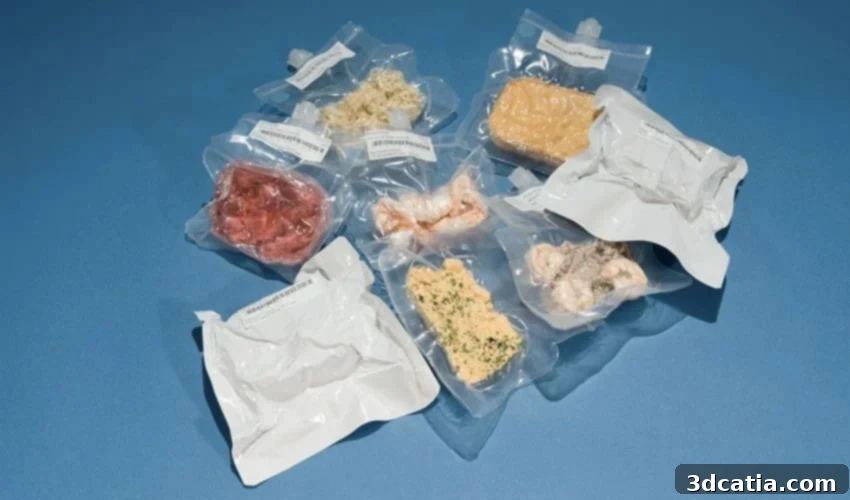
Revolutionizing Space Exploration and Sustainability: The Power of 3D Printed Food from Plastic Waste
For several years, the aerospace industry has increasingly embraced additive manufacturing with the ambitious goal of conquering space. This cutting-edge technology is proving instrumental in developing a wide array of critical components, from robust rocket structures and advanced propulsion systems to even ambitious plans for lunar habitats. The advantages of 3D printing – such as reduced material waste, the ability to create complex geometries, rapid prototyping, and on-demand production – make it an indispensable tool for the unique challenges of space. For instance, NASA recently awarded ICON a substantial 57.2 million dollars to pioneer 3D printed construction techniques for our natural satellite, the Moon, envisioning future human settlements. Similarly, companies like Relativity Space have leveraged additive manufacturing to build entire rockets, significantly streamlining the production process and reducing lead times. In the realm of propulsion, Launcher utilized VELO3D’s advanced metal 3D printing capabilities to optimize and enhance its E-2 Liquid rocket engine, achieving unparalleled performance and efficiency. Beyond hardware, 3D printing’s versatility is now extending into the most fundamental aspect of human survival in space: food. The latest frontier involves developing 3D printed food, offering a sustainable and innovative solution for feeding astronauts on long-duration missions.
The potential applications of 3D printing in space are truly boundless, and its ability to produce customized, on-demand parts is matched only by its emerging role in food production. As additive technology for the food sector gains prominence, it addresses critical issues for sustained space exploration. Traditional space food faces challenges related to shelf-life, weight, nutritional variety, and psychological impact over extended missions. To overcome these hurdles and find sustainable ways to grow and produce food in extraterrestrial environments, leading American, Japanese, and European space organizations are actively collaborating with pioneers in the food industry. This interdisciplinary effort has yielded a remarkably innovative and potentially transformative solution: converting plastic waste, an unavoidable byproduct of human activity in space and on Earth, into edible food.
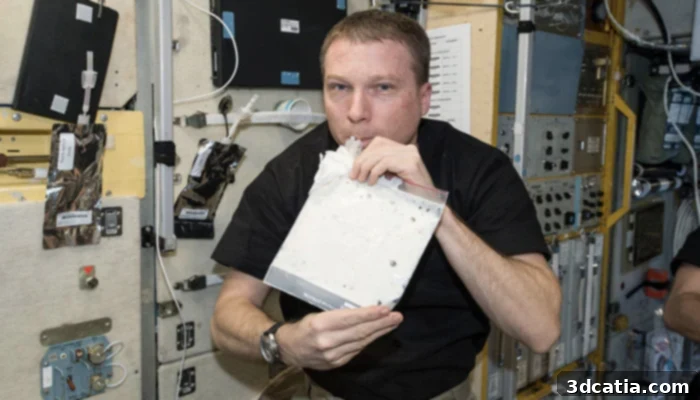
Astronaut Terry Virts drinking a 3D printed milkshake on the International Space Station (Photo credits: NASA / Mark Garcia).
From Waste to Culinary Innovation: The Promise of 3D Printed Food from Plastic
The concept of creating a nutritious meal, such as a steak, from plastic waste might initially sound like science fiction, a utopian dream of sustainable living or an unimaginable leap in recycling technology. Yet, this groundbreaking project is not only real but demonstrably possible, thanks to the pioneering work of Beehex. This innovative company specializes in developing advanced food solutions using various 3D printing technologies, effectively merging culinary art with cutting-edge engineering. Beehex was founded by Anjan Contractor, an accomplished engineer with strong affiliations to NASA, whose vision is to provide astronauts with custom-designed, 3D printed meals that are both nutritious and appealing. The underlying idea, while seemingly straightforward, is a testament to ingenious bio-engineering: “Plastic waste is collected and then meticulously shredded into fine particles. These particles are subsequently introduced into a bioreactor, which houses highly specific, modified bacteria,” Anjan explains. These specially engineered microorganisms possess the remarkable ability to metabolize the plastic, breaking it down and converting it into a nutrient-rich biomass. This biomass then serves as the fundamental building block for producing a diverse range of 3D printed meals, offering a truly circular and sustainable food system.
The implications of this transformative project extend far beyond merely feeding astronauts in the confined environment of a spacecraft. On a global scale, this technology holds immense potential to revolutionize resource management and contribute significantly to pressing environmental and social challenges on Earth. By converting plastic waste, a ubiquitous pollutant, into a valuable food source, it offers a tangible pathway to addressing global warming by reducing landfill burden and the energy required for traditional waste disposal. Furthermore, it presents a compelling alternative to conventional agriculture, potentially mitigating issues related to animal exploitation, land degradation, and excessive water consumption. Imagine a future where plastic pollution is no longer a crisis but a resource for sustainable food production, fostering improved conservation and care for our biosphere and natural environment. This innovation could dramatically enhance food security, especially in regions plagued by scarcity or those recovering from natural disasters, by providing a localized, on-demand food source independent of traditional farming conditions. The ability to create food from what was once considered unusable waste opens up unprecedented possibilities for a more sustainable and equitable future for all of humanity. For more comprehensive insights into groundbreaking initiatives by NASA and their vision for human spaceflight, you can explore their projects HERE.
“The flexibility of this technology is incredible. If the goal is to create food using processed plastic, we have the capability to produce sophisticated replicas like a steak or even chicken breast, tailored to specific nutritional profiles and textures,” confidently concludes Anjan Contractor, highlighting the versatility and potential of Beehex’s innovative approach.
This remarkable advancement in 3D printed food from plastic waste represents a significant stride towards a more sustainable future, both in space and on Earth. What are your thoughts on this revolutionary concept? Do you see it as a viable solution for future food challenges? Share your insights and opinions with us by leaving a comment below, or engage with our community on ourLinkedIn, Facebook, and Twitter pages! To stay informed about the very latest developments and breakthroughs in the dynamic world of 3D printing, remember to sign up for our free weekly Newsletter here – delivering essential news straight to your inbox! Additionally, you can explore all our engaging video content and interviews on our YouTube channel.