
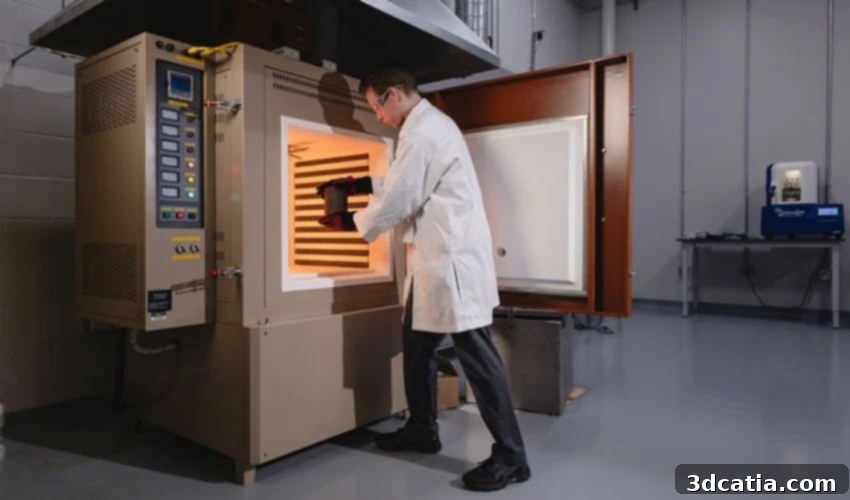
Advancing Hypersonic Technology: The Role of 3D Printed Dark Ceramics in Extreme Aerospace Environments
The pursuit of hypersonic flight, enabling vehicles to travel at speeds exceeding Mach 5 (five times the speed of sound), represents one of the most ambitious and challenging frontiers in modern aerospace engineering. While the potential benefits in defense, transportation, and space exploration are immense, the operational environment for such vehicles is extraordinarily harsh. Components must endure extreme conditions, including temperatures soaring above 2000°C and immense mechanical stresses, pressures, and aerodynamic loads. Under such formidable demands, conventional engineering materials rapidly reach their inherent limits, often failing to maintain structural integrity or functional performance.
Recognizing this critical material challenge, researchers at the Purdue Applied Research Institute (PARI) are at the forefront of developing innovative solutions. Their groundbreaking work focuses on leveraging advanced additive manufacturing processes to produce specialized dark ceramics. These advanced materials, fabricated through sophisticated 3D printing techniques, are designed to create complex-shaped components specifically tailored for the demanding requirements of next-generation hypersonic vehicles. This research marks a pivotal step towards unlocking the full potential of hypersonic capabilities by providing materials that can withstand previously insurmountable operational stresses.
The Imperative for Advanced Materials in Hypersonic Flight
Hypersonic flight introduces a unique combination of physical phenomena that place extraordinary demands on material systems. As a vehicle accelerates to Mach 5 and beyond, the air friction generates immense heat, particularly at leading edges, nose cones, and control surfaces. Temperatures can easily exceed the melting points of many high-performance alloys. Beyond sheer heat, the materials must contend with rapid thermal cycling, high-frequency vibrations, severe oxidative environments, and significant mechanical loads during maneuvers. Conventional metals, while strong at ambient temperatures, lose significant strength and can deform or melt at these extreme heat levels. Traditional ceramics, while heat-resistant, often lack the toughness or ability to be formed into the intricate geometries required for efficient hypersonic design.
The need for materials that can survive and perform reliably in this inferno has driven significant investment into new material science. PARI’s focus on additive manufacturing for dark ceramics offers a promising pathway. The ability to precisely control the material’s internal structure and external geometry through 3D printing allows for designs that can better dissipate heat, manage stress concentrations, and optimize aerodynamic performance, ultimately enhancing the vehicle’s efficiency, longevity, and overall mission success.
Why Dark Ceramics? A Strategic Material Choice for Extreme Conditions
The selection of dark ceramics by the PARI research team is a deliberate and strategic one, driven by their exceptional properties under extreme conditions. Unlike many lighter ceramic materials, dark ceramics possess superior emissivity, meaning they can radiate heat more effectively, helping to cool critical components. Furthermore, they are inherently designed to withstand the brutal thermal and mechanical stresses encountered during hypersonic flight, exhibiting enhanced resistance to cracking, wear, and thermal shock. These characteristics are vital for components that must endure rapid temperature changes and sustained high temperatures without compromising structural integrity.
Leading this critical research initiative is Rodney Trice, a distinguished professor in the College of Engineering’s School of Materials Engineering and the thrust lead in ceramic processing at PARI’s Hypersonics Advanced Manufacturing Technology Center (HAMTC). Under his expert guidance, the research team is focused on a clear objective: to develop the capability to 3D print complex ceramic components on a large scale. This ambitious goal aims to significantly boost the efficiency, performance, and reliability of future hypersonic vehicles, pushing the boundaries of what is currently achievable in advanced aerospace manufacturing.
Revolutionizing Manufacturing: Digital Light Processing for Advanced Ceramics
To achieve their objectives, Professor Trice and his team utilize state-of-the-art 3D printers located at HAMTC, which are equipped with Digital Light Processing (DLP) technology. DLP is a highly precise additive manufacturing method that employs a UV light projector to selectively cure thin layers of a photosensitive ceramic slurry. In this process, a thin layer of ceramic powder finely dispersed in a resin is exposed to UV light. The light polymerizes the resin, solidifying the material and binding the ceramic powder in specific patterns corresponding to the cross-section of the component being built. This layer-by-layer approach allows for the creation of intricate three-dimensional objects with exceptional detail.
Professor Trice highlights the transformative potential of this process, emphasizing its ability to produce highly complex designs and geometries that would be virtually impossible to achieve with traditional manufacturing techniques. DLP technology enables the fabrication of parts with exceptionally smooth surfaces and micrometer precision, crucial attributes for components operating in a hypersonic flow regime where surface roughness can significantly impact aerodynamic performance. The team has already demonstrated success in producing various critical shapes, including aerodynamic cones and hemispherical structures, which are directly applicable to the construction and optimization of hypersonic vehicle components.
Navigating the Challenges of Printing Dark Ceramics
Despite the promising capabilities of DLP and the inherent advantages of dark ceramics, the research has not been without its unique set of challenges. A particularly significant hurdle has been the intrinsic interaction of the dark ceramic color with the UV light emitted by the 3D printer. In contrast, light-colored ceramics, such as aluminum oxide, readily reflect and scatter UV light, which allows for uniform curing of an entire layer. This even light distribution ensures consistent material solidification throughout the build.
Dark ceramics, however, behave differently. Their inherent pigmentation causes them to absorb UV light rather than reflect it. This absorption hinders the necessary light penetration required for proper and deep curing of the resin-ceramic mixture. The consequence is a significant limitation on the thickness of each layer that can be effectively cured during the printing process. This translates directly into slower build times and potential inconsistencies in material properties across layers, complicating the manufacturing of large or robust components.
Professor Trice elaborates on this technical obstacle: “Because dark powders absorb the UV light that would be necessary to cure the material, we cannot form as thick of a layer. Therefore, we get cure depths that are too thin, which then negatively impacts the time it takes to build each part.” This reduced cure depth means that more layers, each thinner, must be printed to achieve the desired component thickness. This not only extends the overall manufacturing time but also increases the potential for defects or weaknesses to arise between layers, underscoring the complexity of working with these high-performance materials.
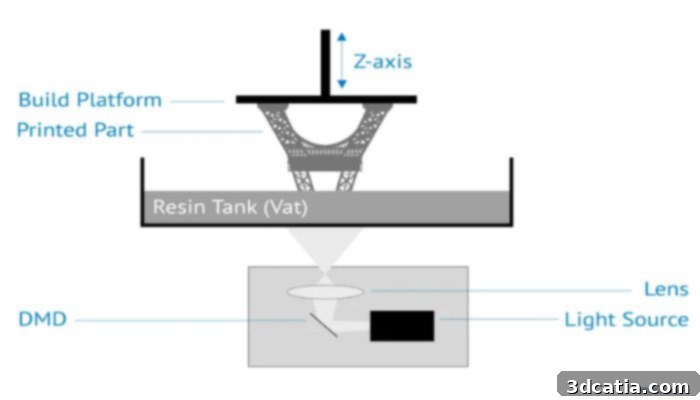
An illustration of the classic DLP process, which was originally commercialized by EnvisionTEC (photo credits: Wevolver)
Innovative Solutions and Collaborative Research Endeavors
To address the critical issue of insufficient cure depths, Professor Trice has assembled a dedicated and innovative research team. He collaborates closely with Matthew Thompson, a talented PhD student specializing in materials engineering, and Dylan Crump, a skilled ceramics research engineer at HAMTC. Together, they are embarking on a comprehensive investigation into various aspects of the additive manufacturing process, seeking to optimize every parameter to overcome the challenges posed by dark ceramic powders.
Their research spans several key areas. They are meticulously studying and developing novel resin systems, aiming to formulate photosensitive polymers that are more responsive to UV light even in the presence of dark ceramic particles. Simultaneously, the team is exploring advanced surface treatments for the ceramic powders themselves, which could potentially modify their interaction with UV light, allowing for deeper and more consistent curing. Thompson underscores the iterative and experimental nature of their work: “We’ve been operating essentially as a research and development test bed for these materials. We’ve been tuning properties and performing surface modifications to improve their performance and enhance the printing process.” This “test bed” approach allows for rapid experimentation and refinement, systematically improving the printability and overall performance of the dark ceramic materials.
Mitigating Post-Processing Hurdles and Establishing Future Pipelines
The challenges in manufacturing advanced ceramic components for hypersonic applications extend beyond the initial 3D printing phase. The post-processing stage, which includes steps like cleaning, sintering (heat treatment to densify the part), and finishing, can be particularly demanding, especially when dealing with larger or more intricate components. During these stages, issues such as delamination – where layers of the printed part peel or separate – or the formation of cracks can arise, significantly compromising the structural integrity and reliability of the final product. These defects are not merely cosmetic; they can critically jeopardize the performance of a component under the extreme stresses of hypersonic flight.
Recognizing these potential pitfalls, the PARI team is actively working to develop robust strategies to prevent such post-processing problems. Their goal is not just to create individual parts but to establish a reliable and repeatable manufacturing pipeline. Thompson further explains their broader objective: “What we’re trying to do is find solutions for how we can either set up a pipeline to make these parts or find strategies that actual stakeholders can use. So, it gives people a starting point to save time on the research and development for any new system.” This forward-thinking approach aims to provide a standardized, efficient, and reliable methodology that can be adopted by industry partners and defense contractors, thereby significantly reducing the time, cost, and risk associated with developing and deploying new hypersonic systems.
Strategic Funding and Broader Implications for National Security
The critical importance and strategic value of this research are underscored by its significant funding. This project is one of five pivotal initiatives currently being supported by the Office of the Secretary of Defense Manufacturing Science and Technology Program. This high-level endorsement highlights the research’s direct relevance to national security and advanced defense capabilities. The program works in close partnership with key defense entities, including the Naval Surface Warfare Center, Crane Division, and the National Security Technology Accelerator’s Strategic and Spectrum Missions Advanced Resilient Trusted Systems (S2MARTS). These collaborations ensure that the research remains aligned with pressing defense needs and that the technological advancements can be effectively transitioned from the laboratory to practical, operational applications.
The advancements made by the PARI team in 3D printing dark ceramics are poised to have far-reaching implications. Beyond enhancing the capabilities of hypersonic vehicles for defense, this research could pave the way for advancements in commercial hypersonic travel, high-temperature industrial applications, and even advanced space exploration. By developing materials and manufacturing processes capable of surviving the most extreme environments, Purdue is not just innovating for today but laying the foundational groundwork for the technological marvels of tomorrow. For more detailed information on this transformative project and other related research, further insights can be found by following the provided links and official publications. Find out more HERE.
What do you think of the pioneering research at PARI into 3D printed dark ceramics for demanding hypersonic applications? We invite you to share your thoughts and insights in a comment below, or engage with us on our social media channels: LinkedIn, Facebook, and Twitter! Don’t miss out on the latest advancements in additive manufacturing—remember to sign up for our free weekly Newsletter here to receive the most current 3D printing news directly in your inbox. You can also explore all our informative videos and content on our dedicated YouTube channel.
*Cover Photo Credits: Purdue University/Charles Jischke