
Revolutionizing Aerospace: AIMEN’s World-First 3D Printed Cryogenic Tank for Liquid Hydrogen
In a monumental leap for sustainable aviation, the AIMEN technology center has successfully completed the manufacture of a 3D printed cryogenic tank designed for the storage of liquid hydrogen. This groundbreaking achievement represents a world first, marking a pivotal milestone for the aeronautical industry. Confronted by an increasingly urgent imperative to drastically reduce its environmental impact, the sector is actively seeking innovative solutions. According to data from Our World in Data, aviation currently contributes approximately 2.5% of global CO₂ emissions. This figure is particularly concerning given that air travel is among the most challenging sectors to decarbonize, all while experiencing relentless growth in demand worldwide. This innovation from AIMEN offers a beacon of hope, demonstrating a tangible path towards cleaner skies.
The development of this pioneering tank is a core component of the ambitious European OVERLEAF project. Spearheaded by the Spanish company ACITURRI, the OVERLEAF initiative is dedicated to developing sustainable, high-performance solutions essential for the future of aviation. Its primary objective is the design of an advanced low-pressure liquid hydrogen (LH₂) storage system, leveraging state-of-the-art materials, sophisticated leak detection sensors, and cutting-edge manufacturing processes. This collaborative effort brings together leading research and technology centers from across Europe, including France, Italy, Norway, Romania, and Spain. Their collective ambition is to fundamentally rethink traditional aircraft architecture, enabling the seamless integration of clean, high-performance propulsion technologies that can truly transform air travel.
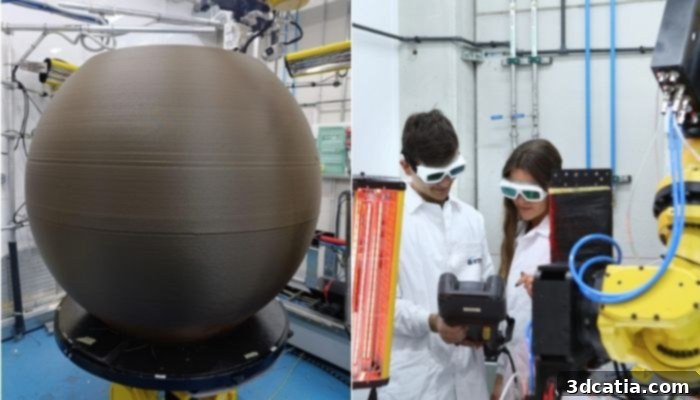
Photo Credits: AIMEN
AIMEN’s triumph lies in manufacturing a prototype cryogenic tank capable of reliably storing liquid hydrogen at incredibly low temperatures, specifically below -250°C. This feat addresses a considerable technical and engineering challenge that has long been a barrier to widespread hydrogen adoption in aerospace. Such a tank is absolutely essential for hydrogen to emerge as a credible, viable alternative to conventional fossil fuels within the aeronautical sector, where storage conditions are exceptionally demanding. The primary hurdle involved creating a structure that could not only withstand these extreme cryogenic temperatures without degradation but also be remarkably lightweight, meeting the stringent mass and performance constraints inherent in aircraft design. The successful integration of these requirements signifies a major breakthrough in material science and additive manufacturing.
The Imperative for Aviation Decarbonization: Why Hydrogen?
The aviation industry faces immense pressure to reduce its environmental footprint. While innovations like Sustainable Aviation Fuels (SAFs) offer near-term solutions, they are limited by feedstock availability and cost. Electric propulsion, particularly for larger aircraft, is severely constrained by battery weight and energy density. This makes liquid hydrogen a frontrunner in the race for long-term, truly zero-emission flight. Hydrogen, when combusted or used in fuel cells, produces only water vapor, eliminating CO₂ and other harmful emissions at the point of use. However, its extremely low boiling point (-253°C) necessitates sophisticated cryogenic storage, a challenge that AIMEN’s new tank directly addresses. The ability to store LH₂ efficiently and safely is the linchpin for unlocking hydrogen’s full potential in commercial aviation, paving the way for future aircraft that are truly eco-friendly.
What Does a 3D Printed Cryogenic Tank for Storing Liquid Hydrogen Look Like?
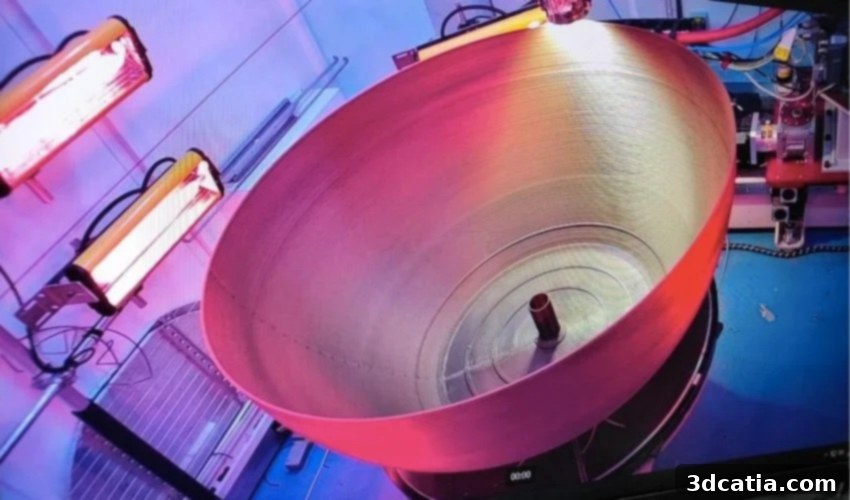
The innovative tank designed by AIMEN, boasting a significant diameter of 1.5 meters, forms the fundamental central element of the liquid hydrogen storage system (LH₂). For its intricate creation, the technology center harnessed the power of large-format, high-pressure additive manufacturing technologies. This approach was critical for achieving the required structural integrity and precise dimensions. The tank’s sophisticated structure is ingeniously composed of two distinct walls: an inner shell meticulously crafted from a high-performance thermoplastic, specifically chosen for its exceptional cryogenic insulation properties, and an outer layer fabricated from robust carbon fiber, engineered to provide the essential mechanical strength and structural rigidity required for demanding aeronautical applications. This dual-wall design is crucial for maintaining the ultra-low temperatures of liquid hydrogen while ensuring the tank can withstand operational stresses.
The entire manufacturing process unfolded within a highly advanced robotized cell, equipped with a state-of-the-art 3D printing system. This system was uniquely combined with integrated infrared heating capabilities, a critical feature for guaranteeing optimum adhesion and fusion between successive layers of material. The precision and control offered by this setup are paramount for producing components that must perform flawlessly under extreme conditions. The additive manufacturing process itself was an extensive undertaking, lasting over 100 hours of continuous operation. Throughout this prolonged period, the printing was subjected to constant and rigorous surveillance using thermal cameras, ensuring every millimeter met exacting quality standards and that the material properties were consistent throughout the entire structure. This meticulous approach underscores the complexity and importance of quality control in developing aerospace-grade cryogenic storage.
Pablo Romero, who leads the R&D group in additive composite manufacturing and skillfully coordinates the OVERLEAF project at AIMEN, eloquently expanded on the significance of this achievement. He stated, “This breakthrough represents a real technological transformation in the manufacture of components vital for sustainable aviation. We have meticulously mobilized all our collective expertise in robotics, cutting-edge 3D printing techniques, and advanced process engineering to meet a challenge of extreme technical complexity. The successful creation of this tank is not just an engineering feat; it’s a testament to what focused innovation and interdisciplinary collaboration can achieve in pushing the boundaries of aerospace technology for a greener future.”
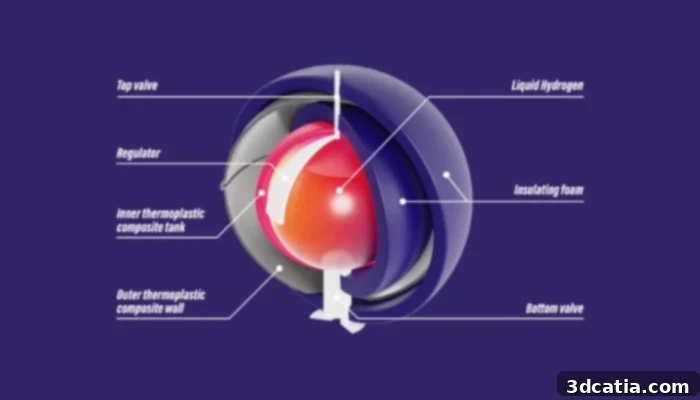
Architecture of the low-pressure liquid hydrogen storage system (image credits: OVERLEAF).
A cornerstone of this groundbreaking reservoir’s development was the strategic collaboration with the French technology center CANOE. Working in synergy, these two pioneering institutions developed an entirely new composite material. This innovative composition uniquely combines a biosourced thermoplastic with reinforcing natural fibers. This novel blend represents a significant step forward, making it possible to produce structural components that are not only exceptionally lightweight and robust but also inherently environmentally sustainable. This development perfectly exemplifies the OVERLEAF project’s unwavering commitment to the ambitious objectives outlined in the European Green Pact 2050, particularly within the critical domain of sustainable aviation. The integration of biosourced materials offers a dual benefit: reducing reliance on fossil-based polymers and potentially lowering the overall carbon footprint of aircraft manufacturing, aligning with a holistic approach to sustainability from production to operation.
Pioneering Sustainable Materials: The Green Impact
The material innovation achieved through the CANOE collaboration cannot be overstated. By developing a composite that incorporates biosourced thermoplastics and natural fibers, the project is addressing sustainability not just in operation (via hydrogen fuel) but also in manufacturing. Traditional aerospace composites often rely on petroleum-based resins and energy-intensive manufacturing. This new material offers a pathway to reducing the embodied energy and carbon footprint of aircraft components. It showcases how advanced material science, combined with additive manufacturing, can create a virtuous cycle of sustainability, pushing the boundaries of what’s possible for green aerospace. This kind of material development is critical for meeting the stringent environmental targets set by initiatives like the European Green Pact 2050, which aims for climate neutrality across the EU by mid-century. The adoption of such materials could significantly accelerate the transition to a circular economy within the aerospace supply chain.
The Broader Impact: Paving the Way for Green Skies
AIMEN’s successful development of this 3D printed cryogenic tank is far more than just an isolated technical achievement; it represents a profound shift in how the aerospace industry approaches decarbonization. This breakthrough provides a tangible, high-performance solution to one of the most persistent challenges in hydrogen aviation: safe, efficient, and lightweight storage. By validating the feasibility of manufacturing such complex components using additive techniques, AIMEN has opened doors for future innovations across the entire aircraft architecture. It proves that additive manufacturing is not just for prototyping but is ready for critical, flight-worthy parts operating under extreme conditions. This success story will undoubtedly inspire further research and investment in hydrogen infrastructure for aviation, moving the dream of zero-emission flights closer to reality. It signals a new era where material science, advanced manufacturing, and sustainable energy converge to redefine the future of air travel.
Beyond the Tank: What’s Next for Hydrogen Aviation?
While the successful manufacture of the prototype tank is a significant step, the journey towards widespread hydrogen-powered flight is ongoing. The next crucial phases will involve rigorous testing and validation of the tank’s performance under simulated flight conditions, including durability, thermal cycling, and pressure resistance. Following successful validation, the focus will shift to scaling up production and integrating these tanks into actual aircraft designs. Certification processes for new aerospace components are notoriously stringent, requiring extensive data and proven reliability. The OVERLEAF project, with its collaborative European framework, is well-positioned to navigate these challenges, aiming to integrate these advanced storage systems into future aircraft designs. This groundbreaking work by AIMEN is a vital piece of the puzzle, accelerating the aerospace industry’s transition towards a cleaner, more sustainable future, with hydrogen at the forefront of this green revolution.
What do you think of this revolutionary 3D printed cryogenic tank and its potential impact on sustainable aviation? Let us know in a comment below or on our LinkedIn, Facebook, and Twitter pages! Don’t forget to sign up for our free weekly Newsletter here, the latest 3D printing news straight to your inbox! You can also find all our videos on our YouTube channel. For more 3D printing news in the aerospace and defense sectors, check out our dedicated page HERE.
*Cover Photo Credits: AIMEN Technological Center