
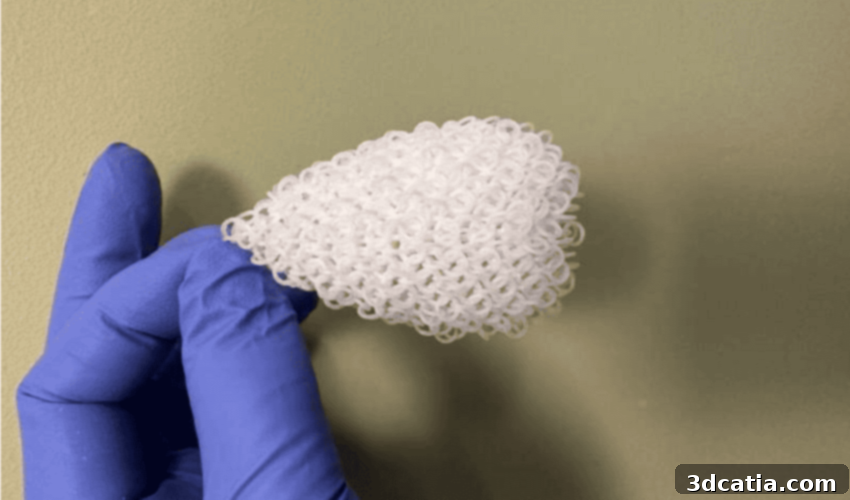
Exploring Polycatenated Architectural Materials (PAMs): The Future of Adaptive 3D Structures and Design
The landscape of architecture and design is continually reshaped by groundbreaking advancements in materials science. Among the most exciting recent developments are Polycatenated Architectural Materials (PAMs), a revolutionary class of substances engineered to interweave and create extraordinarily unique three-dimensional structures. These innovative materials are poised to redefine how we conceive and construct objects, offering unprecedented properties across a multitude of sectors, from advanced engineering to transformative design.
At the forefront of this pioneering research is a collaborative team comprising engineers and scientists from the California Institute of Technology (Caltech), Lawrence Livermore National Laboratory, and Princeton University. Their collective effort has culminated in the creation of a material unlike any seen before. Unlike traditional materials that are either granular or crystalline, PAMs exhibit a remarkable duality: they can seamlessly transition between a fluid and a solid state, depending on the specific stress applied to them. This dynamic responsiveness, coupled with their intricate wireframe capabilities, allows for the creation of complex 3D structures with entirely novel physical attributes. Fabricated primarily through advanced 3D printing techniques, PAMs offer designers and engineers a powerful new paradigm for rethinking conventional designs and fabricating objects with surprising and highly adaptable functionalities.
Understanding the Science Behind Polycatenated Materials (PAMs)
The essence of PAMs lies in their distinctive structural composition, which can be visualized as an intricate network of interlinked chains – similar to the links of a chain, but arranged in an original and highly engineered fashion. The term “polycatenated” itself refers to this multi-linked, interwoven arrangement of molecular or macroscopic components. This design principle emerged from extensive research into how individual elements can be precisely linked together to form complex, macroscopic structures that exhibit emergent properties not found in their constituent parts. A detailed account of their fabrication methods and the fascinating properties observed during rigorous testing was documented and published by the research team in the prestigious journal, *Science*.
What truly sets PAMs apart is their unique mechanical behavior. By transcending the conventional categories of granular or crystalline materials, they unlock a spectrum of mechanical responses. This means they are not simply soft or hard; rather, their stiffness and form can be actively manipulated. The ability to switch between fluid-like flexibility and solid-like rigidity under specific mechanical stimuli represents a significant leap in material science. This dynamic behavior is a direct consequence of their interwoven structure, where the interlocking elements can slide past each other when unconstrained (fluid-like) but lock into place when pressure is applied (solid-like). This inherent adaptability paves the way for materials that can intelligently respond to their environment, offering unprecedented control over their physical characteristics.
3D Printing: The Indispensable Tool for PAMs Fabrication
The realization of Polycatenated Architectural Materials is inextricably linked to the capabilities of advanced 3D printing technology. This additive manufacturing process is not merely a convenience but an essential component in creating the intricate, precise geometries that define PAMs. With 3D printing, researchers possess the unparalleled ability to manufacture complex structures such as interconnected rings, precise hexagons, and other highly specific geometric forms with micron-level accuracy. Traditional manufacturing methods would struggle, or even fail, to achieve such elaborate and customizable designs, which are fundamental to the interweaving nature of PAMs.
The precision offered by 3D printing enables the fine-tuning of the interlinking elements, allowing for meticulous control over the material’s eventual properties. This technological synergy facilitates rapid prototyping and iterative design, crucial steps in the development of novel materials. Engineers can quickly experiment with different structural configurations and material compositions, printing and testing new iterations in a fraction of the time it would take with conventional methods. This not only accelerates the research and development cycle but also opens up a vast array of potential applications where customization and geometric complexity are paramount. From architectural projects requiring unique structural components to highly specialized materials designed for the extreme conditions of space, 3D printing ensures that PAMs can be tailored to exact specifications, modified as required for diverse and demanding environments.
Revolutionary Properties and Their Multifaceted Potential
Through extensive experimentation with various assembly methods and material compositions, the research team uncovered several astonishing characteristics of PAMs. One of the most striking findings was the development of objects that could remain flexible and fluid-like when undisturbed, yet instantly become rigid and hard upon the application of external pressure. Imagine adaptive cushioning that absorbs impact by stiffening only when necessary, or reconfigurable tools that can change their form and strength on demand. This dual-state capability offers transformative potential for applications requiring intelligent, on-the-fly material adaptation, such as advanced protective gear, adaptive architectural facades, or even morphing aircraft components.
Furthermore, other specially printed PAM structures exhibited active, muscle-like behaviors. These materials demonstrated the ability to repel each other and, once interconnected, could actively contract or bend in response to stimuli. This “active” material property mimics biological muscles, suggesting profound implications for the field of soft robotics, prosthetics, and biomimetic design. Envision soft robotic grippers that can delicately handle fragile objects, or adaptive prosthetic limbs that dynamically adjust their stiffness and form. These muscle-like PAMs could lead to the creation of truly smart materials that not only respond to forces but can also generate force, enabling unprecedented levels of autonomy and adaptability in engineered systems.
Diverse Applications: From Earth to Orbit and Beyond
The unique combination of properties offered by Polycatenated Architectural Materials unlocks a vast spectrum of applications across numerous industries. Researchers are actively exploring futuristic uses, particularly in the demanding realm of space exploration.
For space missions, where every gram of weight is critical and environmental conditions are extreme, PAMs offer significant advantages. Their inherent flexibility allows for compact stowage and deployment, meaning structures can be launched in a small, dense package and then expanded to full size in space. Their adaptability would enable them to withstand drastic temperature fluctuations and radiation, while their lightweight nature would drastically reduce fuel consumption and launch costs. Imagine deployable habitats that self-assemble on planetary surfaces, robotic arms that can adapt their grip to various tasks, or even flexible solar arrays that can change shape to optimize energy capture. The potential for reducing the overall weight of space structures, while simultaneously enhancing their resilience and functionality, is an absolute game-changer for future extraterrestrial endeavors.
Beyond space, PAMs promise to revolutionize terrestrial applications:
- Architecture and Construction: Dynamic facades that respond to sunlight or wind, self-repairing infrastructure, lightweight yet robust structural components, and reconfigurable interior spaces that can adapt to changing needs.
- Robotics: The muscle-like properties of PAMs are ideal for soft robotics, enabling the creation of robots that can move more naturally, interact safely with humans, and navigate complex, unstructured environments with greater dexterity.
- Automotive and Aerospace: Lightweight, impact-absorbing chassis components, adaptive aerodynamics that can change shape during flight, and customizable interior elements that enhance passenger safety and comfort.
- Biomedical Devices: Development of advanced prosthetics that mimic natural muscle function, flexible implants that better integrate with biological tissues, and even smart drug delivery systems that respond to physiological cues.
- Defense and Security: Adaptive armor that hardens upon impact, stealth materials that can alter their electromagnetic signature, and reconfigurable shelters for rapid deployment in challenging terrains.
The Road Ahead: Challenges and Future Prospects
While the potential of Polycatenated Architectural Materials is immense, their development is still in its early stages. Several challenges need to be addressed before PAMs can achieve widespread commercial adoption. These include optimizing material properties for specific applications, scaling up production from laboratory-based 3D printing to industrial manufacturing volumes, and reducing the associated costs of specialized polymers and advanced printing techniques. Further research is also required to understand the long-term durability, fatigue resistance, and environmental impact of these novel materials. However, the collaborative nature of the research and the rapid pace of innovation in materials science suggest a promising future.
As research continues, PAMs are expected to move beyond experimental prototypes into tangible solutions, ushering in an era of truly adaptive and intelligent materials. The ability to design and produce materials with such dynamic and customizable properties represents a fundamental shift in engineering possibilities, promising to deliver solutions for some of humanity’s most complex challenges.
You can delve deeper into the scientific intricacies of this breakthrough by accessing the full study HERE.
What are your thoughts on these revolutionary polycatenated architectural materials (PAMs) and their potential to transform various industries? We invite you to share your insights in a comment below or join the discussion on our social media channels: LinkedIn, Facebook, and Twitter. Don’t miss out on the latest advancements in 3D printing and materials science – sign up for our free weekly Newsletter here to receive top industry news directly in your inbox. For more visual content, explore all our videos on our dedicated YouTube channel.