
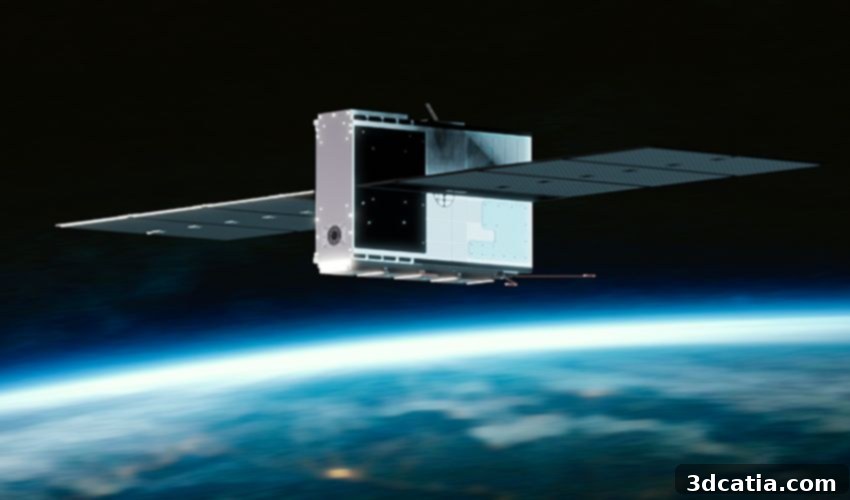
Fleet Space Technologies Propels Space Exploration with 3D-Printed Centauri 5 Satellite Launch
Fleet Space Technologies, the innovative Australian company renowned for its ambitious plans to deploy fully 3D-printed Alpha satellites to the Centauri constellation, recently achieved a monumental milestone. While the Alpha satellites are still in development, the company celebrated a significant leap forward on May 26th, launching its Centauri 5 satellite aboard the SpaceX Falcon 9 Transporter-5 mission. This marked Fleet Space’s third successful collaboration with SpaceX, underscoring a robust partnership dedicated to advancing space technology. Crucially, the Centauri 5 satellite integrates cutting-edge 3D printing into its design, most notably in its pioneering all-metal patch antennas, signaling a new era for additive manufacturing in orbital applications.
The past few years have witnessed additive manufacturing (AM) assume an increasingly pivotal role in the evolution of Australia’s defense and space technology sectors. Visionary companies like Fleet Space and SPEE3D are at the forefront, leveraging 3D printing to revolutionize part fabrication. Their efforts demonstrate how AM can enable faster production cycles, reduce manufacturing costs, and unlock complex, previously unachievable geometries for critical aerospace components. This transformative approach is particularly significant given that Australia’s burgeoning space technology industry is projected to reach an impressive valuation of $12 billion AUD (approximately $8.6 billion USD). Such a dynamic economic landscape provides an exceptionally fertile ground not only for the widespread adoption of 3D printing technologies but also for fostering unprecedented innovation across the entire additive manufacturing spectrum. This strategic embrace of AM is positioning Australia as a key player in the global space race, driving both technological advancement and economic growth within the sector.
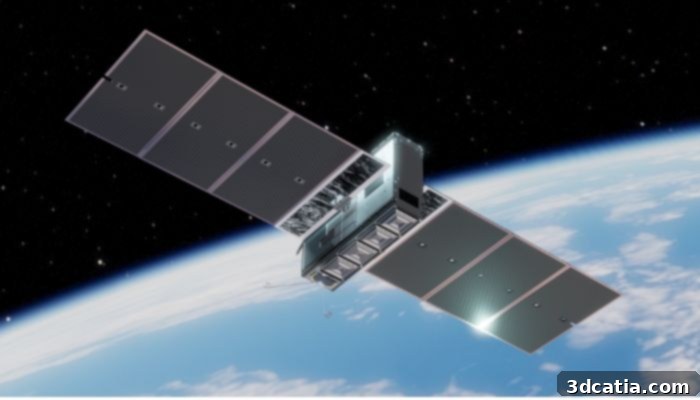
The Centauri 5 satellite features the world’s first entirely 3D-printed, all-metal patch antennas (photo credits: Fleet Space Technologies)
Unveiling the Centauri 5 Satellite: A New Era for IoT Connectivity
Now successfully deployed, the Centauri 5 satellite is positioned in Low Earth Orbit (LEO) at an altitude of approximately 530 kilometers (330 miles). Its primary mission is to significantly enhance and expand connectivity for current and future generations of Internet of Things (IoT) devices across the globe. This latest addition substantially bolsters Fleet Space’s already formidable satellite fleet, which includes six Centauri constellation satellites operated in close collaboration with Tyvak International. The strategic deployment of satellites in LEO is critical for IoT applications, offering advantages such as reduced latency, improved signal strength, and the ability to cover vast, often remote, geographical areas where traditional terrestrial networks are impractical or non-existent. This ensures seamless data transmission for applications ranging from asset tracking and environmental monitoring to smart agriculture and remote infrastructure management.
A groundbreaking feature of the Centauri 5 satellite, proudly touted by Fleet Space as a world-first, is its integration of entirely 3D-printed, all-metal patch antennas. Patch antennas are a type of antenna characterized by their low profile and ability to be mounted directly onto a surface, making them ideal for compact satellite designs. The innovation lies not just in their 3D-printed nature but in their composition: these are fully all-metal components. This design choice provides numerous benefits crucial for space applications, including superior thermal stability, enhanced durability against the harsh conditions of space (such as radiation and extreme temperature fluctuations), and optimized radio frequency performance. The ability to precisely control the internal geometries and material properties through metal additive manufacturing techniques allows for highly efficient and robust antenna designs that would be challenging, if not impossible, to achieve with conventional manufacturing methods.
This particular advancement holds immense significance for Fleet Space, as the company explicitly states that breakthroughs in 3D printing technology are instrumental in the ongoing development of its ambitious, fully 3D-printed Alpha constellation, slated for launch in 2023. The Centauri 5 serves as a crucial testbed and proof-of-concept for the advanced manufacturing techniques that will underpin the Alpha constellation. While Fleet Space has not yet divulged extensive details regarding the specific additive manufacturing technologies employed for these innovative satellites, it is reasonable to infer that, unlike many satellite projects that might utilize plastics or composite materials, this endeavor heavily relies on sophisticated metal additive manufacturing processes. Techniques such as Direct Metal Laser Sintering (DMLS) or Selective Laser Melting (SLM) are commonly used in aerospace for their ability to produce high-performance, lightweight, and complex metal components, making them strong candidates for the production of these groundbreaking antennas and other structural elements. The success of Centauri 5 validates the reliability and efficacy of such advanced manufacturing methods in the challenging space environment.
Fleet Space’s Strategic Vision: Connecting Earth and Beyond
Flavia Tata Nardini, CEO and Co-Founder of Fleet Space, articulated the company’s core philosophy, stating, “We’ve built our business and reputation by consistently delivering on our stated goals, and developing technologies that address real human and commercial needs reliably and cost-effectively. Centauri 5 will bring important new capabilities to our existing constellation. It also supports the development of our forthcoming Alpha constellation, which enables our pioneering ExoSphere mineral exploration tool with transformational benefits for the exploration of critical energy transition materials.”
This statement encapsulates Fleet Space’s dual commitment: to enhance global connectivity and to pioneer sustainable solutions for pressing global challenges. The Centauri 5 satellite’s expanded capabilities will directly contribute to a more robust and responsive global IoT network, serving industries that require reliable data from remote locations. Beyond connectivity, Fleet Space is leveraging its satellite technology to power its revolutionary ExoSphere mineral exploration tool. ExoSphere represents a paradigm shift in the mining sector, offering a non-invasive, satellite-enabled approach to mineral discovery. This system utilizes a network of wireless seismic sensors on the ground, which communicate data directly to Fleet Space’s satellite constellation. The satellites then relay this vital information to exploration teams, allowing them to map subsurface geology and identify potential mineral deposits with unprecedented speed and accuracy.
The implications of ExoSphere are profound, particularly in the context of the global energy transition. As the world shifts towards renewable energy sources and electric vehicles, the demand for critical energy transition materials such as lithium, cobalt, rare earth elements, and copper is skyrocketing. Traditional mineral exploration methods are often time-consuming, expensive, and can have significant environmental footprints. ExoSphere offers a sustainable alternative, drastically reducing the need for destructive exploratory drilling and enabling more targeted, efficient, and environmentally responsible resource identification. By accelerating the discovery of these vital materials, Fleet Space is playing a crucial role in enabling the widespread adoption of green technologies and supporting the transition to a sustainable global economy. The advancements in 3D printing, exemplified by Centauri 5, are integral to making these complex, high-performance satellite networks a reality, showcasing the deep synergy between advanced manufacturing and cutting-edge space applications.
The Future Landscape: 3D Printing and Australia’s Space Ambitions
The successful launch of Centauri 5 and the ongoing development of the Alpha constellation highlight a broader trend: the increasing reliance on additive manufacturing to redefine the possibilities within the aerospace and defense sectors. 3D printing enables the creation of lighter, more structurally optimized components, which translates directly into lower launch costs and greater payload capacity for satellites. Furthermore, the ability to rapidly iterate designs and produce bespoke parts on demand significantly accelerates development cycles, allowing companies like Fleet Space to bring new technologies to market faster. This agility is vital in the dynamic and competitive space industry, where innovation is key to maintaining a leadership position.
Australia’s strategic investments in its space industry, coupled with the ingenuity of companies like Fleet Space, underscore a national commitment to becoming a global leader in advanced space technology. The integration of 3D printing not only fosters a robust domestic manufacturing capability but also positions the nation at the forefront of sustainable space exploration and utilization. As satellite constellations grow in number and complexity, 3D printing will continue to be an indispensable tool for their rapid, cost-effective, and high-performance production. Fleet Space Technologies, through its pioneering work with Centauri 5 and the forthcoming Alpha satellites, is not merely launching hardware into orbit; it is actively shaping the future of global connectivity, resource management, and sustainable technological advancement from space.
What are your thoughts on Fleet Space’s Centauri 5 satellite launch and the transformative role of 3D printing in this project? We invite you to share your insights in a comment below or connect with us on our LinkedIn, Facebook, and Twitter pages! Don’t miss out on the latest 3D printing news and innovations – remember to sign up for our free weekly Newsletter here, delivered straight to your inbox! You can also explore all our compelling video content on our YouTube channel.