
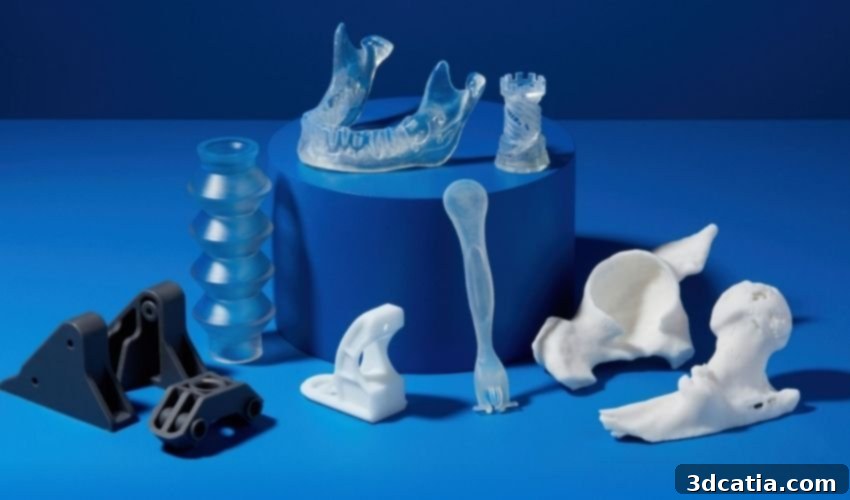
Formlabs Report Reveals Soaring 3D Printing Adoption and Strategic Industry Shifts
Formlabs, a leading innovator in the 3D printing sector, recently unveiled its inaugural comprehensive market study, aptly titled the “2022 3D Printing Application Report.” This pivotal market research, executed in collaboration with Industry Week and Machine Design, gathered insights from over 400 respondents in November 2021. The report offers an unparalleled look into the significant evolution of attitudes and adoption rates surrounding additive manufacturing (AM). According to Formlabs, the landscape of 3D printing has transformed dramatically over the past two years, propelled by shifts in consumer behavior and increasingly dynamic industry requirements. Crucially, the study provides concrete evidence for what many in the industry have already observed: 3D printers are no longer confined to merely producing prototypes but are increasingly being leveraged for advanced industrial applications, including the direct manufacturing of end-use parts. This paradigm shift underscores additive manufacturing’s growing strategic importance across diverse sectors.
In the report’s introduction, Maxim Lobovsky, co-founder and CEO of Formlabs, highlighted the profound impact of the global pandemic as a catalyst for a broader digital revolution within manufacturing. He articulated, “Over the past few years, we have seen a rapid expansion of digital fabrication applications into manufacturing processes. Accelerated by COVID supply chain disruptions, we’ve seen 3D printing add flexibility, mitigate risk, streamline workflows, and support traditional manufacturing methods in new and exciting ways.” Lobovsky further emphasized that the manufacturing sector, in particular, has experienced substantial benefits, with numerous companies steadily expanding their in-house 3D printing capabilities to meet new challenges and seize emerging opportunities. This expansion is a testament to the technology’s adaptability and its critical role in navigating an uncertain global economy.
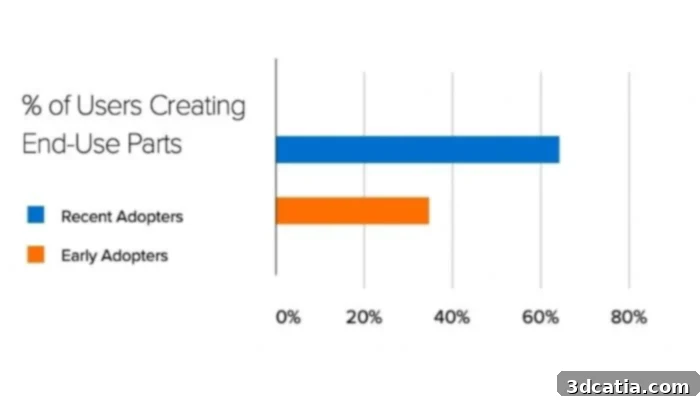
More and more companies are using additive manufacturing for the production of end-use parts (photo credits: Formlabs)
A compelling revelation from the study is that nearly half of the companies surveyed have already established dedicated internal teams focused exclusively on additive manufacturing. This trend strongly suggests that 3D printing is bridging the historical divide between mass production and bespoke customization, ushering in an era where both can coexist and thrive. This powerful synergy is empowering an increasing number of businesses to transcend the traditional confines of prototyping and venture into the direct 3D printing of functional end-use parts. While rapid prototyping (cited by 58% of respondents) and the creation of models and props (53%) remain crucial applications, the report clearly indicates that the utility of 3D printing is significantly expanding beyond these initial uses. Enhanced design flexibility, superior material durability, and a host of other advanced features are enabling companies to leverage additive manufacturing for the creation of final, ready-to-market products. Indeed, a remarkable 60% of existing 3D printing users are already employing the technology for their final products, a trend mirrored by one-third of new adopters who are similarly integrating AM into their end-product manufacturing workflows from the outset.
Formlabs Study Highlights Significant Growth in 3D Printing Adoption Across Industries
The Formlabs report meticulously chronicles the tremendous surge in 3D printer adoption since the onset of the global pandemic in March 2020. This period forced countless companies to fundamentally rethink and redesign their entire manufacturing processes. The study’s findings underscore that, in order to consistently meet evolving customer demands, organizations must strategically re-evaluate how they utilize 3D printers. A particular emphasis should be placed on leveraging AM to address critical supply chain vulnerabilities, facilitate personalized product development, and enable the cost-effective and efficient production of small-batch items. This strategic application of additive manufacturing allows companies to satisfy diverse customer needs with unprecedented agility, whether it involves producing highly customized headphones or rapidly launching the latest sneaker designs. Ultimately, the core takeaway is that businesses increasingly recognize AM as a significant competitive differentiator, empowering them to accelerate innovation and bring cutting-edge products to market with greater speed and efficiency.
The versatility of the 3D printer has long since eclipsed that of a simple all-around tool, evolving into a sophisticated manufacturing solution. Its inherent adaptability offers the unique capability to sustain entire production lines, even when necessitating the use of diverse materials. This flexibility has proven invaluable in navigating the complexities of modern supply chains. According to the survey data, a substantial 57% of respondents indicated that they primarily deploy additive manufacturing as a robust solution to mitigate supply chain disruptions and bolster resilience. By doing so, companies gain the critical advantage of establishing and controlling their internal 3D printing capabilities, thereby significantly reducing their dependency on external suppliers and fostering greater operational autonomy. This strategic shift translates into more secure and responsive manufacturing operations.
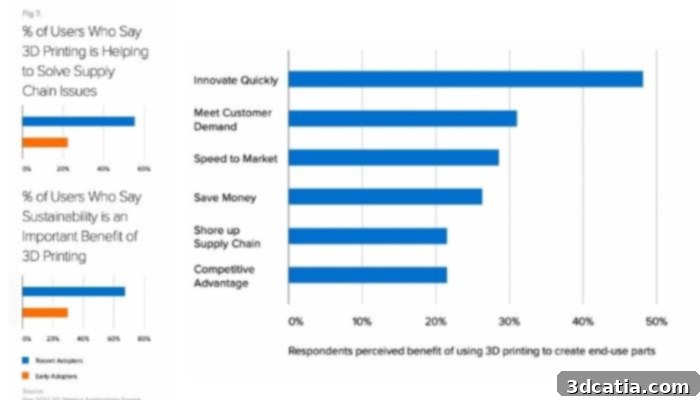
Sustainability and fewer nodes in the supply chain are crucial points for the companies (photo credits: Formlabs)
Formlabs’ report illuminates how additive manufacturing provides companies with a profoundly more flexible and agile production method that is not only inherently less expensive but also significantly faster than traditional approaches. A key insight revealed is that integrating in-house manufacturing through 3D printing substantially reduces the number of intermediaries, or “nodes,” within the supply chain. This streamlining directly leads to shorter lead times for product development and delivery. Consequently, the final product can reach the customer more rapidly and often at a more competitive price point. Beyond the critical concerns of supply chain efficiency, sustainability has emerged as another paramount issue, identified as crucial by an impressive 70% of new 3D printer users. Interestingly, among existing users, a smaller but still significant 30% view sustainability as a primary deciding factor for adopting additive manufacturing, highlighting a growing consciousness of environmental impact across different user groups.
Analyzing the participating companies, a notable 72% affirmed their current utilization of 3D printing technology. This figure, however, merits further nuance regarding their operational preferences: a substantial 76.4% of these companies opt for internal use of their own 3D printing machines, emphasizing a trend towards in-housing AM capabilities. Conversely, the remaining 23.6% choose to outsource their 3D printing-related business activities to third-party providers, indicating a strategic decision based on factors like expertise, capital expenditure, or specific project requirements. Regarding technology adoption, Fused Deposition Modeling (FDM), also known as Fused Filament Fabrication (FFF), remains the most commonly employed method, primarily attributed to its comparatively low entry cost and ease of use. Nevertheless, as companies increasingly transition to producing end products directly through 3D printing, they are simultaneously adapting and diversifying their technological portfolios. Accordingly, Stereolithography (SLA) is now utilized by 56% of users, and Selective Laser Sintering (SLS) by 44%. Both SLA and SLS have seen a marked increase in adoption compared to previous years, reflecting their suitability for higher-fidelity parts and more complex geometries, while FDM has experienced a slight decrease in its relative share for end-part production, though it still dominates for prototyping and low-cost applications.
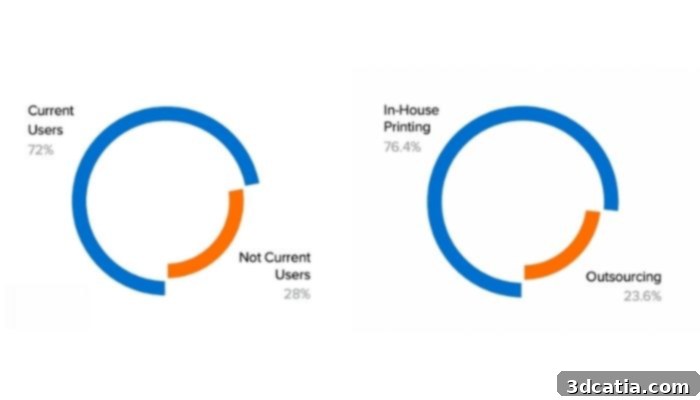
Around three quarters of the companies surveyed benefit from internal 3D printing capabilities (photo credits: Formlabs)
Future-Proofing: Sustained Investment and Growth in 3D Printing Expected Through 2022 and Beyond
The forward-looking insights derived from Formlabs’ market research paint a distinctly positive trajectory for the future of 3D printing. The outlook projects sustained growth and increased strategic investment within the additive manufacturing sector. A compelling 64% of companies that have integrated additive manufacturing within the past two years are planning medium to large-scale investments in 3D printing during 2022, signaling strong confidence in the technology’s immediate value. Furthermore, approximately 70% of all surveyed companies express intentions to invest similarly within the next two years. This robust commitment is largely underpinned by the widespread belief—shared by three out of four companies—that 3D printing has fundamentally revolutionized manufacturing as a whole. This perceived revolution manifests primarily in a profound shift towards more customized product design and production, perfectly aligning with contemporary customer preferences for personalized goods and solutions. Additionally, a significant 72% of respondents firmly believe that 3D printing is unequivocally enabling more customized manufacturing processes, while an equally impressive 71% assert that additive manufacturing is rapidly becoming a foundational cornerstone in both manufacturing operations and product development strategies.
In conclusion, Formlabs’ report clearly indicates that the demands placed upon the global job market are set to continue their transformative evolution in the years ahead. Proficiency in Computer-Aided Design (CAD) software and practical experience in 3D printing are rapidly ascending in importance, becoming increasingly critical skills for the modern workforce. This necessitates a proactive response from universities and other educational institutions, which must adapt and modernize their curriculum to incorporate a wider range of relevant software and hardware training. By doing so, they can effectively equip the next generations of engineers, designers, and technicians with the optimal skillset required to thrive in an additive manufacturing-driven economy. For those interested in delving deeper into these insights and understanding the full scope of Formlabs’ findings, the comprehensive report is available for free download HERE.
*Cover Photo Credits: Formlabs
What are your thoughts on this latest study from Formlabs? Have you personally observed an increased adoption of 3D printing technologies within your industry or organization over the past year? We invite you to share your insights in a comment below or engage with us on our Linkedin, Facebook, and Twitter pages! Don’t forget to sign up for our free weekly Newsletter here, ensuring you receive the latest 3D printing news directly to your inbox! You can also explore all our informative videos and content on our dedicated YouTube channel.