
Exploring the Cutting Edge: Top 5 3D Printing Innovations Driving Additive Manufacturing Forward
Welcome to our weekly dive into the dynamic world of additive manufacturing! This week, we’ve curated the top five most impactful videos showcasing how 3D printing technology is not just evolving, but fundamentally transforming various industries and production processes. From intricate medical devices to robust automotive components, and even groundbreaking space exploration, the reach of additive manufacturing continues to expand at an astonishing pace. Our hand-picked selection highlights crucial advancements and applications across diverse sectors, including medical, automotive, and beyond. These innovations are reshaping how products are designed, manufactured, and utilized, promising a future of unprecedented efficiency and customization. We encourage you to watch these videos to stay abreast of the latest developments and understand the profound implications of these technologies. If you find this compilation insightful, remember you can explore an even wider array of 3D printing videos on our dedicated YouTube channel. We hope you enjoy this journey through the forefront of additive manufacturing and have an insightful reading experience!
Top 1: Optimizing Metal 3D Printing with Inert Gases for Superior Quality
In the realm of metal additive manufacturing, achieving unparalleled quality and precision in manufactured parts is not merely an advantage, but an absolute necessity. This is particularly true for critical components deployed in demanding sectors such as aerospace and automotive, where material integrity and structural reliability are paramount. A fundamental challenge in these high-stakes applications is preventing impurities from contaminating the metal material during the intricate 3D printing process. Even trace amounts of oxygen or moisture can compromise the mechanical properties, leading to defects, reduced strength, and ultimately, part failure. To counteract this, manufacturers must operate within hyper-controlled, inert environments. These specialized environments are meticulously purged of reactive atmospheric gases and instead are exclusively filled with inert, or chemically inactive, gases such as argon or nitrogen. This stringent control is crucial across various advanced metal additive manufacturing techniques, including directed energy deposition, electron beam melting, selective laser sintering, binder jetting, and powder bed fusion. Each of these methods involves high-energy processes that can make metals highly reactive, underscoring the importance of an inert atmosphere. This is precisely where industry leaders like Air Products play a vital role. Specializing in the production and supply of industrial gases, Air Products offers comprehensive solutions to optimize gas usage in metal additive manufacturing. In this compelling video, Air Products delves into the scientific principles and practical applications behind optimizing these inert gases, explaining how their precise control and delivery can significantly enhance the quality, consistency, and structural integrity of 3D printed metal components, thus pushing the boundaries of what’s achievable in advanced manufacturing.
Top 2: 3DCeram Sinto Unveils the Future of Ceramic 3D Printing
For centuries, traditional manufacturing has leveraged the extraordinary high-performance properties of ceramics, prized for their exceptional heat resistance, hardness, and chemical inertness. It was only a matter of time before the transformative capabilities of additive manufacturing began to unlock new possibilities for this remarkable material. While materials like metal and plastic have seen more widespread adoption in the early days of 3D printing, ceramics are rapidly emerging as a game-changer, albeit being relatively newer to the additive manufacturing landscape. The unique inherent qualities of ceramics – including their superior mechanical strength, thermal stability, chemical resistance, and electrical insulation properties – make them indispensable for a growing array of demanding applications that traditional materials simply cannot fulfill. These attributes are highly sought after in advanced manufacturing, particularly in sectors requiring components to withstand extreme conditions. As a result, a multitude of innovative companies are now keenly investing in and exploring ceramic 3D printing. Among these pioneers is 3DCeram Sinto, a company at the forefront of this exciting field. In this enlightening video, 3DCeram Sinto expertly outlines the myriad advantages that ceramic materials offer when processed through additive manufacturing. They specifically demonstrate how their advanced stereolithography (SLA) technology is being utilized to precisely develop and fabricate incredibly complex ceramic structures. These intricate parts are not only aesthetically precise but also functionally superior, finding critical applications in highly specialized industries such as the medical sector, where biocompatibility and precision are crucial for implants and surgical tools, and the aerospace sector, where lightweight, high-temperature resistant components are essential for optimal performance. The video highlights how ceramic 3D printing is breaking new ground, enabling designs and functionalities previously deemed impossible, thereby paving the way for a new generation of high-performance components across various industrial applications.
Top 3: Introducing the Terran 1 – The World’s First Fully 3D Printed Rocket by Relativity Space
In a bold pursuit of humanity’s multi-planetary future, Relativity Space is leveraging the transformative power of 3D printing technology to redefine rocket manufacturing. This visionary company is not only establishing the first autonomous rocket factory, aiming to provide launch services for satellites with unprecedented efficiency, but it has also achieved a monumental feat: building the first-ever fully 3D printed rocket, christened the Terran 1. The Terran 1 stands as a testament to the revolutionary capabilities of additive manufacturing. It is additively manufactured using Relativity’s proprietary “Stargate” 3D printer, which is itself one of the largest metal 3D printers in the world. The impact of this approach is staggering: the Terran 1 requires less than 1,000 individual parts, a dramatic reduction from the tens of thousands typically found in conventionally manufactured rockets. Furthermore, its entire structure can be built in a mere two months, with iteration cycles taking as little as six months. This represents a seismic shift from traditional rocket manufacturing methods, which often demand years of intricate assembly and labor-intensive processes. Thanks to the agility and speed afforded by 3D printing, Relativity Space has been able to compress the timeline from raw materials to a flight-ready rocket down to an astonishing sixty days. This exponential increase in speed and reduction in complexity not only slashes production costs but also allows for rapid design iterations, enabling engineers to quickly test, refine, and improve rocket designs. This agility is critical for the fast-evolving space industry, where constant innovation is key. The video below provides an in-depth look into Relativity Space’s groundbreaking Terran 1 rocket and the innovative Stargate technology that is propelling humanity closer to a multi-planetary existence, showcasing how additive manufacturing is literally launching us into the future.
Top 4: A Glimpse Inside a Restaurant Serving Revolutionary 3D Printed Meat
Over the past few years, the 3D printed meat industry has witnessed an extraordinary surge in growth, accompanied by rapid advancements in biotechnology and material science. This burgeoning sector has seen the emergence of numerous innovative startups, while many more established food companies and restaurateurs have begun to seriously explore and incorporate this cutting-edge technology into their offerings. The impetus behind this shift is profound and multifaceted. The industrial production of traditional meat is a well-documented contributor to global greenhouse gas emissions, deforestation, and water scarcity, playing a significant role in exacerbating the ongoing climate crisis. As global consumers become increasingly environmentally conscious and ethically aware of their food choices, there is a growing demand for sustainable and cruelty-free alternatives. It comes as no surprise, then, that companies are turning to advanced solutions like 3D printing to produce a less harmful and more ethical alternative to conventional meat products. Additively manufacturing meat offers several compelling advantages, including the potential for enhanced speed, greater cost efficiency, and the ability to precisely control nutritional content and texture. This technology allows for the creation of intricate meat structures from plant-based proteins or cultivated animal cells, replicating the appearance, taste, and mouthfeel of conventional meat without the associated environmental footprint or ethical concerns. This fascinating video offers an exclusive look inside a restaurant that is pioneering the integration of 3D printed meat into its culinary repertoire. It explores how chefs are experimenting with these novel ingredients to craft innovative dishes and delves into the broader implications of this technology. The segment examines how 3D printed meat is poised to significantly impact the future of food manufacturing, supply chains, and consumer dining experiences, offering a glimpse into a sustainable and technologically advanced culinary landscape.
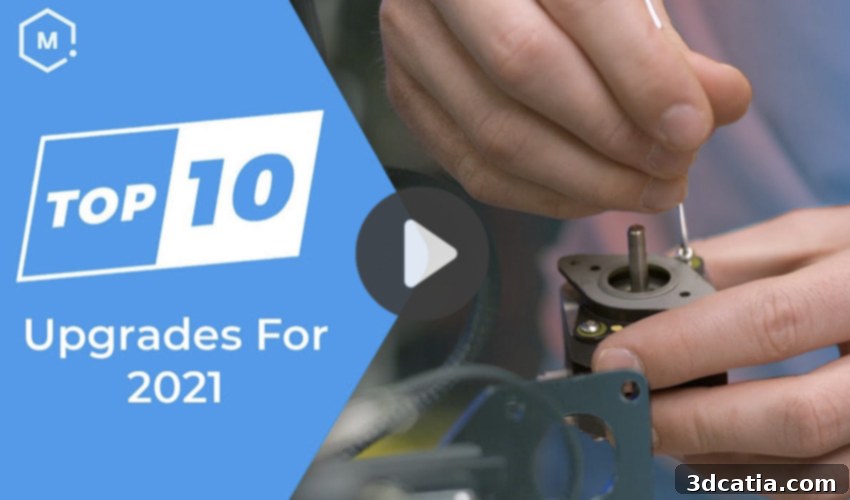
Top 5: 10 Essential Ways to Upgrade Your 3D Printer for Peak Performance in 2021 and Beyond
While the start of a new year often inspires personal resolutions and self-improvement goals, for the enthusiasts and professionals at MatterHackers, this period is an opportune moment to focus on something equally important: enhancing the performance and capabilities of your beloved 3D printer. This comprehensive guide from MatterHackers compiles their top ten highly recommended 3D printer upgrades, specifically curated for 2021 and relevant for continuous improvement. The list is meticulously crafted to include upgrades that are not only accessible and relatively easy to implement for users of all skill levels but also deliver substantial improvements in print quality, reliability, and overall user experience. Each upgrade featured on the list has undergone rigorous professional testing to ensure its effectiveness and value. The recommendations span a wide array of potential enhancements, addressing common bottlenecks and areas for improvement in standard 3D printers. From simple yet effective additions like motor dampers, which significantly reduce noise and improve print smoothness by minimizing vibrations, to more advanced modifications such as installing new, high-performance nozzles designed for specific materials or finer detail, and even crucial build plate modifications that ensure optimal first layer adhesion and easy part removal. Other potential upgrades might include advanced auto-bed leveling systems for consistent prints, improved hotends for better thermal management and broader material compatibility, or even firmware updates that unlock new features and functionalities. These ten printer upgrades have been carefully chosen with the explicit goal of elevating your 3D printing experience. By implementing these enhancements, you can expect to see a marked improvement in the operational efficiency of your 3D printer, leading to higher quality, more consistent, and professional-grade parts. Investing in these upgrades not only extends the life and utility of your machine but also empowers you to tackle more ambitious and intricate projects with confidence. Watch the full video below to discover how you can transform your 3D printer into a high-performance additive manufacturing powerhouse.
We hope this week’s curated selection of the top five 3D printing videos has offered you valuable insights into the incredible advancements shaping the additive manufacturing landscape. From the precision required in metal 3D printing with inert gases to the pioneering efforts in ceramic fabrication, the audacious creation of fully 3D printed rockets, the innovative future of food with 3D printed meat, and practical tips for optimizing your own 3D printer, these videos underscore the diverse and impactful applications of this transformative technology. Which of these groundbreaking innovations resonated with you the most? Do you have a favorite among this week’s highlights, or perhaps a particular area of additive manufacturing that you find most compelling? We’d love to hear your thoughts and engage in a discussion! Please feel free to share your comments and feedback below, or connect with us on our social media channels: find us on Facebook and Twitter. And to ensure you never miss out on the latest news, breakthrough innovations, and essential updates from the fast-evolving 3D industry, don’t forget to sign up for our free weekly Newsletter. Get all the cutting-edge information delivered straight to your inbox, keeping you at the forefront of additive manufacturing!