
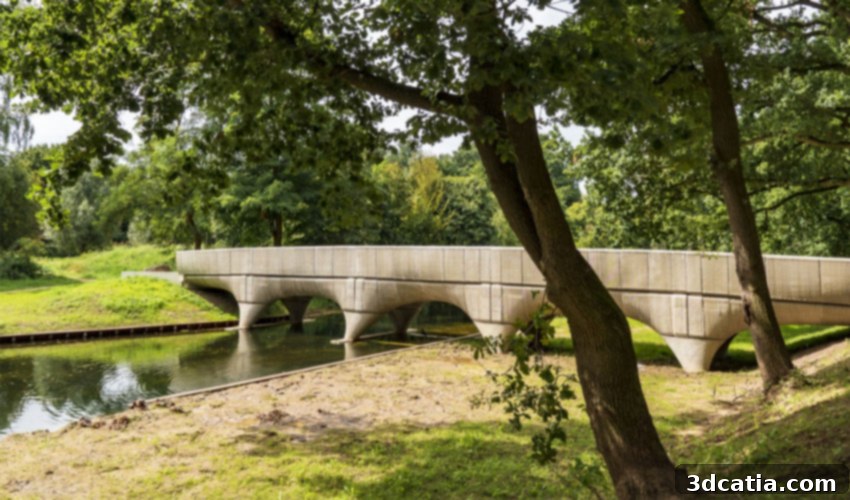
Nijmegen’s Pioneering Achievement: Unveiling the World’s Longest 3D-Printed Concrete Bicycle Bridge
In a remarkable feat of modern engineering and sustainable innovation, the Dutch city of Nijmegen has proudly inaugurated what stands as one of the longest 3D-printed bridges specifically designed for cyclists. After months of meticulous work and groundbreaking development, this architectural marvel was officially opened on September 8th, marking a significant milestone in additive manufacturing and civil infrastructure. Measuring an impressive 29 meters in length, the bridge is not merely a pathway but a testament to the future of construction, blending cutting-edge technology with environmental consciousness. This innovative structure demonstrates how advanced digital fabrication techniques can lead to the creation of both functional and aesthetically pleasing urban elements.
The construction of this pioneering structure took place at the advanced 3D printing center of Saint-Gobain Weber Beamix, a facility renowned for its innovative approach to concrete additive manufacturing. The center utilizes state-of-the-art BAM robotic arms, which are instrumental in bringing complex designs to life with unparalleled precision and efficiency. What truly sets this bridge apart, however, is the sophisticated methodology employed in its conception: parametric design software. This advanced software played a crucial role in optimizing every aspect of the bridge’s creation, from the precise amount of material required to the intricate details of printing time and overall expenses. It achieves this by dynamically adjusting the design based on various applied loads, such as the estimated number of bicycles, pedestrians, and overall weight the bridge is expected to bear throughout its lifespan. This optimization ensures not only structural integrity but also maximizes resource efficiency, setting a new standard for sustainable infrastructure development.
The Vision Behind the Structure: Parametric Design and Collaborative Innovation
We first brought this ambitious project to your attention back in April, promising to keep you informed of its exciting progress. True to our word, the completion and inauguration of this bridge in Nijmegen now stand as a shining example of how additive manufacturing is transforming urban landscapes. Much like the MX3D bridge in Amsterdam, which also saw its completion recently, the Nijmegen bridge underscores the Netherlands’ position as a global leader in embracing 3D printing for public works. This parallel development highlights a burgeoning trend in Dutch innovation, pushing the boundaries of what is possible in modern construction and design.
The journey from concept to inauguration involved a diverse consortium of brilliant minds and leading organizations, highlighting the power of collaborative innovation. Key partners in developing this innovative structure included the esteemed Technological University of Eindhoven (TU/e), which provided invaluable academic and research expertise in concrete technology and structural engineering. Their contribution was vital in ensuring the material science and structural integrity met the highest standards. Architect Michiel van der Kley lent his artistic vision and design prowess, ensuring the bridge was not only functional but also aesthetically integrated into its natural surroundings, reflecting an organic and flowing form. Further critical contributions came from Summum Engineering and Witteveen+Bos, who were instrumental in the parametric design phase and in translating complex 3D models into printable components. Their combined expertise allowed for the intricate optimization of the bridge’s form and material use. The entire structure was ingeniously broken down into several 3D-printed blocks, which were then efficiently assembled directly on-site. This modular approach significantly simplified the construction logistics, demonstrating a practical and scalable method for future large-scale 3D-printed projects while reducing on-site construction time and disruption.
Bert Velthuis, representing the Nijmegen City Council, expressed profound pride and optimism regarding the new addition: “The city of Nijmegen is very honored to receive this innovative 3D-printed bridge. We are a city of bridges, and this special, innovative bridge is a wonderful addition. The bridge leads to connection: in the design and construction phase it connected the different partners, and from now on the bridge connects our residents.” His words beautifully encapsulate the dual significance of the project – not only as a physical connector for the city’s residents, enhancing their daily commutes and recreational activities, but also as a symbol of technological advancement and the collaborative spirit that brought it to fruition, uniting various expert teams in a shared vision.
Aesthetic Integration and the Power of 3D Printing
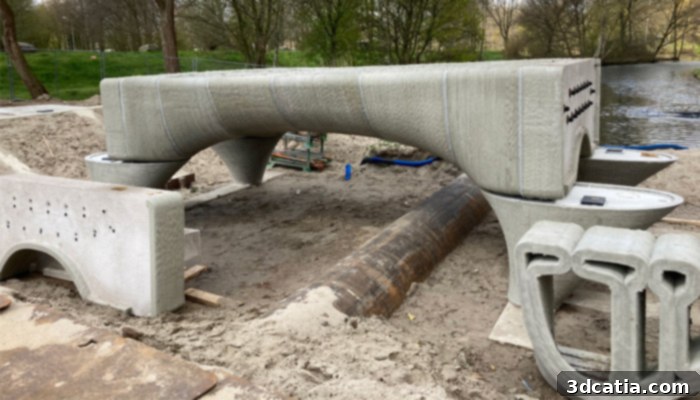
Beyond its impressive length and technological sophistication, the 29-meter bridge is a visual delight, seamlessly blending into the natural landscape. Architect Michiel van der Kley’s vision was to imbue the structure with round, organic, and natural shapes, creating a fluid aesthetic that complements its environment rather than disrupting it. These distinctive wavy forms and naturalistic contours are a direct result of the design freedom offered by 3D printing technology. Conventional construction methods, reliant on molds and rigid forms, would have made achieving such complex, non-linear geometries prohibitively difficult, expensive, or even impossible. This project stands as a powerful demonstration of how additive manufacturing liberates architects and engineers from traditional design constraints, opening up new possibilities for aesthetically pleasing and contextually integrated infrastructure that harmonizes with its surroundings.
The team behind this pioneering project harbors ambitious aspirations for the future of concrete 3D printing. They envision a world where this transformative technology is utilized to create an even wider array of 3D-printed civic structures, from pedestrian walkways and decorative urban elements to more complex architectural components for buildings. Their collective aim is to push the boundaries of what is possible with concrete additive manufacturing, continuously exploring new applications and advancing its capabilities for greater efficiency and sustainability. Professor Theo Salet, a leading expert in Concrete Structures at TU/e, eloquently summarized the immense potential of this field: “The printing of concrete has enormous growth potential. We use less raw materials and can drastically increase the construction speed. In the future, we want to make concrete more sustainable and also reuse it. There is much more to achieve. I am also proud that the knowledge developed has found its way to the industry so quickly.” His statement highlights several critical advantages of concrete 3D printing: the significant reduction in raw material consumption, which contributes to environmental sustainability by minimizing waste; the potential for dramatically increased construction speeds, leading to more efficient project timelines and reduced labor costs; and the exciting prospect of developing methods to make concrete even more sustainable through innovative recycling and reuse strategies. This rapid transfer of academic knowledge into practical, industrial applications underscores the maturity and readiness of 3D concrete printing to revolutionize the construction industry.
The environmental benefits of this construction approach cannot be overstated. By printing only the material necessary for the structural integrity and aesthetic form, waste is drastically minimized compared to traditional formwork-intensive concrete casting. This precision also allows for the integration of internal structures that optimize material use, further reducing the overall carbon footprint of the project. Furthermore, the localized manufacturing of bridge sections reduces transportation needs, contributing to lower emissions and energy consumption associated with material logistics. This holistic approach to sustainability, from design to execution, positions the Nijmegen bridge as a blueprint for future eco-conscious infrastructure projects worldwide, offering a tangible example of how innovative technology can serve both progress and planet. You can find more detailed information and insights into the project HERE.
Impact and the Future of Urban Infrastructure
The successful completion of the Nijmegen 3D-printed concrete bicycle bridge serves as a powerful beacon for the future of urban infrastructure globally. It demonstrates that additive manufacturing is not merely a niche technology but a viable, sustainable, and innovative solution for large-scale public works. This project paves the way for cities around the world to consider 3D printing for their own infrastructure needs, offering benefits ranging from accelerated construction timelines to enhanced design flexibility and significant environmental advantages. It provides a real-world case study for implementing advanced digital construction techniques in real urban settings.
The bridge embodies the spirit of a ‘smart city’ – one that embraces technology to create more efficient, sustainable, and livable urban environments. By integrating advanced digital design with robotic fabrication, Nijmegen has not only built a bridge but has also built a bridge to the future, showcasing how innovation can solve contemporary urban challenges. The knowledge and experience gained from this project are invaluable, providing a robust foundation for further research, development, and implementation of 3D-printed structures in diverse applications, from housing and public buildings to complex engineering structures, ultimately contributing to more resilient and adaptive urban landscapes.
This project is a testament to the synergistic relationship between academic research and industrial application. The rapid transition of cutting-edge concepts from the laboratory at TU/e to a tangible, operational bridge in the heart of Nijmegen highlights an effective model for technological advancement. It inspires confidence in the potential of additive manufacturing to address pressing global issues, such as the need for rapid housing solutions, resilient infrastructure in challenging environments, and construction methods that minimize environmental impact. The team’s aspiration to extend this technology to more civic structures is a clear indication of the scalable and versatile nature of 3D concrete printing, promising a future where innovative, sustainable structures become the norm rather than the exception.
What are your thoughts on this revolutionary 3D-printed bridge and its implications for urban development and sustainable construction? We invite you to share your perspectives in a comment below or join the conversation on our Facebook and Twitter pages. Don’t miss out on the latest advancements in additive manufacturing – be sure to sign up for our free weekly newsletter, delivering all the essential news and insights directly to your inbox!
Cover Photo Credit: City of Nijmegen / Michiel van der Kley