
Revolutionizing Water Purification: 3D-Printed Ceramic Monoliths Tackle Forever Chemicals
The global water crisis is one of the most pressing challenges of our time, with devastating consequences for human health and environmental stability. Alarming statistics from the latest United Nations World Water Development Report reveal that a staggering 2.2 billion people worldwide lack access to a safe drinking water supply, while an additional 3.5 billion people live without adequate sanitation facilities. These figures underscore an urgent need for concerted action to safeguard healthy living conditions and ensure universal access to clean water. At the heart of this crisis lies the pervasive problem of water pollution, a multifaceted issue exacerbated by human activities.
From rampant litter and the growing scourge of plastic in our oceans to the insidious run-off of agricultural chemicals and industrial waste into groundwater, countless human-driven factors are severely compromising the quality and safety of our vital water resources. This widespread contamination demands innovative and effective solutions. Fortunately, a growing number of forward-thinking companies and research institutions are now specializing in developing cutting-edge technologies to address these environmental threats. Among the most promising recent advancements is a groundbreaking approach that utilizes novel 3D-printed ceramic monoliths to purify water, specifically targeting the notoriously persistent “forever chemicals.”
Understanding PFAS: The Persistent Threat of “Forever Chemicals”
Perfluoroalkyl substances, commonly known as PFAS, represent a vast and diverse family of man-made chemicals that have become indispensable in various industrial applications and consumer products due to their unique properties. These compounds are often referred to as “forever chemicals” because of their extraordinary environmental persistence; they can take up to a millennium to naturally decompose, enduring in our environment for an exceptionally long time. Their remarkable resistance to water, grease, and fire has led to their widespread incorporation into countless everyday items, making them ubiquitous in modern society.
PFAS can be found in a wide array of products, from the non-stick coatings of Teflon pans and the active ingredients in cleaning agents to grease-resistant paper packaging, water-repellent textiles, and even firefighting foams. While their utility is undeniable, the health implications of PFAS exposure are profoundly concerning. Extensive scientific studies have unequivocally linked PFAS to a spectrum of serious health issues, including thyroid disorders, hormonal imbalances, developmental problems in children, cardiovascular complications, and an increased risk of developing certain cancers and diabetes. Given their widespread presence and severe health risks, finding effective methods for PFAS removal from water sources is not just an environmental imperative but a critical public health priority.
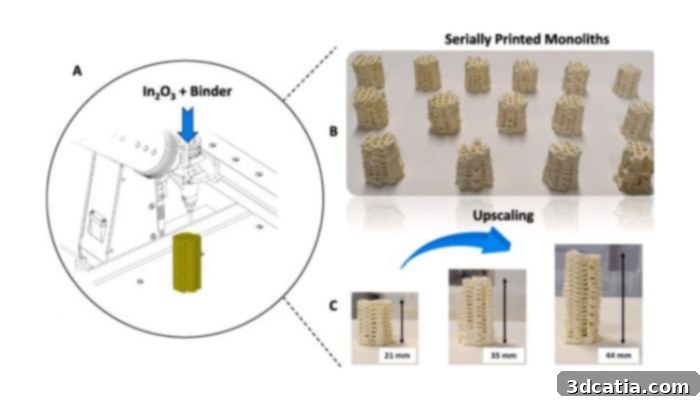
Photo Credits: Chemical Engineering Journal
A Breakthrough from the University of Bath: Leveraging 3D Printing for PFAS Removal
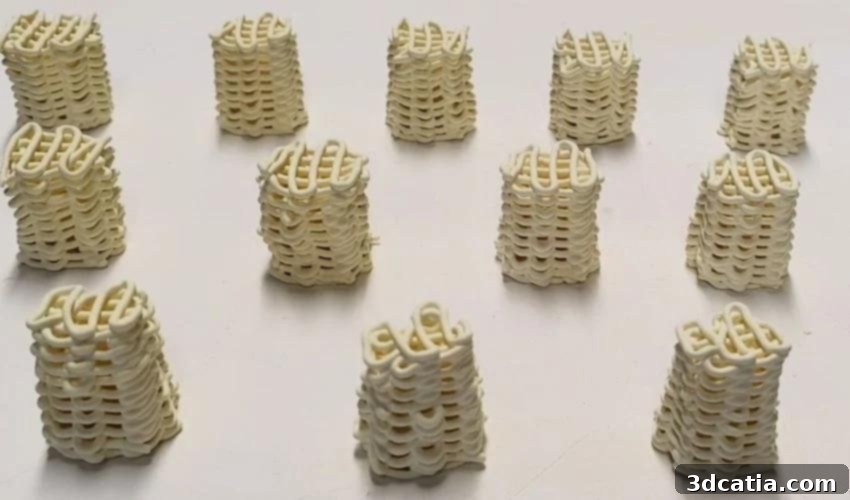
The persistent challenge posed by forever chemicals may soon be mitigated thanks to a remarkable scientific breakthrough. A dedicated team of researchers from the University of Bath in England has developed an innovative solution capable of effectively removing perfluorooctanoic acid (PFOA), one of the most prevalent and harmful PFAS compounds, from water. Their pioneering invention centers around the creation of unique, tendril-shaped monoliths that are precisely fabricated using ceramic material through advanced 3D printing techniques. This method has demonstrated an impressive capability, successfully removing at least 75% of PFOA from contaminated water.
The initial results of this groundbreaking study are not merely promising; they signal a significant leap forward in environmental engineering. The developers view their novel product as an effective, highly scalable, and sustainable new tool in the global effort to combat chemical water pollution. This development holds immense potential for transforming water treatment processes and offering a viable pathway to cleaner, safer drinking water for communities worldwide. By harnessing the power of additive manufacturing, the University of Bath team has opened new avenues for tackling one of the most stubborn environmental contaminants of our era.
How It Works: The Science Behind 3D-Printed Ceramic Monoliths for Water Purification
Understanding the operational mechanism behind these innovative ceramic monoliths reveals the elegance and efficiency of their design. Each monolith measures approximately 4 cm in length and features an intricate grid-like structure, meticulously crafted to maximize surface area. The key to their effectiveness lies in the specialized ink used during the 3D printing process, which is impregnated with ceramic indium oxide. When these specially designed monoliths are introduced into water containing PFAS, the ceramic indium oxide acts as a potent adsorbent, immediately attracting and adhering the “forever chemicals” to the monoliths’ extensive surfaces. This rapid adsorption process allows for the swift removal of these harmful chemicals from the water, often in under three minutes.
Dr. Liana Zoumpouli, a Research Associate in the Department of Chemical Engineering at the University of Bath, further elaborates on the advantages of this manufacturing approach: “Using 3D printing to create the monoliths is relatively simple, and it also means the process should be scalable. 3D printing allows us to create objects with a high surface area, which is key to the process. Once the monoliths are ready you simply drop them into the water and let them do their work. It’s very exciting and something we are keen to develop further and see in use.” Her insights highlight the dual benefits of additive manufacturing: the ability to produce complex, high-surface-area designs critical for efficient adsorption, and the inherent scalability of the process, which is crucial for widespread adoption in water treatment facilities.
Additive Manufacturing’s Precision: Crafting Efficient Purification Tools
The production of these highly effective ceramic monoliths relies on material extrusion, a precise and versatile 3D printing technique. Specifically, the Lutum®5 ceramic 3D printer from VormVrij, a Dutch-based manufacturer renowned for its ceramic 3D printing solutions, was utilized for this project. The choice of 3D printing for fabrication is pivotal, as it enables the creation of the intricate lattice design crucial for the monoliths’ performance. This complex geometry significantly increases the reactive surface area, enhancing the efficiency of PFAS capture. Beyond their initial effectiveness, an important aspect of this technology is its reusability. The study demonstrated that these monoliths can be regenerated and reused after an initial cleaning process that removes the captured PFAS. To restore their adsorptive capabilities, they simply need to undergo a high-temperature “regeneration” heat treatment following each use, making them a sustainable and cost-effective solution.
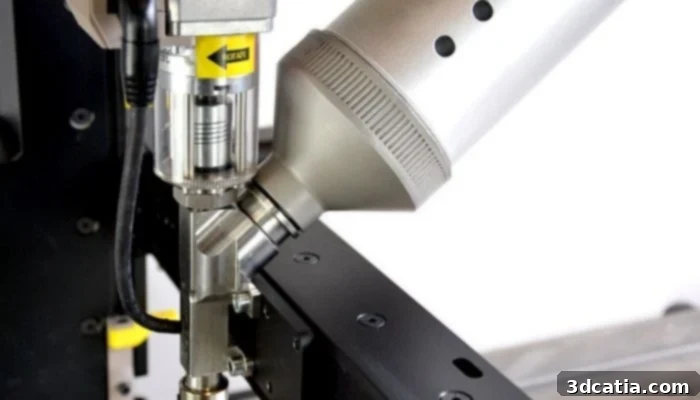
Extruder of the Lutum®5 (photo credits: VormVrij)
Promising Results and Future Outlook for Global Water Solutions
The initial phase of testing has yielded highly encouraging results, confirming the efficacy of the 3D-printed ceramic monoliths. The tests consistently showed that these innovative structures can remove an impressive 75% of PFOA from contaminated water. Crucially, the manufacturing process and the subsequent use of these monoliths have been assessed as fully compatible with existing water treatment plants, not only in the UK but also globally. This compatibility is a significant advantage, as it suggests a smoother integration into current infrastructure, potentially accelerating their adoption on a larger scale. The researchers are not stopping here; they are committed to continuous refinement of the monoliths, aiming to enhance their performance and broaden their application to a wider range of PFAS compounds. Their ultimate goal is to deploy this technology extensively, making a substantial impact on global water purification efforts.
The implications of this research extend far beyond the laboratory. As the world grapples with escalating environmental challenges and the urgent need for sustainable practices, technologies like these 3D-printed ceramic monoliths offer a beacon of hope. This study represents a significant step forward in developing practical, scalable solutions for critical environmental problems. It underscores the transformative potential of additive manufacturing in tackling complex issues such as chemical pollution and ensuring access to clean, safe water. The full paper detailing this groundbreaking research was published in the Chemical Engineering Journal, providing comprehensive insights for the scientific community and interested stakeholders. You can delve deeper into the specifics of their findings by reading the complete publication HERE.
Addressing the Global Water Challenge with Advanced Environmental Technology
The development of 3D-printed ceramic monoliths for PFAS removal represents a pivotal advancement in environmental technology and sustainable engineering. This innovative approach offers a tangible and highly effective solution to one of the most persistent and dangerous forms of water pollution. By providing a scalable and reusable method for eradicating “forever chemicals,” this technology contributes significantly to the broader goals of environmental protection, public health, and sustainable development. It exemplifies how advanced manufacturing techniques can be harnessed to create tools that directly address urgent global challenges, paving the way for a future where clean drinking water is accessible to all, free from harmful contaminants.
What do you think of using these 3D-printed ceramic monoliths for water purification? Do you believe they could truly be the definitive solution to these pervasive ‘forever chemicals’ and help secure a cleaner water future? We invite you to share your thoughts and insights in a comment below or join the conversation on our LinkedIn, Facebook, and Twitter pages! Don’t miss out on the latest advancements and news in additive manufacturing—sign up for our free weekly newsletter here to get all the cutting-edge 3D printing news delivered straight to your inbox! For more visual content and in-depth discussions, you can also find all our videos on our dedicated YouTube channel.
*Cover Photo Credits: University of Bath