
Revolutionizing Dental Practices: The Indispensable Role of 3D Scanners in Modern Orthodontics and Prosthetics
The dental industry is undergoing a significant digital transformation, with independent businesses like AC Smile leading the charge. Founded by Mihai-Catalin Palincas almost two years ago, AC Smile emerged from his extensive experience in various dental laboratories. Based in the bustling city of Paris, Mihai-Catalin’s venture specializes in providing cutting-edge dental 3D scanner services, primarily catering to orthodontic practitioners. This shift towards digital solutions marks a pivotal moment, promising enhanced efficiency, precision, and patient care in the realm of modern dentistry.
The Dawn of Digital Dentistry: Why 3D Scanners are Essential
One of the most compelling advantages of integrating a 3D scanner into a dental practice is its unparalleled ability to digitize patients’ jaws and mouths. These intricate anatomical details are then stored securely on virtual servers, fundamentally altering how dental professionals manage patient records. This digital archiving not only streamlines data management but also delivers substantial space savings. Dental practitioners are legally obligated to retain patient models for a minimum of ten years, a requirement that traditionally consumed vast amounts of physical storage space. With digital files, this burden is eliminated, freeing up valuable clinic real estate.
Beyond mere storage, these digital files offer remarkable flexibility and ease of access. Practitioners can view patient models from multiple viewpoints on a computer screen, allowing for more detailed examination and collaborative discussion. This digital format facilitates precise measurements, treatment planning, and even patient education, as individuals can visualize their dental structure and proposed treatments with unprecedented clarity. The transition from bulky plaster models to compact, accessible digital data is not just a convenience; it’s a foundational step towards a more efficient, accurate, and patient-centric dental practice.
Choosing the Right Tool: A Deep Dive into Dental 3D Scanners
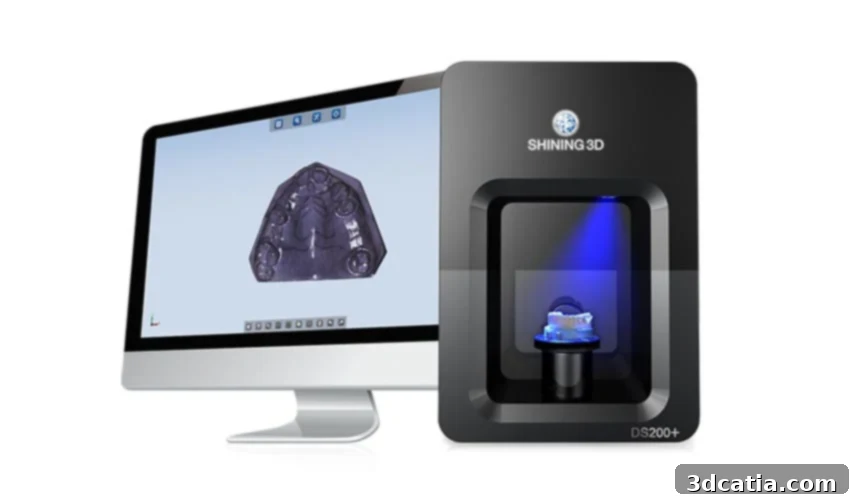
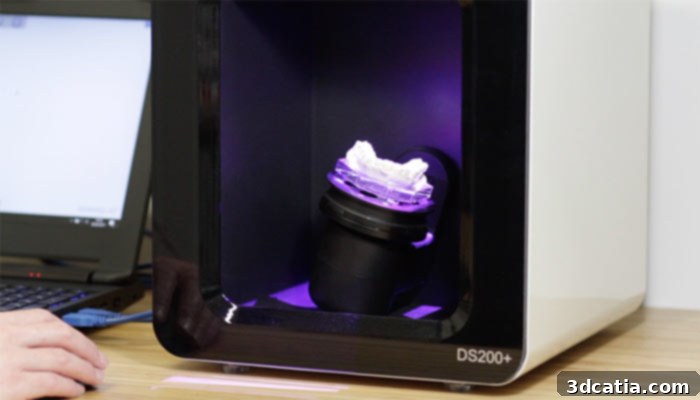
Equipping a modern dental laboratory with the right technology is crucial. When Mihai-Catalin Palincas, an experienced prosthetist, sought to enhance AC Smile’s capabilities, he turned to Jean-Michel Delannoy at Machines-3D. Their meeting at a dental fair in Lille proved instrumental. After a thorough discussion of AC Smile’s production needs and goals, Jean-Michel recommended the AutoScan-DS200+ 3D scanner by Shining3D. This particular model stood out due to its advanced structured blue light technology.
Structured blue light technology offers significant advantages over older methods such as laser triangulation or white light scanning. Blue light is far less susceptible to external environmental factors that can compromise scan accuracy, such as flickering neon lights or fluctuating ambient brightness. This resilience ensures consistently precise and reliable scans, a critical factor in dental applications where accuracy is paramount for effective treatment. The AutoScan-DS200+’s ability to perform reliably in diverse settings makes it an ideal choice for busy dental laboratories.
The decision to select this scanner was also influenced by its competitive pricing compared to other high-performance models available in the market. Beyond cost-effectiveness, its technical specifications were equally impressive. The AutoScan-DS200+ boasts an exceptional scan speed, capable of digitizing an entire jaw in less than a minute. Its remarkable quality, with a resolution below 0.015 mm, ensures that even the most minute anatomical details are captured with fidelity. Furthermore, the absence of an annual license fee for its accompanying software represents a significant long-term cost saving, making it an economically sound investment for dental practices. Machines-3D, recognizing the evolving needs of the dental sector, now offers a comprehensive suite of innovative solutions, ranging from advanced 3D printers and 3D scanners to efficient thermoformers, empowering dental professionals with the tools for tomorrow.
Mastering the Workflow: Step-by-Step 3D Scanning in Practice
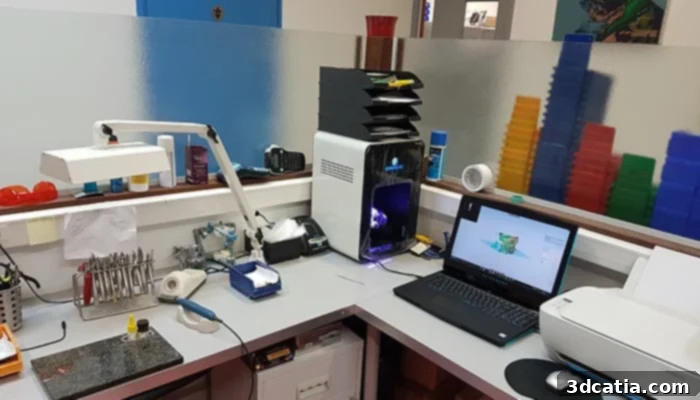
Integrating a new piece of technology like a 3D scanner requires proper training and calibration. After receiving comprehensive guidance from the Machines-3D team and ensuring precise equipment calibration, the prosthetist at AC Smile was fully prepared to utilize the new 3D scanner. The process begins with the creation of a physical mold of the patient’s teeth, meticulously crafted by the orthodontist, typically using alginic acid. This initial mold remains a crucial first step, capturing the patient’s unique dental anatomy in a tangible form.
Once the physical mold is ready, the next step involves the digital input process. Using the intuitive dental 3D scanning software, DentalScan, the prosthetist inputs essential patient information: the file number, the patient’s name, and the referring practitioner. This meticulous data entry ensures accurate record-keeping and seamless integration with existing patient management systems, enhancing the overall efficiency and traceability of each case.
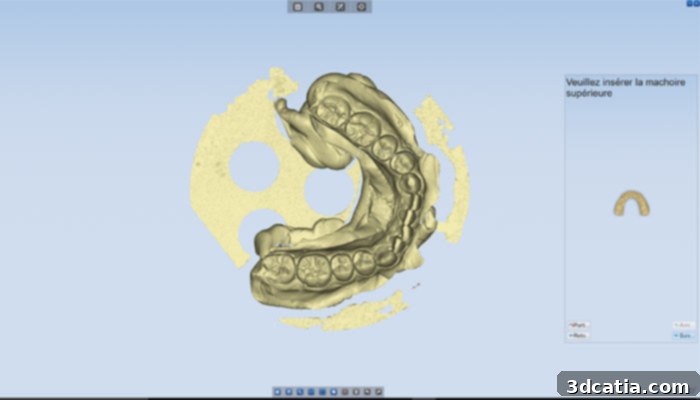
The second critical phase involves the prosthetist casting rough plaster models from the patient’s initial alginic acid impressions. These durable plaster models, representing the patient’s upper and lower arches, are then carefully positioned within the 3D scanner’s platform. The scanner then proceeds to capture data in three distinct positions to ensure a complete and accurate digital replica: first, a scan of the arches occluded (on top of one another) to capture the bite relationship; second, a scan of the lower arch; and third, a scan of the upper arch. This multi-position scanning approach guarantees that all surfaces and relationships are accurately recorded. This entire scanning stage is remarkably swift, often completed in less than a minute, culminating in a finished digital model of the jaw in the widely recognized STL file format.
Finally, the generated STL file undergoes a crucial post-processing phase using specialized software, such as Maestro3D. This powerful software allows for detailed refinement of the digital model: cleaning the file to remove any artifacts or imperfections, creating a virtual base for stability and orientation, and meticulously measuring various dental parameters, including distances between teeth and their individual dimensions. This comprehensive digital model, refined and analyzed, then enables the orthodontist to develop a highly accurate and effective treatment plan, moving from raw scan data to actionable clinical insights with precision and confidence.
The Transformative Advantages of Integrating 3D Scanning
The integration of 3D scanning technology represents a monumental leap forward for the dental industry. Jean-Michel Delannoy of Machines-3D eloquently articulates this sentiment: “The advent of 3D printing and 3D scanners is a real evolution for the dental world. The new methods to manufacture prosthetics, but also the practices of dental professionals, can now save time, save material, and also save a significant amount of space. We therefore skip several steps that were once essential to traditional manufacturing workflows.” This statement encapsulates the multifaceted benefits that digital dentistry brings to practitioners, laboratories, and ultimately, patients.
Beyond the fundamental savings in time, materials, and space, 3D scanning significantly enhances the accuracy and precision of dental work. Digital models allow for an unparalleled level of detail and consistency, leading to better-fitting prosthetics, more effective orthodontic appliances, and improved treatment outcomes. The ability to simulate treatments virtually and make precise adjustments before any physical fabrication begins minimizes errors and reduces the need for costly chairside adjustments.
Furthermore, 3D scanning fosters improved communication and collaboration within the dental team. Digital files can be easily shared between orthodontists, prosthetists, and other specialists, facilitating a synchronized and efficient approach to patient care. This seamless data exchange ensures that all parties are working from the most accurate and up-to-date information, leading to more coherent and effective treatment strategies. Patients also benefit from enhanced communication, as they can more easily understand their treatment plans through visual digital models, leading to greater engagement and satisfaction.
With increasingly affordable equipment and ever more precise quality, equipping dental professionals with the latest 3D scanners has become more accessible than ever before. The entire dental ecosystem—from the laboratory technicians crafting appliances, to the patient receiving treatment, and the practitioner delivering care—benefits immensely from these innovations. The digital revolution, spearheaded by 3D scanning, is not just about adopting new tools; it’s about transforming the very essence of dental practice, making it more efficient, precise, and patient-centered for the future.
You can compare all different kinds of 3D scanners in our Comparator here.
What do you think of 3D scanning in dental? Let us know in a comment below or on our Facebook and Twitter pages! Sign up for our free weekly Newsletter, all the latest news in 3D printing straight to your inbox!