

Walmart’s Vision for the Future of Retail: Pioneering 3D Printed Logistics with Alquist 3D
The landscape of retail has been dramatically reshaped by the relentless rise of e-commerce. As consumers increasingly turn to digital platforms for their shopping needs, businesses face unprecedented pressure to innovate their supply chains, delivery mechanisms, and overall customer experience. This burgeoning demand for online shopping interfaces necessitates not just technological advancements in digital platforms, but also revolutionary solutions in physical infrastructure to support seamless order fulfillment. Responding proactively to these evolving market dynamics, retail giant Walmart has embarked on a pioneering project that sets a new benchmark for speed, efficiency, and sustainability in commercial construction.
In Athens, Tennessee, Walmart has unveiled a groundbreaking extension to one of its existing stores, specifically designed to optimize online delivery and pickup services. This facility is a testament to Walmart’s commitment to enhancing its omni-channel capabilities, ensuring that customers receive their orders faster and more conveniently than ever before. However, what truly distinguishes this Athens structure from conventional retail support buildings is not merely its function, but its innovative construction method. Spanning an impressive nearly 8,000 square feet and soaring over 20 feet high, this architectural marvel holds the distinct honor of being one of the largest free-standing, 3D printed commercial concrete structures ever built in the United States. Its very existence heralds a new era for retail infrastructure and the broader construction industry, demonstrating the immense potential of additive manufacturing at scale.
Embracing Innovation: Why Walmart Chose 3D Concrete Printing
Walmart’s decision to pursue 3D concrete printing (3DCP) for this significant expansion project was the culmination of a thorough exploration of various cutting-edge construction technologies. The company’s strategic objective was clear: to identify a method that could drastically accelerate construction timelines while simultaneously aligning with its overarching corporate sustainability goals. In 3DCP, Walmart found a solution that promised to deliver on both fronts, offering unparalleled efficiency and environmental benefits compared to traditional building practices. This bold move underscores Walmart’s vision for a future where technology and sustainability are intrinsically linked in shaping the built environment, addressing the growing need for both speed and responsibility in modern commercial development.
For the execution of this ambitious endeavor, Walmart partnered with Alquist 3D, a recognized leader in advanced additive manufacturing for construction. Mike Neill, VP of New Construction for Walmart, elaborated on this crucial partnership, stating, “Alquist presented the best ability to work with due to their deep knowledge of 3D materials, robotics, and desire to take on an ambitious and unique project.” This endorsement highlights Alquist 3D’s specialized expertise, which extends far beyond basic construction. Their proficiency in the intricate science of 3D printable concrete mixtures, coupled with their mastery of robotic automation, made them the ideal candidate to bring Walmart’s innovative vision to life. Furthermore, Alquist 3D’s robust network and collaborations with other industry pioneers, such as SICA and RIC Technology, solidified their position as the preferred partner, ensuring access to the latest advancements and best practices in the rapidly evolving field of construction technology.
Understanding 3D Concrete Printing: A Revolution in Construction
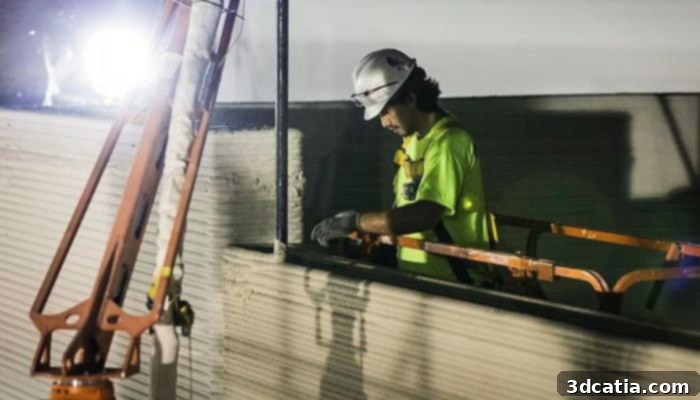
A worker monitors the 3DCP process
3D concrete printing, often abbreviated as 3DCP, represents a paradigm shift in how structures are built. At its core, 3DCP is a sophisticated form of material extrusion, where a specialized concrete mixture is precisely pushed through a nozzle attached to a multi-axis robotic arm. This robotic system operates based on digital blueprints, laying down concrete layer by painstaking layer to construct walls and structural elements with remarkable precision and speed. Unlike conventional construction, which relies on complex formwork, extensive manual labor, and time-consuming concrete pouring and curing processes, 3DCP automates much of the process, leading to significant efficiencies and reducing human error.
This innovative type of additive manufacturing offers a multitude of advantages, particularly within the realm of architecture and large-scale construction. Firstly, it drastically reduces the labor required on-site, mitigating dependency on skilled manual trades which are increasingly scarce in many regions. This automation translates to significantly faster build times and potentially reduced overall project costs. Secondly, 3DCP excels at handling complex and organic designs that would be prohibitively expensive or structurally challenging using traditional methods. Architects gain unprecedented design freedom, enabling the creation of unique, aesthetically pleasing, and functionally optimized structures tailored to specific needs. Thirdly, and perhaps most crucially for environmentally conscious companies like Walmart, 3DCP inherently promotes sustainability. By precisely depositing only the required amount of material, it significantly reduces waste by up to 30-50% compared to conventional methods. Furthermore, advances in concrete formulations mean that carbon-neutral or low-carbon materials can be employed, contributing to a smaller environmental footprint and helping companies meet their green initiatives.
While 3D printed houses and other architectural projects have been gaining traction globally, this Walmart building distinguishes itself as the largest 3D concrete printed retail building in the United States. This scale is what makes the project particularly groundbreaking and a landmark achievement for the industry. Zachary Mannheimer, Founder and Chairman of Alquist 3D, rightly emphasized the monumental nature of this achievement, stating, “It is the first such facility of its kind and it’s just incredible that it is a reality. This is going to play a major role in the advancement of 3DCP technology.” Indeed, projects of this magnitude serve as powerful proofs-of-concept, validating the technology for wider commercial adoption and accelerating innovation across the entire additive manufacturing ecosystem. It moves 3DCP from a niche application to a mainstream solution for complex commercial needs, paving the way for a more efficient and sustainable construction future.
Overcoming Challenges and Pushing the Boundaries of 3DCP
No pioneering project of this scale is without its challenges, and the Walmart Athens facility was no exception. Alquist 3D’s team encountered several hurdles that provided invaluable learning experiences, ultimately contributing to the refinement and advancement of 3DCP techniques. One significant factor was the intense Tennessee summer weather. The consistency and printability of concrete are highly sensitive to temperature fluctuations, which can affect its flow, setting time, and structural integrity. In the scorching heat, builders had to meticulously manage and regulate the concrete temperature using specialized cooling methods, often involving water and careful mixture adjustments, to ensure the material remained ideal for continuous extrusion and proper curing, preventing premature setting or structural weaknesses. This rigorous control over environmental factors is a critical aspect of successful large-scale 3D printing, demanding a deep understanding of material science and on-site adaptability.
Another notable challenge involved Alquist’s original pumping system, which experienced clogging issues. Such blockages in the material delivery system can severely impede progress, halting printing and leading to significant delays – in this case, for several weeks. However, rather than deterring the team, these setbacks fueled innovation. By systematically diagnosing and resolving these pump issues, Alquist 3D gained crucial insights into optimizing material flow, pump pressure, and nozzle design for continuous, high-volume concrete printing. These practical lessons enabled them to achieve significantly faster print times and, for the very first time in their experience, successfully construct a freestanding wall towering at an impressive 20 feet. This achievement alone marks a considerable milestone in the capabilities of 3DCP, demonstrating the technology’s readiness for higher and more complex structures and validating Alquist 3D’s expertise under pressure.
The successful completion of the Athens facility, despite these technical complexities, stands as a powerful testament to Alquist 3D’s resilience, expertise, and problem-solving prowess. Their ability to adapt and innovate on-site has not only benefited this specific project but has also contributed invaluable knowledge to the broader 3DCP community, setting new precedents for large-scale additive construction. Given this remarkable achievement, Walmart has already indicated its intention to collaborate with Alquist 3D on a second project in the near future, further cementing their partnership and signaling continued investment in this transformative construction method. This ongoing collaboration highlights the immense trust and confidence earned through the successful Athens build. To witness the intricate process of 3DCP in action, interested readers can watch this compelling video, and delve deeper into the project details by reading the official press release here.
The Future of Construction: 3DCP’s Transformative Potential
The successful deployment of 3D concrete printing for a high-profile commercial venture like Walmart’s Athens facility raises profound questions about the future trajectory of the construction industry. Could 3DCP truly be the harbinger of a new age in building, moving beyond its current innovative niche to become a mainstream standard? The implications are vast and multifaceted. Firstly, the technology’s inherent speed can dramatically reduce project timelines, allowing businesses to bring new facilities online much faster. This agility is crucial in today’s fast-paced economic environment, particularly for sectors like retail and logistics where rapid expansion and adaptation are key to maintaining a competitive advantage and meeting dynamic consumer demands.
Beyond speed, 3DCP offers significant economic benefits. Reduced labor requirements, minimized material waste, and the potential for greater automation can lead to substantial cost savings over the entire lifecycle of a project. These savings can be reinvested, leading to more projects, or passed on to consumers. Furthermore, the design flexibility offered by additive manufacturing opens doors to creating more structurally optimized and aesthetically pleasing buildings, potentially influencing architectural trends and urban planning. Imagine custom-designed public spaces, uniquely tailored commercial storefronts, or rapidly deployed residential communities built with unprecedented efficiency and artistic freedom, challenging the conventional uniformity of mass-produced structures.
From a sustainability perspective, 3DCP is poised to redefine industry standards. By enabling the use of localized materials, reducing transportation emissions, and minimizing construction waste, it addresses several critical environmental concerns associated with traditional building. The ability to precisely control material usage means less concrete is wasted, and the potential to incorporate recycled aggregates or innovative, eco-friendly binders further enhances its green credentials. This shift aligns perfectly with global efforts to decarbonize the construction sector and move towards a more circular economy, contributing significantly to a greener built environment for future generations.
Moreover, the widespread adoption of 3DCP could profoundly influence labor markets within the construction industry. While some traditional roles might evolve or be partially automated, new high-tech jobs in robotics operation, digital design and modeling, material science, and quality control would emerge. This shift necessitates investment in training and education to equip the workforce with the specialized skills needed for this modernized construction landscape. The Walmart project serves as a compelling case study, demonstrating that large-scale commercial applications of 3DCP are not only feasible but also highly beneficial, paving the way for further adoption across various sectors, from affordable housing initiatives to critical infrastructure development and disaster relief efforts, where rapid deployment is paramount.
The success in Athens, Tennessee, is more than just a single building; it’s a blueprint for future innovation. It exemplifies how collaborative efforts between forward-thinking corporations like Walmart and technological pioneers like Alquist 3D can accelerate the adoption of transformative technologies, pushing the boundaries of what is possible in construction. As the demand for efficient, sustainable, and rapidly deployable infrastructure continues to grow globally, 3D concrete printing is undeniably positioned to play a pivotal role in shaping the built world of tomorrow. This project stands as a beacon, illuminating the path forward for an industry ripe for disruption, modernization, and a truly sustainable future.
Join the Conversation on 3D Printing in Construction
What are your thoughts on the future of construction with technologies like 3D concrete printing? Do you envision 3DCP becoming the industry standard for commercial and residential projects, or will it remain a specialized solution for unique architectural endeavors? How do you believe the integration of advanced additive manufacturing could influence current construction practices, supply chains, and labor demands, creating new opportunities and challenges for the workforce? We encourage you to share your insights and predictions with us! Let us know your perspective in a comment below or join the discussion on our official social media channels: LinkedIn, Facebook, and Twitter.
Don’t miss out on the latest advancements and breaking news from the dynamic world of 3D printing. Sign up for our free weekly newsletter here to have cutting-edge stories delivered directly to your inbox. For a visual deep dive into the technology and its applications, you can also find all our comprehensive videos on our YouTube channel. Stay informed, stay ahead in the rapidly evolving landscape of additive manufacturing!
*All photo credits Dustin Chambers for Wall Street Journal