RAYSHAPE Edge E1 Review: Advanced LCD 3D Printing for Precision Dental Applications
RAYSHAPE, a distinguished Chinese manufacturer, has carved out a niche in the competitive additive manufacturing landscape by specializing in the development and distribution of high-performance resin 3D printers. Founded in 2019 by Bill Liu, the company, along with his dedicated teams, has diligently built an extensive portfolio of DLP 3D printers. This comprehensive range caters to diverse needs, from compact desktop units tailored specifically for the demanding dental sector to robust industrial-grade machines engineered for large-scale mass production. RAYSHAPE’s commitment to innovation and quality has positioned it as a significant player in the global 3D printing industry.
Since its inception, RAYSHAPE has pursued an ambitious global expansion strategy, successfully penetrating key markets across Europe and North America. The company aims to establish itself as a leading global force in additive manufacturing, serving a multitude of sectors including dental, general industry, engineering, education, as well as the cultural and creative fields. A testament to this growth and innovation is the Edge E1 3D printer, the latest groundbreaking addition to RAYSHAPE’s acclaimed dental product line. This innovative desktop printer signifies a pivotal shift in the company’s technological approach, marking a new chapter in digital dentistry.
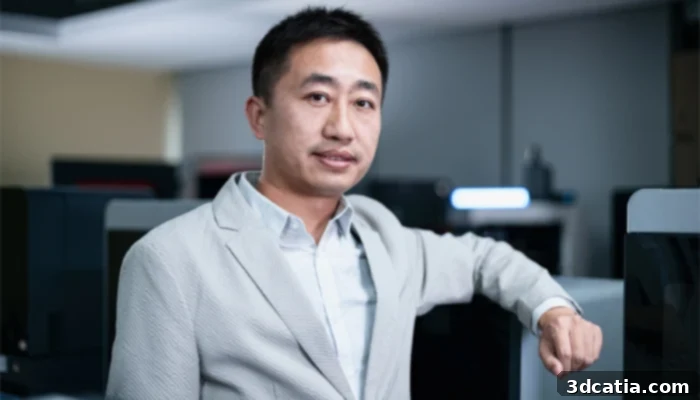
Bill Liu, founded RAYSHAPE in 2019, steering the company towards global leadership in additive manufacturing.
The Edge E1 introduces a significant evolution in RAYSHAPE’s printing technology, distinguishing itself as the manufacturer’s inaugural LCD 3D printer. This marks a strategic divergence from the DLP technology utilized in previous models like the Shape+. Despite this technological shift, the Edge E1 remains a compact desktop solution, seamlessly integrating into RAYSHAPE’s comprehensive dental 3D printing ecosystem. To provide a complete workflow solution for dental professionals, RAYSHAPE offers optional Wash & Cure post-processing machines, along with a specialized range of high-performance dental resins, ensuring optimal results from printing to final curing.
With the Edge E1, RAYSHAPE embarks on an exciting exploration of LCD technology, a field that has witnessed remarkable advancements in recent years, primarily driven by the advent of higher-resolution LCD screens. This technological progress means that modern LCD printers can now deliver most of the precision and technical capabilities traditionally associated with DLP printing, but at a significantly reduced entry cost. Our team at the 3Dnatives Lab conducted several weeks of rigorous testing on the RAYSHAPE Edge E1, and we are now delighted to share our detailed findings and hands-on experience in this comprehensive review.
Exploring LCD Technology: A Strategic Move for RAYSHAPE
The Edge E1 represents a pivotal shift for RAYSHAPE, as it is their first foray into LCD 3D printing. Historically, the company has focused on DLP technology for its resin printers. This transition to LCD is a clear acknowledgment of the rapid evolution and increasing viability of LCD-based additive manufacturing. Modern LCD screens, particularly those with 4K resolution or higher, now offer a level of detail and precision that rivals or even surpasses that of many DLP systems, all while providing a more accessible price point.
The cost-effectiveness of LCD technology lowers the barrier to entry for many dental practices and laboratories looking to adopt in-house 3D printing. However, it’s crucial to understand the trade-offs. While initial acquisition costs for LCD printers are often lower than their DLP counterparts, the LCD screens themselves are consumable components that degrade over time with use. This means that during the printer’s operational lifetime, the LCD screen will eventually require replacement, leading to recurring maintenance costs. Despite this, the overall economic advantage, combined with enhanced resolution, makes LCD a compelling choice for many applications, especially in the dental sector where precision and cost efficiency are paramount.
Unpacking and Initial Impressions of the Edge E1 3D Printer
Our initial encounter with the Edge E1 began with the arrival of its surprisingly large packaging, delivered securely on a pallet. While the printer boasts a respectable build volume of 192 × 120 × 190 mm, its external dimensions are quite substantial at 390 × 420 × 535 mm, suggesting a robust and stable build. This imposing size hints at the underlying quality and engineering of the machine, which prioritizes durability and precision.
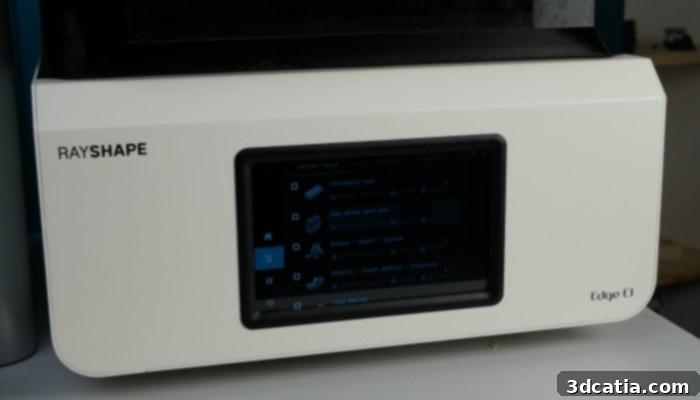
Upon unboxing, the Edge E1 immediately impresses with its construction. It features a sturdy chassis meticulously crafted from folded sheet metal and aluminum, underscoring its industrial-grade design. The Z-axis movement system, a critical component for print accuracy, is built upon reliable linear rails and a precision leadscrew. This robust mechanical foundation bodes exceptionally well for consistent, precise, and dependable print outcomes. The front of the printer is dominated by a clear and responsive 7-inch color touchscreen, which, from the moment it’s powered on, presents a remarkably intuitive and user-friendly interface, simplifying initial setup and operation.
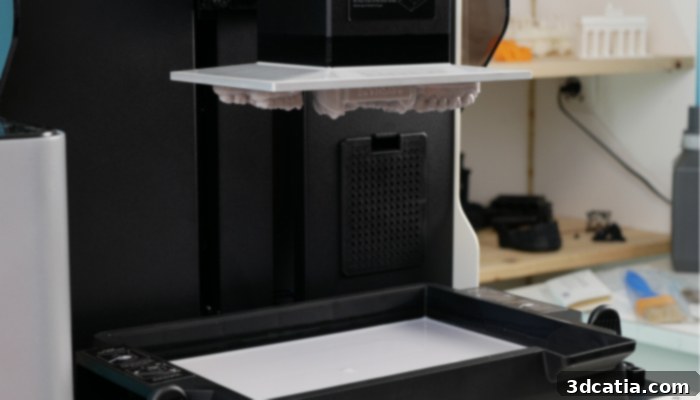
Despite its relatively imposing overall dimensions, the Edge E1 features a minimalist, premium design ideal for professional environments.
While the Edge E1 may not be the most compact desktop printer on the market, its design philosophy leans heavily towards a professional, minimalist aesthetic. RAYSHAPE has made a deliberate aesthetic choice to elegantly conceal most of the mechanical components, resulting in a cleaner, more understated machine. This thoughtful design ensures that the printer can seamlessly integrate into the professional environment of a dental practice or prosthetic laboratory without being an obtrusive presence.
Crucially, for medical and laboratory settings, the Edge E1 incorporates an interchangeable activated carbon filter. This vital feature helps to mitigate the presence of volatile organic compounds (VOCs) emitted during the resin printing process, ensuring a safer and more comfortable working environment. The unpacking experience further revealed a meticulously organized array of accessories. These included two hermetically sealed plastic boxes, cutting pliers, plastic and metal spatulas, filters, tweezers, a sprayer, disposable gloves, micro-fiber wipes, Allen keys, an Ethernet cable, a mallet, and a plastic tray. Each item was neatly packaged in individual bags and clearly labeled with its name and function, demonstrating a thoughtful approach to user convenience and making the initial setup of the RAYSHAPE Edge E1 remarkably straightforward and user-friendly.
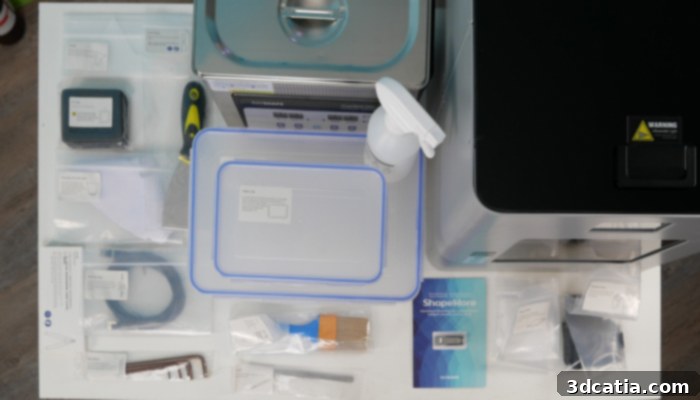
The RAYSHAPE dental printer is accompanied by a comprehensive suite of accessories, significantly enhancing the overall user experience.
Beyond the printer itself, we also received essential post-processing equipment that completes RAYSHAPE’s dental manufacturing ecosystem: the ShapeWash and ShapeCure units. The ShapeWash is an ultrasonic cleaning tank, indispensable for effectively removing uncured resin from printed parts, ensuring they are clean and ready for the next stage. The ShapeCure, on the other hand, is a dedicated post-curing machine designed to expose parts to UV light, ensuring optimal polymerization of the resin. This critical step is vital for achieving the desired mechanical properties, dimensional stability, and biocompatibility, particularly crucial for dental applications using photopolymerization solutions.
Installing and Calibrating the RAYSHAPE Edge E1 3D Printer
Once all components were unboxed, the Edge E1 printer, along with its accessories and post-processing units, was strategically placed on a stable work surface. It’s important to allocate sufficient space behind the machine to allow the cover to open fully, granting convenient access to the 3D printer’s interior for maintenance and resin management. Connecting the equipment is straightforward, and upon powering on, the printer’s intuitive screen interface immediately greets the operator, ready for the initial setup sequence.
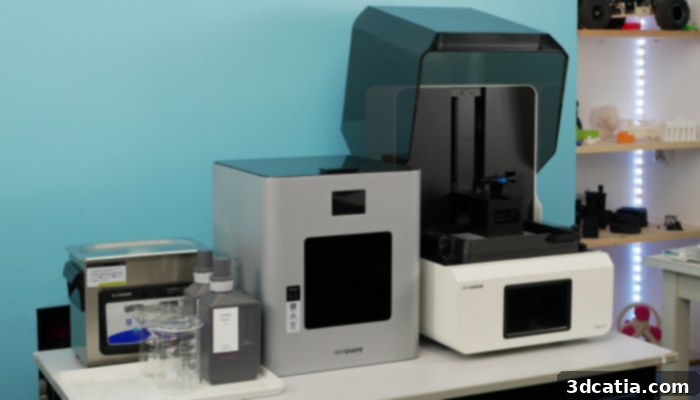
RAYSHAPE’s dental ecosystem provides a complete solution, including the Edge E1 printer, dedicated post-processing machines, and specialized dental resins.
The first critical step involves adjusting the print plate height relative to the monochrome LCD screen. This process is user-friendly but requires precision, using a standard sheet of paper as a guide. To perform this adjustment, the resin vat is temporarily removed, and the build plate is lowered until the A4 sheet, placed between the screen and the plate, exhibits sufficient resistance. While the build plate arrives factory-leveled and calibrated, performing this minor spacing adjustment after transport is crucial to ensure optimal printing performance and consistent layer adhesion. A quick test of the 4K LCD print screen confirms its proper functionality, after which the resin tray is reinstalled and manually filled with the chosen dental resin. Once the entire 1 kg bottle of resin is poured into the tray, the Edge E1 is fully prepared to commence its first print job.
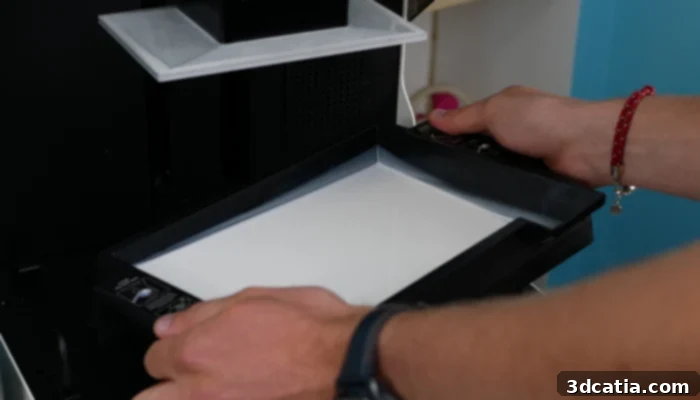
The resin vat of the RAYSHAPE Edge E1 is designed for easy insertion and secure fastening with swivel clips, streamlining the user experience.
One minor operational note: after restarting the 3D printer, the Edge E1 does not appear to automatically reconnect to previously saved Wi-Fi networks. Despite having the password stored, manual reconnection by selecting the correct network is necessary. While a small inconvenience, it’s a point to remember for seamless workflow integration.
ShapeWare: RAYSHAPE’s Proprietary Slicing Software for Optimized Workflow
Consistent with its holistic approach, RAYSHAPE has developed its own dedicated slicing software, “ShapeWare,” to complement its 3D printers. This slicer is equipped with all the essential functionalities expected from professional software, including intuitive tools for model orientation, precise cutting, hollowing, and automated support generation. Beyond these basics, ShapeWare offers advanced and highly practical features such as integrated nesting, which significantly optimizes build plate utilization and enables efficient serial production, a critical advantage in professional settings like dental labs. It is worth noting, however, that the software appears to have been originally developed in Chinese and subsequently translated into English, leading to occasional minor translation quirks that, while not hindering functionality, can subtly impact the overall user experience.
In addition to its powerful file manipulation capabilities, ShapeWare comes pre-loaded with optimized profiles for each specific resin type offered by RAYSHAPE, ensuring users can achieve optimal print quality and mechanical properties right out of the box. Furthermore, the software boasts an open architecture that allows for the creation and import of customized profiles. This flexibility means users are not restricted to RAYSHAPE’s proprietary resins but can experiment with and utilize any compatible third-party resins, significantly expanding their material options. A major enhancement to the user experience is ShapeWare’s ability to wirelessly transmit print jobs to the Edge E1 via Wi-Fi. This network connectivity streamlines the workflow by allowing print files to be sent directly from a workstation to the printer over the local network, eliminating the need for manual file transfers via USB drives.
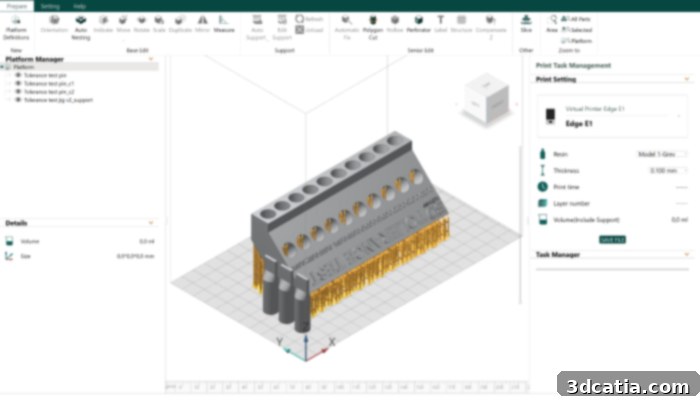
ShapeWare, RAYSHAPE’s proprietary slicer, provides comprehensive tools for preparing models for high-quality resin 3D printing.
During our testing, we encountered a minor hiccup related to resin profiles. We received samples of an older resin, necessitating the use of custom profiles provided by RAYSHAPE to achieve optimal printing results. While importing these custom profiles into ShapeWare was a straightforward process, it’s reassuring to know that end-users receiving the latest resins will typically find pre-configured profiles already integrated, thus bypassing this extra step. The sole notable limitation of ShapeWare currently is its lack of support for the 3MF file format, which is steadily gaining traction and becoming a standard in the 3D printing industry. Consequently, users must ensure that their 3D models are saved or converted to supported formats like STL before importing them into the slicing software.
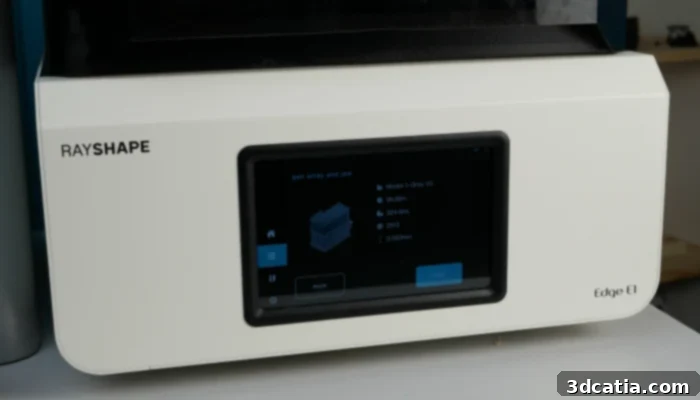
Once print files are wirelessly transmitted via the slicer, jobs can be conveniently initiated directly from the RAYSHAPE Edge E1’s intuitive touchscreen interface.
Exceptional Precision: First Prints With the RAYSHAPE Edge E1
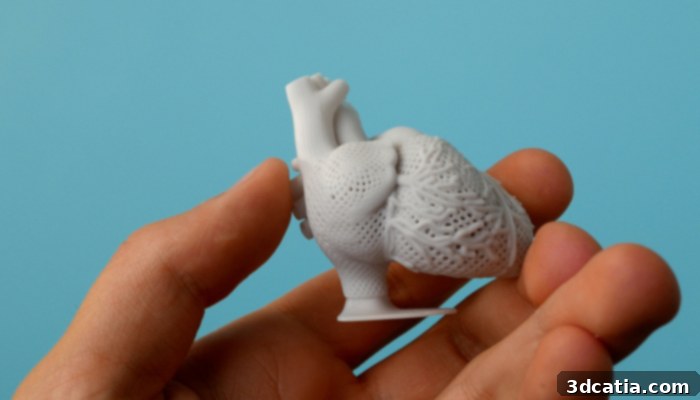
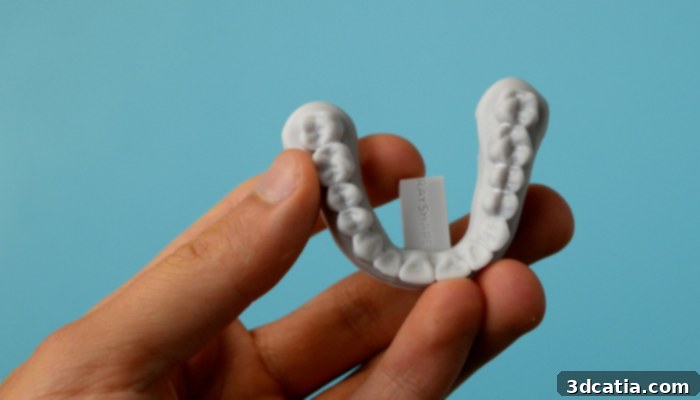
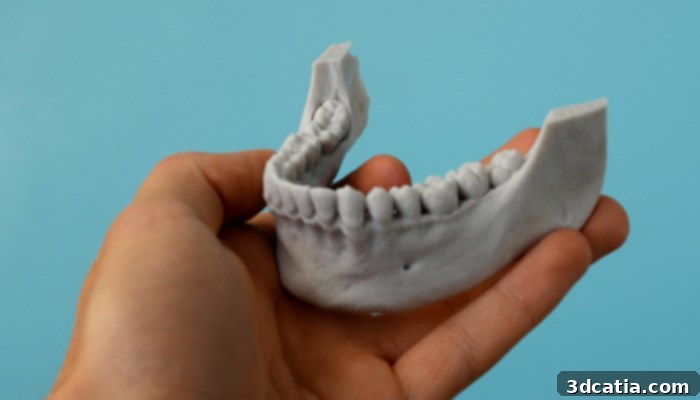
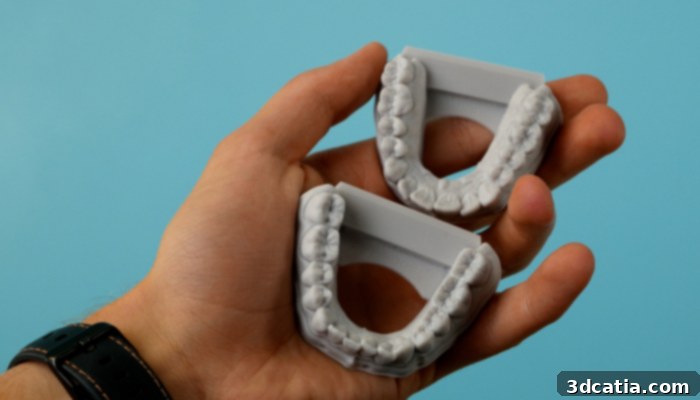
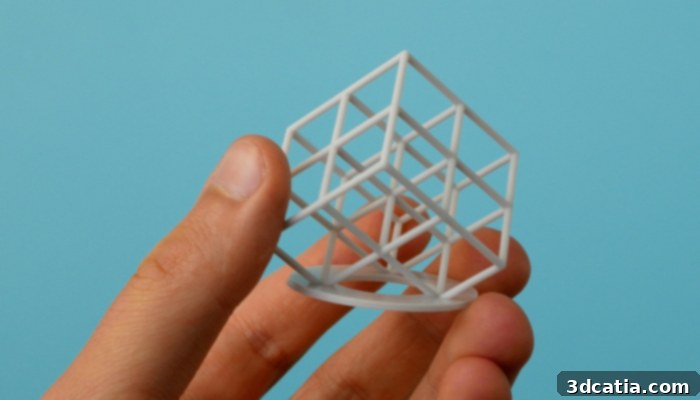
Once models are prepared and sliced using ShapeWare, the print file is seamlessly transmitted over the local network, allowing for print jobs to be initiated directly from the Edge E1’s integrated touchscreen. The printed parts produced by the RAYSHAPE Edge E1 consistently demonstrated remarkable detail and an impressive fidelity to their original 3D models. Individual voxels and layer lines are almost imperceptible to the naked eye, a clear indicator of the printer’s capacity to deliver exceptionally high-resolution prints. Despite its medium-sized print volume, the Edge E1 proves to be remarkably versatile and well-suited for a comprehensive array of demanding dental applications, from diagnostic models to surgical guides.
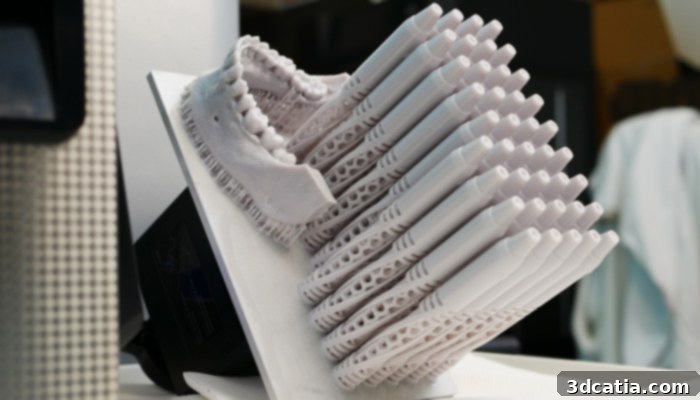
During our evaluation, test prints of “Model 1” and “Record Model” resins met or exceeded expectations, exhibiting consistent and superior print quality. RAYSHAPE specifies a dimensional accuracy ranging between 50 and 90 microns for the Edge E1. Impressively, our rigorous laboratory tests were able to validate even tighter tolerances, down to an exceptional 3 microns, underscoring the printer’s precision capabilities, which are vital for critical dental applications where accuracy is paramount. The serial printing function allows up to 12 dental models to be printed simultaneously, significantly boosting productivity for busy practices.
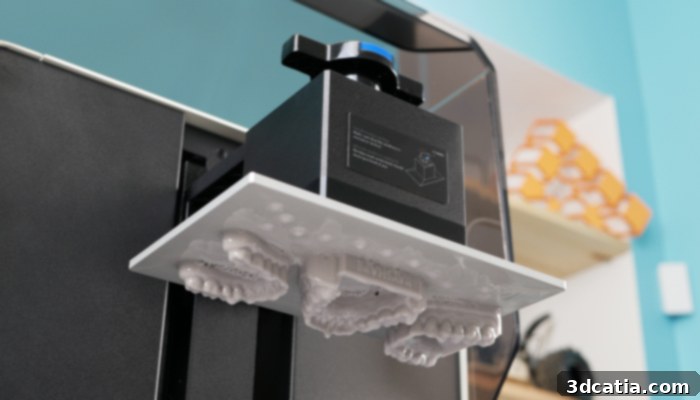
The RAYSHAPE Edge E1 is adept at producing highly detailed dental models using specialized resins. Its serial printing capability allows for the simultaneous production of up to 12 models.
As the Edge E1 currently lacks an automatic resin-filling system, users must manually ensure the resin tank has sufficient material before each print job. RAYSHAPE also strongly emphasizes the importance of stirring the resin prior to every print to guarantee optimal results and prevent sedimentation, which can affect print quality. A helpful enhancement would be a direct reminder or prompt on the printer’s screen to mix the resin before initiating a print, further streamlining the user workflow and minimizing potential errors.
Integrated Post-Processing: ShapeWash and ShapeCure+
The post-processing phase is just as critical as printing for achieving functional and aesthetic parts, especially in dental applications. RAYSHAPE’s ecosystem includes the ShapeWash and ShapeCure+ to streamline this workflow. The ShapeWash ultrasonic cleaning machine, originally manufactured by Skymen and subsequently rebadged by RAYSHAPE, performs its function admirably. It offers adjustable cleaning times and temperatures, ensuring thorough removal of uncured resin. While the ShapeWash features a built-in heating function, users should exercise caution and avoid using it when cleaning with solvents, particularly alcohol, due to safety considerations. With competitive pricing—approximately $200 for the smaller 020S model and $350 for the larger 040S—ShapeWash units provide an effective and accessible solution for cleaning a wide variety of 3D printed parts.
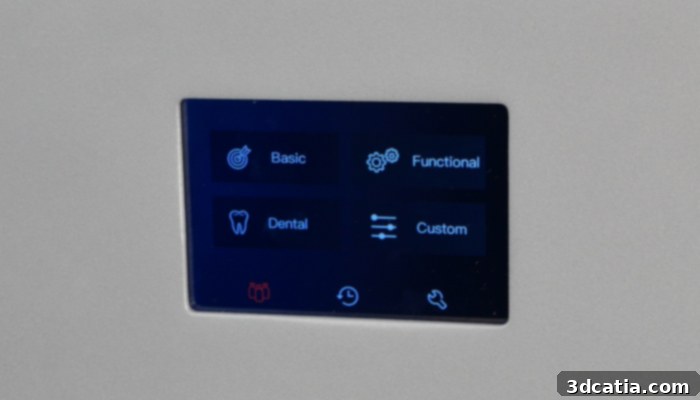
ShapeCure facilitates the post-polymerization of prints, utilizing pre-configured profiles for various resins to ensure optimal curing.
The ShapeCure+ post-curing machine further simplifies the workflow with its user-friendly color touch screen, which comes pre-loaded with specific curing profiles tailored for each resin type sold by RAYSHAPE. These profiles automatically configure the optimal curing time and temperature, ensuring consistent and reliable results. While the machine is designed for ease of use, its custom settings feature theoretically allows for an “infinite” heating temperature, though this is practically limited by the machine’s physical capabilities. For safety and optimal results, it is always recommended to adhere to adapted temperatures. Priced at $1,000 for the ShapeCure and $2,000 for the ShapeCure+, these post-polymerization machines are invaluable investments that simplify the post-processing workflow, guaranteeing that prints are correctly light-cured for maximum stress resistance, dimensional stability, and biocompatibility, particularly crucial in dental applications.
Although the ShapeCure+ does not offer direct internet connectivity, it is equipped with a USB A port internally. This port likely facilitates user-initiated firmware updates, allowing for the addition of new resin profiles and enhanced functionalities in the future, thus ensuring the machine remains up-to-date with evolving resin technologies and user requirements.
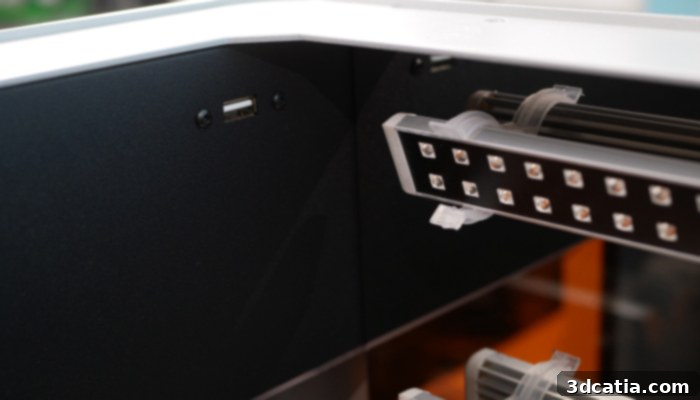
The ShapeCure post-curing machine features an internal USB A port, enabling future updates and the addition of new curing profiles to its system.