
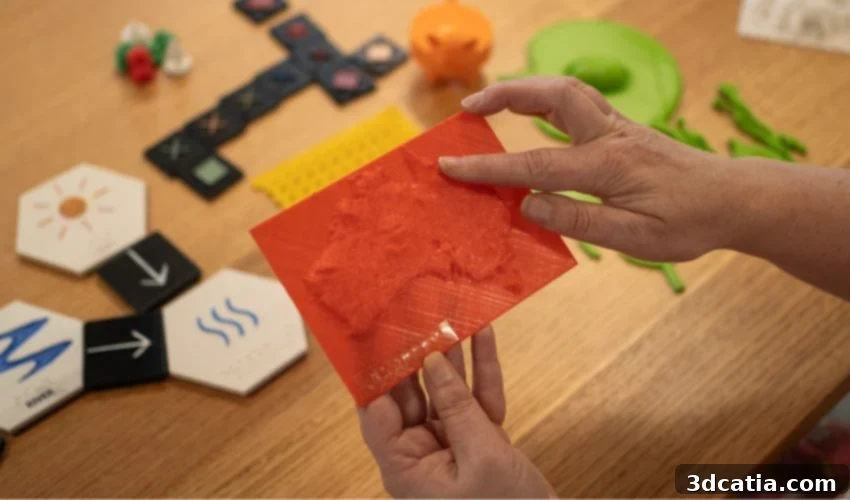
Revolutionizing Accessibility: How Monash University’s 3D Printing Guidelines Empower Learning for Print Disabilities
The landscape of assistive technology is continuously evolving, with innovations emerging that significantly enhance the lives of individuals with disabilities. Among these groundbreaking advancements, 3D printing technology stands out as a powerful tool for customization and improvement. From tailored prosthetics that fit unique anatomical needs to highly personalized hearing aids and wheelchairs, additive manufacturing is transforming how we approach adaptive solutions. These innovations are not just about functionality; they’re about providing greater independence, dignity, and access to the world for countless people.
Beyond physical aids, 3D printing offers immense potential to serve individuals who are blind or have low vision. By creating intricate tactile objects, this technology opens new avenues for conveying information and facilitating learning through the sense of touch. Imagine educational models that allow students to physically explore complex concepts, detailed maps that guide navigation, or even replicas of famous art pieces that bring cultural experiences to life — all accessible through touch. These 3D printed items foster a deeper, more immersive understanding of the world, moving beyond traditional two-dimensional representations that often exclude individuals with visual impairments.
However, to truly harness the power of 3D printing for this community, careful consideration must be given to design principles. Crafting a 3D print specifically for blind or low-vision users requires a nuanced understanding of tactile perception, ensuring that the objects are not only accurate but also intuitively interpretable through touch. Recognizing this critical need, researchers at Melbourne’s esteemed Monash University have taken a significant step forward. They have developed and shared a comprehensive set of new guidelines aimed at creating effective 3D printed educational tools and other accessible aids to support people with what they term “print disabilities.” These guidelines represent a crucial development in making additive manufacturing truly inclusive.
In a recent press statement from Monash University, Leona Holloway, a prominent figure from the Faculty of Information Technology, emphasized the groundbreaking nature of these free guidelines. She clarified that the term “print disabilities” encompasses a broader spectrum than just blindness or low vision. It extends to individuals facing a variety of challenges, including those with physical disabilities that limit their ability to interact with traditional 2D materials, individuals who struggle to follow a line of print due to various conditions, and those whose disabilities impact their concentration and ability to process visual information effectively. This inclusive definition ensures that the guidelines cater to a wide range of learning and access needs, promoting a more equitable educational and informational environment.
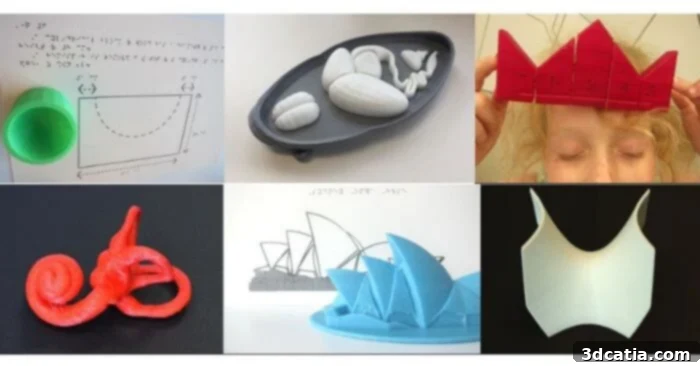
3D prints for use in the classroom. (Photo credits: Monash University, from “The Guidelines for Producing Accessible Prints”)
Crucially, “The Guidelines for Producing Accessible Prints” are made freely available to the public, underscoring Monash University’s commitment to widespread accessibility. This initiative empowers a diverse group of stakeholders, including dedicated teachers, supportive parents, and specialized educational professionals, to create truly inclusive and engaging tactile models. The scope of these models is vast and incredibly beneficial for learning. They can range from fundamental braille learning aids that introduce literacy through touch, to complex curriculum-based models suchs as historical artifacts that allow students to feel the texture and form of ancient objects. Furthermore, the guidelines support the creation of detailed landform models for geography, accurate anatomical models for biology, practical math aids, innovative educational games, and various adaptive tools designed to meet specific individual needs. The potential for enhancing educational experiences and fostering active participation through these tactile resources is immense.
“One of the distinct advantages of 3D printed models over traditional raised line drawings is their inherent versatility and inclusivity,” Holloway pointed out. “They possess the unique capability to be utilized effectively by blind, low vision, and sighted students concurrently within educational environments. This fosters a shared learning experience that bridges sensory gaps and encourages peer interaction. Furthermore, these models prove invaluable for individuals who may not have received formal training in ‘touch reading,’ making complex information accessible to a wider audience and breaking down barriers to understanding.” This aspect is particularly vital, as it promotes an integrated classroom setting where all students can engage with the same learning materials, promoting collaboration and mutual understanding.
The development of these comprehensive guidelines was not an isolated academic endeavor but a deeply collaborative project. The Monash University researchers worked in close partnership with the non-profit organization, Round Table on Information Access for People with Print Disabilities (Round Table). This partnership ensured that the guide was informed by extensive experience and a deep understanding of the needs of the community it aims to serve. Additionally, and perhaps most importantly, the team actively sought and incorporated invaluable insights directly from individuals who are blind and low-vision. This user-centric approach guarantees that the guidelines are practical, relevant, and truly address the challenges faced by end-users. The culmination of this dedicated effort is an entirely comprehensive guide: it meticulously explains the fundamentals of what 3D printing entails, delves into the intricate process of how to design models optimized for understanding through touch, and provides guidance on numerous other aspects, effectively leading the reader from the initial concept to the final accessible product.
In the crucial section dedicated to designing for touch, the guide eloquently explains a fundamental difference between visual and tactile perception: “Touch differs from vision in that very fine details cannot be distinguished and an understanding of the whole must be built up through sequential active exploration of the parts through direct contact with the body.” This insight is central to effective tactile design. Unlike vision, which can take in an entire scene instantaneously, touch requires a more sequential and investigative process. A tactile learner must systematically explore individual components of an object to construct a holistic mental image. Therefore, the guide meticulously describes how to strategically modify various features, including the optimal spacing between elements, the precise height differentials, the clarity and distinctness of lines, and the appropriate scale of the model. These design adjustments are paramount to ensure that the 3D printed object is not only easily discernible but also intuitively readable and comprehensible through tactile exploration, preventing confusion and enhancing the learning experience.
The practical application of these design principles is vividly illustrated within the guidelines. For instance, a common pitfall in designing for touch is overcrowding features or making them uniformly flat, which hinders tactile discrimination. The guidelines demonstrate how a poorly optimized model, with all features at the same height and crammed together, becomes nearly impossible to interpret accurately by touch. In stark contrast, an optimized model, designed with tactile readers in mind, is often larger, employing variable heights to differentiate elements, using more distinct shapes, and incorporating wider spacing. These strategic adjustments make the model far more accessible and understandable, allowing individuals to truly grasp the intended information through their fingertips. It’s a testament to the fact that effective design for accessibility is not just about making something available, but making it truly usable and informative.
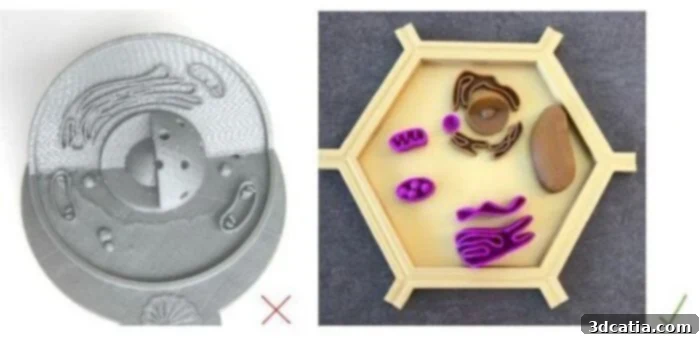
The 3D printed cell model on the left is not optimized for reading by touch: all features are the same height with crowding. The model on the right is better suited for touch readers: it is larger and uses variable heights, more distinct shapes and wider spacing. (Photo credits: Monash University (left), Texas School for the Blind and Visually Impaired (right), from “The Guidelines for Producing Accessible Prints”)
Sonali Marathe, the esteemed President of Round Table, articulated the profound benefit of proactively engaging with new technologies and exploring their emerging applications. Her insights highlight how embracing innovations like 3D printing can unlock unprecedented educational opportunities. “The 3D printed models can help students who are blind gain a crucial spatial and dimensional understanding of things that they may have never experienced before,” Marathe explained. “For example, for the very first time ever, students are learning different architectural concepts through tangible 3D printed models of iconic structures like the Burj Khalifa, the Taj Mahal, and the Statue of Liberty.” This ability to physically interact with scaled models of complex structures transforms abstract concepts into concrete, understandable realities, fostering a deeper appreciation and comprehension of architectural design and global landmarks. It’s a game-changer for conceptual learning.
The real-world impact of these guidelines is already being felt in educational settings. Adrian Riessen, an Orientation and Mobility Teacher at the South Australian School and Services for Vision Impaired (SASSVI), exemplifies this transformative power. He founded a highly successful 3D printing club at his school, witnessing firsthand how the technology dramatically improves access to curricula that were previously considered “historically challenging to teach.” Topics that rely heavily on visual representation, such as complex geographical maps or intricate scientific diagrams, can now be made tangible and accessible, opening up new learning pathways for students with visual impairments.
“Students that often struggle with abstract mapping concepts find that when they can explore something in 3D, it seems to take on significantly more meaning,” Riessen observed. “They can truly feel that it’s a building with a door and a window. It’s no longer just an abstract square on a flat, white sheet of paper. This tactile engagement transforms two-dimensional representations into a concrete, three-dimensional reality, enhancing comprehension and making learning far more intuitive and memorable for them.” This testimonial underscores the profound shift from abstract learning to tangible understanding that 3D printing facilitates.
It is highly noteworthy that these guidelines are the first of their kind, filling a crucial void in the rapidly expanding field of additive manufacturing. While general information about 3D printing abounds, the specific, accessibility-focused insights detailed in these guidelines — particularly concerning how to effectively design and utilize 3D prints for the blind and low vision community — have historically been absent. “Though there is a lot of information available about 3D printing generally, the accessibility-specific information in these guidelines about how to design and use 3D prints for the blind and low vision community has never been available before,” Marathe reiterated, emphasizing their pioneering nature. “We sincerely hope these standards are shared and adopted by as many organizations and people across the world as possible,” she added. The widespread adoption of these meticulously developed standards holds the promise of fostering a globally consistent approach to accessible 3D printed materials, ensuring that more individuals with print disabilities can benefit from this transformative technology. To access these vital guidelines, which are thoughtfully made available in both print and braille formats, simply click here.
The Monash University guidelines mark a pivotal moment in the journey towards fully inclusive education and information access. By providing clear, practical, and user-informed directives, they empower educators, innovators, and caregivers to leverage 3D printing’s full potential. This initiative not only addresses a critical need but also champions the principle that learning should be accessible to everyone, regardless of their sensory or physical capabilities. As 3D printing technology continues to advance, these foundational guidelines will serve as a cornerstone for future developments, inspiring further innovation in accessible design and ensuring that no one is left behind in the digital age.
What are your thoughts on these innovative 3D printing guidelines for people with print disabilities? How do you envision these guidelines impacting education and daily life for individuals with visual impairments and other print disabilities globally? Let us know in a comment below or on ourLinkedIn,Facebook, andTwitter pages! Don’t forget to sign up for our free weeklyNewsletter here, to get the latest 3D printing news straight to your inbox! You can also find all our videos on ourYouTube channel.
*Cover Photo Credits: Monash University