
Revolutionizing Bone Regeneration: The Promise of 3D/4D Printed Bio-Piezoelectric Scaffolds in Next-Generation Tissue Engineering
In recent years, the convergence of bioengineering and advanced manufacturing technologies, particularly 3D and 4D printing, has ushered in a remarkable era of innovation within the medical field. Among the most exciting applications is the area of bone regeneration, a critical challenge in orthopedics and reconstructive surgery. Human bones possess a fascinating and often underappreciated property: piezoelectricity. This natural phenomenon allows bone tissue to generate minute electrical charges when subjected to mechanical stresses such as compression or tension, playing a vital role in its self-repair mechanisms. These endogenous electric signals are crucial for stimulating cell metabolism, promoting osteogenesis (new bone formation), and orchestrating the complex biological processes required for effective healing. Despite this inherent natural benefit, many contemporary additive-manufactured scaffolds, while innovative in their structural design, often overlook the essential electrical microenvironment necessary for truly efficient and robust bone regeneration. However, a groundbreaking study featured in the prestigious International Journal of Extreme Manufacturing has illuminated a transformative path forward. This research highlights the immense potential of advanced 3D/4D printed bio-piezoelectric scaffolds, positioning them as a cornerstone for the next generation of bone tissue engineering solutions.
Understanding Bone Piezoelectricity and Its Therapeutic Potential
The concept of piezoelectricity in human bones has long been recognized as a fundamental mechanism governing bone growth, remodeling, and repair. This profound biological discovery has inspired researchers to venture beyond traditional approaches, actively exploring novel lead-free biological piezoelectric materials. These cutting-edge materials are specifically engineered for their exceptional characteristics, including excellent processability, ensuring they can be easily manipulated and formed into complex scaffold structures. Crucially, they boast high biocompatibility, meaning they are well-tolerated by the body and do not elicit adverse immune responses. Furthermore, their multicellular inducibility allows them to effectively guide and stimulate various cell types critical for tissue regeneration. The bio-piezoelectric scaffolds fabricated from these advanced materials exhibit a remarkable capacity to orchestrate cellular activity. They are proven to induce bone cell differentiation, encouraging mesenchymal stem cells to specialize into osteoblasts that form new bone tissue. Beyond osteogenesis, these scaffolds actively promote vascular cell recruitment, fostering angiogenesis—the formation of new blood vessels—which is essential for supplying nutrients and oxygen to the regenerating tissue. Intriguingly, initial findings also suggest their potential to contribute to nerve cell repair, a significant advantage for complex injuries involving neural damage. One of the most compelling features of these smart scaffolds is their innovative reconstitution strategy, allowing for either minimally invasive or entirely non-invasive electrical stimulation in vivo. This is achieved through programmable external stimuli, such as ultrasound or magnetic treatment, which can be precisely adjusted in terms of timeline, duration, and strength, offering unparalleled control over the healing process and enabling personalized therapeutic interventions.
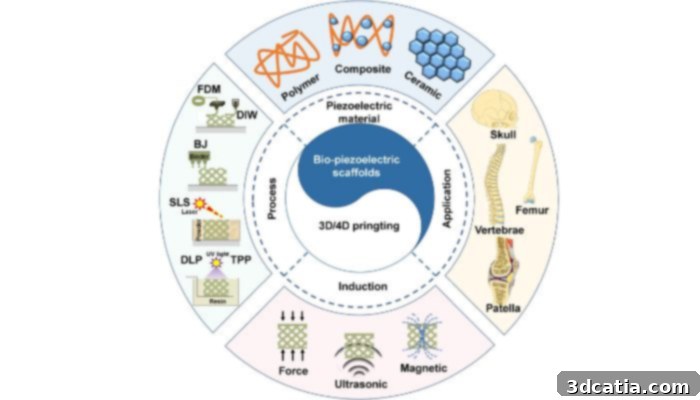
Overview of the potential of smart bio-piezoelectric scaffolds created through 3D/4D printing methods like DIW, FDM, BJ, SLS, DLP, and TPP, as a promising alternative for bone tissue engineering. (Photo credits: Annan Chen et al 2023 Int. J. Extrem. Manuf.)
The Evolution to 4D Printing: Dynamic Scaffolds for Enhanced Regeneration
While 3D printing provides unprecedented control over scaffold architecture, the advent of four-dimensional (4D) printing technology further amplifies the capabilities and potential of bio-piezoelectric scaffolds. Unlike static 3D printed objects, 4D printing involves the creation of structures designed to exhibit time-dependent functionality-shifting behavior. This means that the fabricated scaffolds can dynamically change their shape, properties, or functions in response to specific external stimuli after the initial printing process. These stimuli can include variations in temperature, pH levels, light, magnetic fields, or even moisture. For bio-piezoelectric scaffolds, this 4D functionality translates into an unparalleled advantage: the ability to offer a truly programmable and adaptive electrophysiological microenvironment. Instead of a fixed electrical stimulation, 4D scaffolds can dynamically adjust their piezoelectric output or mechanical properties over time, mimicking the natural, evolving requirements of a healing bone. This dynamic response significantly aids tissue regeneration by providing optimal conditions throughout various stages of the repair process, potentially accelerating healing and improving integration with host tissue. This adaptability allows the scaffold to better conform to the physiological changes occurring during bone repair, offering a level of sophistication and bio-mimicry previously unattainable with conventional static scaffolds.
Bridging the Gap: From Lab to Clinical Application
Despite the immense promise and exciting advancements in 3D and 4D printing of bio-piezoelectric scaffolds, a considerable gap currently exists between cutting-edge research capabilities and the stringent clinical requirements for their widespread application. Translating these sophisticated lab-based prototypes into viable, safe, and effective medical devices for patients necessitates a robust, multidisciplinary approach. This collaborative effort must seamlessly integrate expertise from several distinct yet interconnected fields. Materials science plays a crucial role in developing novel lead-free piezoelectric polymers and ceramics that offer optimal mechanical properties, biodegradability, and long-term stability within the biological environment. Mechanical engineering is essential for designing scaffolds with precise structural integrity, porosity, and mechanical cues that match the native bone and can withstand physiological loads. Bioengineering provides the critical understanding of cell-material interactions, tissue regeneration pathways, and methods for assessing biocompatibility and therapeutic efficacy. Furthermore, bridging this gap requires extensive collaborative research involving experts from various medical disciplines. Orthopedics, for instance, is the primary field that will benefit from enhanced bone repair solutions for fractures, non-unions, and reconstructive surgeries. Stomatology (dentistry and oral surgery) will leverage these scaffolds for craniofacial bone defects, dental implants, and jaw reconstruction. Oncology is another vital area, where these scaffolds could revolutionize the reconstruction of large bone defects resulting from tumor resections, offering hope for patients undergoing aggressive cancer treatments. These concerted efforts are already underway, uniting scientists, engineers, and clinicians to unlock the full therapeutic potential of these smart bio-piezoelectric scaffolds and accelerate their journey from bench to bedside.
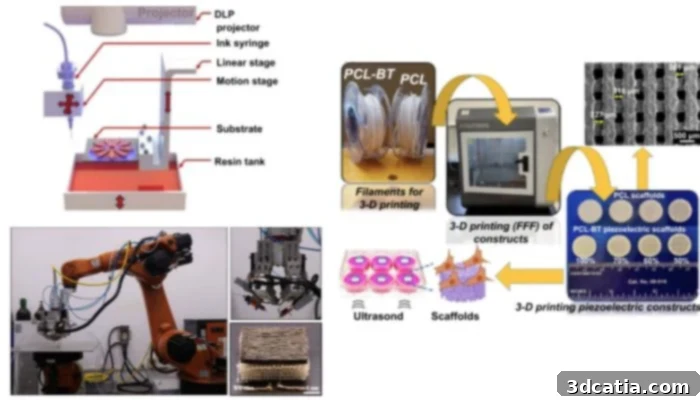
Fused Deposition Modeling (FDM) schematics and other potential 4D printing strategies for bio-piezoelectric scaffolds (Photo credits: Annan Chen et al 2023 Int. J. Extrem. Manuf.)
Expert Perspectives and Future Directions
The scientific community is keenly aware of the profound implications these advancements hold. Professor Jian Lu, a highly esteemed expert from the City University of Hong Kong, has articulated a strong belief in the revolutionary impact of this breakthrough research. He asserts, “With the collaborative efforts of multidisciplinary studies, 3D/4D printing would be expected to soon reach its full potential in creating smart bio-piezoelectric scaffolds for next-generation tissue engineering.” This optimistic outlook underscores the rapid pace of development and the commitment from various fields to realize this vision. Professor Lu further emphasizes the importance of drawing inspiration from other cutting-edge technologies to propel this field forward. He suggests incorporating principles from intelligent manufacturing, which can streamline production, ensure quality control, and enable mass customization of scaffolds, making them more accessible and efficient to produce. Bionic medicine, by studying and mimicking the intricate designs and functionalities found in nature, can inform the creation of scaffolds that are even more biologically analogous and effective. Furthermore, the integration of machine learning and artificial intelligence offers unprecedented opportunities to optimize scaffold design, predict material behavior, personalize treatment plans based on patient-specific data, and even automate aspects of the design and manufacturing process. By leveraging these advanced technologies, researchers aim to overcome existing limitations and significantly accelerate the clinical application and widespread adoption of bio-piezoelectric scaffolds, pushing the boundaries of what is possible in regenerative medicine.
Transforming Patient Care: A New Era in Regenerative Medicine
The successful translation of 3D/4D printed bio-piezoelectric scaffolds from research laboratories to clinical practice promises to usher in a new and exciting era in medical treatments. By effectively bridging the current gap between technological capabilities and pressing clinical requirements, we can anticipate a future where patients receive vastly improved solutions for bone repair and restoration. This innovative approach holds the potential to fundamentally transform the landscape of regenerative medicine, moving beyond conventional treatments that often fall short in complex or large bone defects. With the advent of these smart scaffolds, patients can look forward to not only more effective but also highly personalized bone repair solutions. The ability to program electrical stimulation, mimic natural bone activity, and adapt to the healing environment means treatments can be tailored precisely to individual patient needs, leading to faster recovery times, stronger bone formation, and reduced risk of complications. This personalization, coupled with enhanced healing capabilities, ushers in a new wave of medical interventions that hold the profound potential to transform countless lives, restoring function and improving quality of life for those suffering from bone injuries and diseases. The collaborative synergy between bioengineering, advanced 3D/4D printing techniques, and a diverse spectrum of medical experts is actively paving the way for this brighter future. In this vision, bone regeneration becomes significantly more efficient, widely accessible, and truly patient-centric. As this groundbreaking technology continues to progress and researchers diligently explore the full scope of 3D/4D printed bio-piezoelectric scaffolds, the outlook becomes increasingly promising. We are undoubtedly approaching the cusp of a groundbreaking era in bone tissue engineering, one that promises to reshape how we heal and rebuild the human body. To delve deeper into this exciting research, the original study can be accessed HERE.
What are your thoughts on the future of 3D/4D Bio-Piezoelectric Printing in medicine? We encourage you to share your insights and comments below, or connect with us on our LinkedIn, Facebook, and Twitter pages! Don’t miss out on the latest advancements in additive manufacturing – sign up for our free weekly Newsletter here, delivering the freshest 3D printing news straight to your inbox! You can also explore all our insightful videos on our YouTube channel.
*Cover photo credit: iStock