
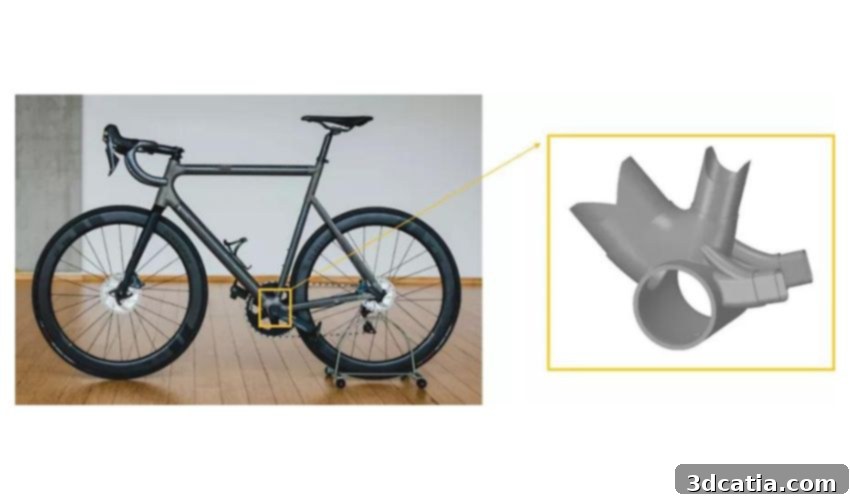
Revolutionizing Bicycle Manufacturing: Ansys and Aconity3D Conquer 3D Printing Delamination Challenges
Innovation in advanced manufacturing is constantly pushing the boundaries of what’s possible, and the creation of a fully 3D printed bicycle stands as a testament to this progress. Located in Limburg, the Netherlands, Brightlands Chemelot is a vibrant hub of innovation, one of four such campuses fostering collaboration among designers, researchers, and engineers. It was within this dynamic environment that a groundbreaking project unfolded: the development of a pioneering 3D printed bicycle. This remarkable achievement leverages high-performance materials and state-of-the-art additive manufacturing techniques, aiming to produce a bicycle frame that is not only exceptionally lightweight and durable but also highly customizable. The adoption of additive manufacturing, particularly for complex structures like bicycle frames, offers unparalleled advantages in design freedom, material optimization, and rapid prototyping.
While the entire bicycle represents a significant feat of engineering, our focus here narrows to a specific, yet crucial, element: the bottom lug. This component serves as a critical junction, connecting various segments of the bicycle’s intricate structure, and its integrity is paramount to the overall performance and safety of the bike. To bring this complex part to life, Brightlands Chemelot forged a strategic partnership with Aconity3D, a renowned leader in the field of laser-based metal 3D printing solutions. This collaboration combined Brightlands’ vision for innovative bicycle design with Aconity3D’s expertise in high-precision metal additive manufacturing, setting the stage for both remarkable advancements and unforeseen challenges.
Material Selection and Initial Production Hurdles
The choice of material is fundamental to the success of any advanced engineering project, especially when aiming for both durability and lightness. For the custom-made bicycle’s bottom lug, designers meticulously selected Ti-6Al-4V, a premium titanium alloy. This material is celebrated across various high-stakes industries for its exceptional strength-to-weight ratio, superior corrosion resistance, and excellent biocompatibility. Its robust properties make it an ideal candidate for demanding applications in aerospace, where component integrity is critical, and in medical implants, where reliability and biological compatibility are essential. For a bicycle component, Ti-6Al-4V promised to deliver the necessary stiffness and strength while keeping the overall weight to a minimum, significantly enhancing rider performance and handling.
The manufacturing process for the bottom lug utilized Aconity3D GmbH’s advanced AconityMIDI+ laser powder bed fusion (LPBF) system. LPBF is a sophisticated additive manufacturing technique where a high-power laser precisely melts metallic powder particles layer by layer, solidifying them according to a 3D digital model. This process is particularly adept at creating parts with complex geometries and intricate internal structures, which is often difficult or impossible with traditional manufacturing methods. However, even with cutting-edge technology and material, the initial printing process encountered an unexpected and significant problem: delamination. This defect occurred at the interfaces between the lower lug part and the supporting structures, which are essential for anchoring the part to the build plate and dissipating heat during the printing process. The high thermal stresses generated during the LPBF build process caused these support structures to weaken, failing to maintain a solid bond with the intricate geometry of the printed part. Delamination, manifesting as separation between layers or between the part and its supports, severely compromised the structural integrity and quality of the bottom lug, necessitating a re-evaluation of the printing strategy.

Delamination defects in the parts (Photo credits: Aconity GmbH)
Uniting Forces: Ansys Additive Simulation and Aconity3D for Process Optimization
Recognizing the critical nature of the delamination challenge, Ansys and Aconity3D formed a strategic partnership to integrate advanced 3D printing process simulations directly into the manufacturing workflow. This collaboration marked a pivotal shift from a trial-and-error approach to a predictive, data-driven methodology. By harnessing the capabilities of Ansys Additive LPBF simulations, the combined team gained the ability to proactively identify crucial stress regions within the printed components and thoroughly evaluate various build orientations and support strategies *before* any physical printing commenced. This computational approach allowed engineers to rapidly iterate on designs and process parameters in a virtual environment, significantly reducing the time and material waste associated with failed physical prototypes. The LPBF simulation specifically provided a powerful tool for visualizing and quantifying high-stress areas, enabling engineers to pinpoint exact locations susceptible to crack formation or delamination either during or after the build process. Armed with this invaluable insight, an optimized strategy was meticulously formulated, paving the way for physical validation printing on Aconity3D’s sophisticated Aconity MIDI+ system with a much higher probability of success.
Predictive Simulation: Unveiling the Root Cause of Delamination
To thoroughly understand and mitigate the delamination problem, a detailed static structural model, incorporating the concept of inherent stress, was developed and utilized. This model was designed to precisely simulate the manufacturing configuration that led to the initial defective prints. It faithfully replicated the exact manufacturing orientations of the part and the geometry of the original support structures. Inherent stress, a critical factor in additive manufacturing, refers to the residual stresses locked into the material as it cools and solidifies layer by layer. These stresses, if not properly managed, can lead to distortion, cracking, and delamination. A specialized “high-stress function” was integrated into the simulation results analysis, designed to clearly identify and highlight areas where critical stress buildup occurred during the virtual printing process. This advanced visualization allowed engineers to quickly discern problematic regions that might compromise part integrity.
Upon a comprehensive review of the simulation outcomes, a groundbreaking discovery was made: the identified high-stress areas within the virtual model directly and precisely corresponded with the locations where delaminations had physically manifested during the actual, initial build attempts. This striking correlation provided irrefutable validation of the simulation’s accuracy and predictive power. These critical stress concentration points were conclusively identified as the likely initiation sites for delamination. From these points, cracks would rapidly propagate across the adjacent interface between the underside of the lug’s tab and the supporting structures, leading to the observed defects. This precise identification of failure mechanisms through simulation was a game-changer, providing the necessary data to formulate an effective, targeted solution rather than relying on costly and time-consuming physical experiments.
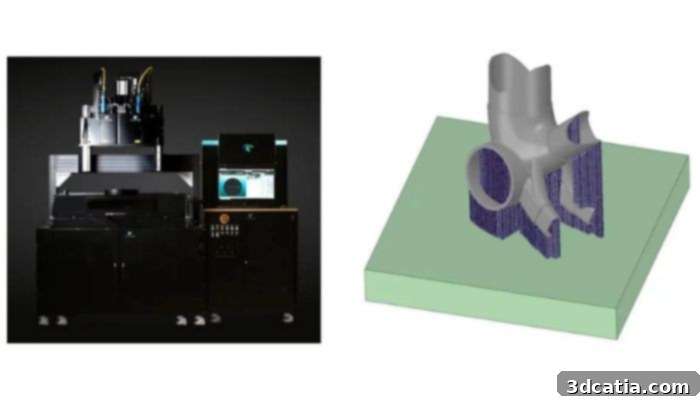
Aconity MIDI+ simulation can predict possible errors
A compelling demonstration of this optimized workflow was seen in a recent preliminary simulation. With high voltage detection (referring to high stress concentration) enabled for a newly configured build setup – incorporating optimized support structures and potentially revised part orientation – the results were transformative. Compared to the previous, problematic setup, the simulation revealed a dramatic reduction in high-stress regions at the critical interface between the bottom of the newly oriented lug tab and its supporting structures. This outcome was a clear indicator of success, confirming that the new strategy effectively mitigated the conditions that previously led to delamination. By proactively incorporating process simulations, Aconity3D’s engineers are now empowered to evaluate the feasibility and effectiveness of diverse manufacturing strategies in a virtual environment. This predictive capability leads to vastly improved results in actual physical manufacturing, ensuring higher part quality, increased production reliability, and ultimately, more robust and reliable components for cutting-edge projects like the 3D printed bicycle. This synergy between simulation and advanced manufacturing represents a significant leap forward in digital manufacturing, enabling complex designs to be realized with unprecedented precision and efficiency. To delve deeper into this exciting advancement, you can explore the original source HERE.
This groundbreaking collaboration between Ansys and Aconity3D exemplifies the power of integrated digital tools in solving complex manufacturing challenges. By leveraging advanced simulation, they’ve not only overcome a critical hurdle in 3D printing high-performance bicycle components but also set a new standard for efficiency and reliability in additive manufacturing. What are your thoughts on how these two leading companies are utilizing simulation to anticipate and prevent potential errors in complex 3D printing projects? We’d love to hear your perspective! Share your insights in a comment below or join the discussion on our Facebook, Twitter, and LinkedIn pages. Stay up-to-date with the latest advancements in additive manufacturing by signing up for our free weekly Newsletter here, delivering the most relevant 3D printing news straight to your inbox!
*Cover Photo Credits: Aconity GMBH