
Weekly Additive Manufacturing Insights: Top 3D Printing Videos You Can’t Miss
As another week draws to a close, it’s time to immerse ourselves in the most compelling advancements and breakthroughs from the world of 3D printing. This week’s curated selection of top videos offers a fascinating glimpse into how additive manufacturing continues to push the boundaries across diverse sectors. From revolutionary material production using metal 3D printing to the surprising acoustics of a 3D printed violin, and from expansive large-format applications in the marine industry to crucial industry partnerships, these videos highlight the dynamic evolution of this transformative technology. We also take a moment to celebrate an industry titan, Jay Dinsmore, and explore a groundbreaking collaboration between Forward AM and Essentium that promises to redefine extrusion 3D printing. Prepare to be inspired by the ingenuity and innovation showcased in this week’s roundup. Happy watching and enjoy your Sunday!
1. Pioneering Material Production with Metal 3D Printing Technology
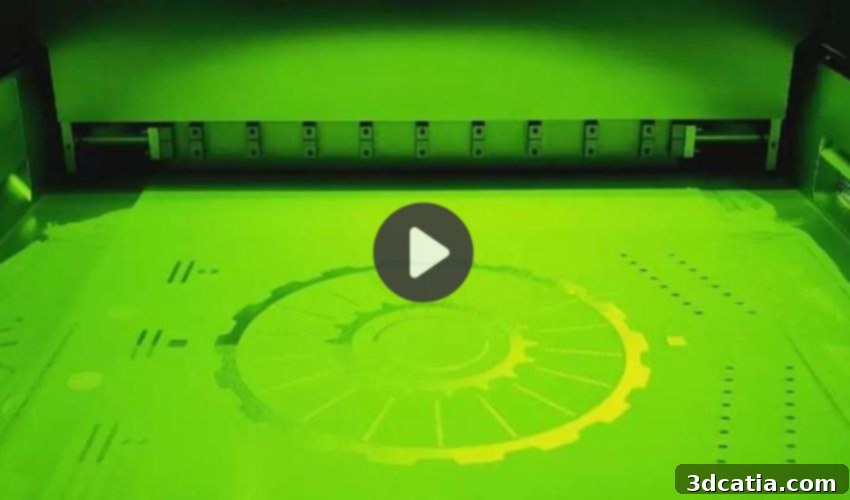
In a significant development for material science, researchers based in Foshan City, China, are leveraging the power of metal 3D printing to drastically improve manufacturing processes. Their innovative approach aims to circumvent a common challenge in traditional material processing methods: the formation of welding defect pores. By utilizing advanced metal powder bed fusion techniques, these researchers are paving the way for the development of entirely new materials, particularly in critical high-performance sectors.
The focus of this research is not merely on incremental improvements but on addressing fundamental industry hurdles. Bi Yunjie, deputy director of the Institute of Advanced Additive Manufacturing of Ji Hua Laboratory, articulates this vision clearly: “We aim to solve some of the main difficulties in the industry at present, such as improving the quality and performance of products and reducing costs.” This initiative represents a strategic effort to enhance product quality, boost performance, and achieve significant cost reductions. Looking ahead, the long-term goal is even more ambitious: “In the long run, we strive to develop new materials and future technologies in China, especially in equipment such as key components for engines and aerospace fields.” This highlights China’s commitment to becoming a leader in advanced material development, with additive manufacturing at its core, enabling the creation of components vital for aerospace, automotive, and other high-tech industries. The adoption of metal 3D printing in these applications promises lighter, stronger, and more complex parts than ever before possible through conventional methods. Discover the details of this groundbreaking work in the video below:
2. The Sound of Innovation: Ray Chen Tests a 3D Printed Violin
The fusion of music and technology reaches new heights as renowned Taiwanese-Australian violinist Ray Chen puts a 3D printed instrument to the ultimate test. While the concept of 3D printed musical instruments has intrigued us before, this video offers a unique opportunity to witness a professional assessment. Ray Chen not only spearheaded the creation of his own 3D printed violin but also dedicated time to practice on it, meticulously evaluating its acoustic qualities and playability against that of a traditionally crafted wooden instrument.
The experiment delves into critical questions about material science, acoustics, and the potential for additive manufacturing to democratize access to musical instruments. Can a violin produced through additive processes genuinely compete with the rich, nuanced tones of a century-old wooden counterpart, crafted by master luthiers? Factors such as resonance, sustain, projection, and the instrument’s tactile response under a violinist’s bow are all under scrutiny. This test is more than just a novelty; it represents an exploration into whether innovative manufacturing techniques can replicate, or even enhance, the complex sonic properties traditionally associated with natural materials. The implications for custom instrument creation, rapid prototyping for instrument design, and reducing manufacturing costs are immense. Witness the captivating comparison and draw your own conclusions about the success of this audacious experiment. The future of musical instrument production might just be in layers. Check out the video below to discover the surprising results!
3. Envisioning the Future: Large-Format 3D Printing in the Maritime Sector
The demand for truly immense parts has driven the rapid rise of large-format 3D printing, and nowhere is its impact more pronounced than in the maritime sector. This industry, characterized by its need for custom, robust, and often unusually shaped components, has increasingly recognized the significant benefits offered by additive manufacturing. Large-format 3D printing allows for the creation of components that would be impossible or prohibitively expensive to produce with traditional methods, ranging from intricate prototypes to functional end-use parts for ships, submarines, and offshore structures.
This week’s featured video provides an exciting case study from Cure Marine, an Australian boat manufacturer. They demonstrate the sophisticated process involved in creating a rubber mold for their cutting-edge Cure 55 catamaran. The video meticulously details every stage, beginning with the intricate CAD design phase, where digital models are sculpted to precise specifications. This is followed by the core of the process: the large-format 3D printing of the mold itself, allowing for complex geometries and significant size. Finally, the additive manufacturing process is seamlessly integrated with 7-axis milling, showcasing a powerful hybrid manufacturing workflow. This combination allows for the rapid production of large, highly accurate tooling, which can then be used for composite fabrication. The use of additive manufacturing for mold creation not only significantly reduces lead times and material waste but also opens up possibilities for more innovative and hydrodynamic vessel designs. It’s a compelling illustration of how hybrid manufacturing approaches are revolutionizing production in an industry where scale and precision are paramount, accelerating innovation in everything from prototyping new hull designs to manufacturing bespoke components for marine vessels. Dive into this fascinating process below:
4. Shaping the Future of AM: An Introduction to Jay Dinsmore
In any rapidly evolving industry, certain individuals emerge as pivotal figures, shaping its direction and fostering its growth. Jay Dinsmore is undoubtedly one such luminary in the world of additive manufacturing. If you’re not yet familiar with his substantial contributions, this video offers an invaluable opportunity to understand his impact. As the visionary founder of Dinsmore – a company that has been at the forefront of rapid prototyping and advanced manufacturing services for decades – and the current chairman of SPE Additive Manufacturing & 3D Printing, Dinsmore’s influence is profound and far-reaching.
His extensive experience, strategic insights, and unwavering dedication have not only propelled his own enterprises but have also significantly contributed to the broader adoption and understanding of AM technologies across various sectors. Dinsmore has played a crucial role in advocating for industry standards, fostering educational initiatives, and promoting collaboration, all of which are essential for the sustained growth of additive manufacturing. His leadership at SPE Additive Manufacturing & 3D Printing underscores his commitment to advancing the technical and business aspects of the industry. We recognized his importance by conducting a one-on-one interview with him just last year, capturing his unique perspectives on the industry’s past, present, and future. This new video from ADDMAN delves deeper into his remarkable journey, chronicling the milestones and challenges that have defined his career and explaining how his foresight and dedication have helped to fundamentally shape the wider additive manufacturing landscape into what it is today. Don’t miss this chance to gain insights from one of the true pioneers of the AM revolution.
5. Game-Changing Partnership: BASF Forward AM and Essentium Innovate Extrusion 3D Printing
The additive manufacturing sector is constantly abuzz with strategic alliances and technological advancements, and this week brings exciting news from a prominent player. Not long ago, we reported on BASF Forward AM’s significant move to branch out from BASF, establishing itself as an independent entity focused entirely on advanced additive manufacturing solutions. Now, the company is making waves again with a groundbreaking partnership that promises to revolutionize a core segment of 3D printing.
In a recent live talk, BASF Forward AM unveiled its collaboration with Essentium, a leader in high-speed extrusion technology. Together, they have forged a strategic alliance aimed at developing the first FFF (Fused Filament Fabrication) system platform specifically designed to overcome the persistent challenges that have long hampered industrial extrusion 3D printing. These traditional issues include notoriously slow printing speeds, a limited array of material choices that restrict application diversity, and often insufficient z-strength, which compromises the mechanical integrity of printed parts. This new partnership directly addresses these pain points.
The core of this innovation lies in the integration of Essentium’s high-speed extrusion printers with BASF Forward AM’s cutting-edge FlashFuse™ technology. FlashFuse™ is engineered to enhance interlayer adhesion, significantly improving the z-strength of FFF printed parts to levels comparable with injection-molded components. This technological synergy is set to propel FFF 3D printing beyond its traditional role in rapid prototyping and into robust, cost-effective industrial use cases. For industries demanding higher throughput, broader material compatibility, and reliable mechanical properties, this platform promises to unlock unprecedented possibilities. It signifies a major step towards making FFF a truly viable and competitive option for manufacturing end-use parts in high-volume, high-demand applications, marking a new era for industrial extrusion 3D printing. Learn more about this transformative partnership and its implications in the video below:
We hope you enjoyed this comprehensive look at the latest developments and compelling stories from the world of 3D printing. What were your thoughts on the innovative use of metal 3D printing in material manufacturing, or perhaps Ray Chen’s venture into 3D printed instruments? We’d love to hear your insights and opinions! Share your comments below or connect with us on our vibrant community platforms. You can find us on LinkedIn, Facebook, and Twitter pages, where you can engage with fellow enthusiasts and industry experts. Don’t miss out on the most current 3D printing news and exclusive content—be sure to sign up for our free weekly newsletter here, delivered straight to your inbox! For an even deeper dive into the visual world of additive manufacturing, you can always find all our exciting videos and more insightful content on our dedicated YouTube channel. Stay informed, stay inspired, and keep exploring the endless possibilities of 3D printing!