
Unleashing the Demogorgon: Aaron Sims Creative on Revolutionizing Film Character Design with 3D Printing for Stranger Things
In the dynamic world of film and television, where imagination knows no bounds, concept design and visual effects studios play a pivotal role in bringing fantastical creatures and elaborate worlds to life. Among these innovators, Aaron Sims Creative (ASC) stands out for its groundbreaking work, particularly their integration of cutting-edge 3D printing technology. We recently had the privilege of interviewing the team at Aaron Sims Creative, the visionary studio behind the iconic Demogorgon from Netflix’s global phenomenon, *Stranger Things*. Their unique approach involves a diverse array of methods for crafting memorable characters for both the big and small screens. In our conversation, we delved into their journey with 3D printing, its transformative applications within their workflow, and the intricate process that led to the physical realization of the terrifying Demogorgon.
This interview offers a deep dive into how a leading creative studio harnesses the power of digital fabrication to bridge the gap between imagination and tangible reality, providing invaluable insights for aspiring designers, filmmakers, and 3D printing enthusiasts alike. From initial sketches to final, hand-painted models, ASC’s story is a testament to the evolving landscape of creative production and the ever-growing significance of additive manufacturing in the entertainment industry.
Meet Aaron Sims Creative: Pioneering ‘Sketch to Screen’ Character and World Building
3DN: Can you introduce yourself and your design studio?
We are Aaron Sims Creative, a dedicated concept design and visual effects studio with a singular passion: specializing in unparalleled character and world building for film, television, digital media, and emerging platforms. Our philosophy is rooted in a comprehensive and collaborative approach, which we’ve distilled into what we proudly call our ‘Sketch to Screen’ workflow. This unique methodology is designed to immerse us with filmmakers right from the nascent stages of project development and visualization. Our goal is to serve as an extension of their creative vision, meticulously helping to translate their abstract ideas into vivid realities. This involves a seamless integration of diverse creative services, including intricate design work, compelling storyboards, dynamic animatics, sophisticated previsualization, stunning visual effects, and, as a relatively recent yet profoundly impactful addition, advanced 3D rapid prototyping.
Our team comprises highly skilled artists, designers, and technicians who thrive on pushing creative boundaries. We believe that true magic happens when every aspect of a character or world is considered from multiple perspectives – from its initial conceptualization on paper to its final manifestation, whether digital or physical. This holistic workflow ensures consistency, fosters innovation, and ultimately delivers a cohesive and immersive experience for audiences. We pride ourselves on being a creative partner that not only understands the artistic nuances of storytelling but also possesses the technical prowess to execute even the most ambitious visions.
Bridging Digital and Physical: Aaron Sims Creative’s Journey with 3D Printing
3DN: What is your link with 3D printing?
Our connection with 3D printing represents a relatively new, yet rapidly expanding and increasingly invaluable, dimension within our comprehensive workflow. This transformative technology empowers us to bridge the gap between the purely digital and the tangibly physical, allowing us to imbue life into otherwise two-dimensional designs and intricate digital models by rendering them into physical forms. The true genesis of our deep engagement with 3D printing can be traced back to our very first significant print: the awe-inspiring Demogorgon, a creature we meticulously designed for the Duffer Brothers for their groundbreaking series, *Stranger Things*. This initial success served as a powerful proof of concept, demonstrating the immense potential of integrating physical models into our creative process.
The impact was immediate and undeniable. Once a few key clients had the opportunity to witness this imposing, meticulously hand-painted 3D model of the Demogorgon, they were captivated. The tactile nature and intricate detail of the physical model provided a level of understanding and immersion that digital renderings alone couldn’t fully achieve. The sheer presence of the Demogorgon model quickly became a powerful conversational piece, and almost instinctively, clients began requesting similar 3D prints for their own characters, creatures, and prop designs across various projects. This organic demand underscored the intrinsic value of physical prototypes in visualization and validation.
At Aaron Sims Creative, we firmly believe that 3D printing is not merely a supplementary tool but an essential, integral part of the modern visualization process. It provides an unparalleled opportunity to assess scale, form, and texture in a way that is simply not possible on a screen. This tactile feedback loop is crucial for refining designs, identifying potential issues, and ensuring that the final on-screen assets are as compelling and realistic as possible. We are continuously exploring and pushing the boundaries of where this medium can take us, investing in new techniques, materials, and printer capabilities. Our aim is to fully integrate 3D printing as a core component that consistently elevates our creative process, offering unprecedented freedom and precision in character and world building for the entertainment industry.
Crafting a Monster: The Demogorgon Design and 3D Printing Process for Stranger Things
3DN: Can you tell us more about designing the Demogorgon for Stranger Things?
The journey of creature design and asset development at Aaron Sims Creative is an elaborate and often extensive one, typically spanning many weeks depending on the sheer complexity and intricate requirements of the specific project. Our process is highly structured yet flexible, commencing with foundational pencil sketches that serve as the initial conceptual blueprints. These traditional drawings allow our artists to rapidly explore diverse silhouettes, anatomical features, and thematic elements, laying the groundwork for the creature’s identity. Once the core concept is solidified, we transition into the digital realm, utilizing industry-standard software to bring these designs to life.
Our primary tool for sculpting highly detailed models is ZBrush, a powerful digital sculpting application that enables artists to manipulate millions of polygons as if working with digital clay. This stage is critical for defining the creature’s intricate textures, musculature, and overall organic form. Following the sculpting phase, we move to Maya for comprehensive asset creation, where the high-resolution sculpts are optimized for various production needs, including rigging, animation, and rendering. Textures and materials are further refined in this stage, ensuring a high level of visual fidelity. Finally, the creature models are rendered using V-Ray, a renowned rendering engine that produces photorealistic imagery, allowing us to visualize the creature in diverse lighting conditions and environments.
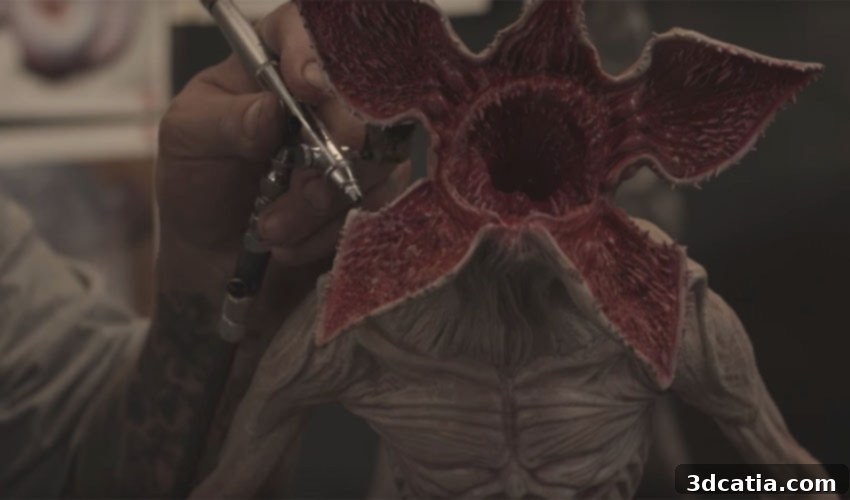
At this point, with our digital assets meticulously prepared and rendered, we are perfectly set up to transition any and all of our creations from the digital screen to the physical world through 3D printing. The actual 3D printing of a model, while dependent on its size and complexity, can often be completed within a matter of days. However, our process doesn’t stop there. We believe that the artistry truly shines through in the post-processing. Each printed model undergoes a meticulous hand-painting process, which is painstakingly tailored to achieve the specific textural qualities and visual aesthetics we are striving for. For instance, the iconic Demogorgon from *Stranger Things* presented a unique artistic challenge: replicating its almost translucent and moist skin layer. To achieve this signature look, our artists employed a sophisticated series of custom-blended colors and multiple layers of clear coats, carefully building up the desired depth, sheen, and eerie realism that audiences have come to recognize and fear.
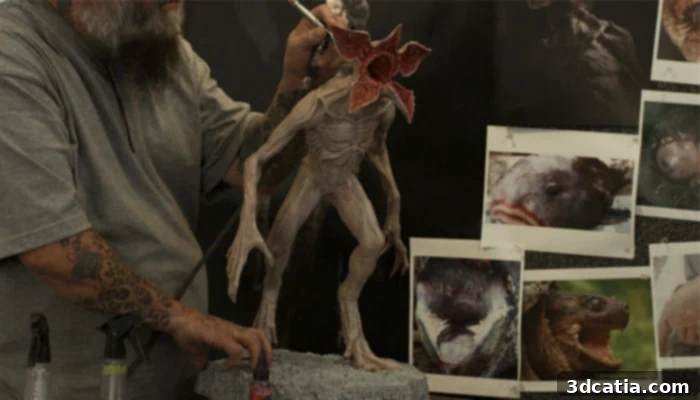
The largest Demogorgon print we have proudly executed stands at an impressive approximate height of twenty inches, a significant physical representation of the creature’s intimidating presence. Due to the inherent size limitations of our current in-house 3D printers, this formidable model was not produced as a single monolithic piece, but rather meticulously comprised of about 20 individual, interlocking printed segments. This modular approach necessitated an extraordinary level of precision in both design and engineering for each component. Every piece had to be designed with exact tolerances and connection points to ensure a flawless, seamless fit during the final assembly stage. This intricate process allowed us to achieve a large-scale, highly detailed physical model that accurately reflects our digital design, despite the constraints of individual print volumes. This also highlights our expertise in planning and executing complex multi-part prints, transforming a challenge into an opportunity for innovative problem-solving.
To facilitate our extensive 3D printing needs and maintain a high level of creative control, we currently operate four FormLabs printers in-house. These machines have proven to be exceptionally reliable and versatile, greatly enhancing our ability to rapidly prototype and iterate on designs. We’ve found them to be truly fabulous to work with, consistently delivering high-quality prints. Furthermore, the collaborative relationship we’ve established with the support team at FormLabs has been nothing short of amazing. Their expertise and willingness to engage with our unique challenges have been instrumental as we continuously strive to push the perceived limitations of what these incredible machines can achieve. This synergy between our creative vision and FormLabs’ technological support allows us to explore new frontiers in physical model creation, ensuring we remain at the forefront of character and prop development in the entertainment industry.
Overcoming Challenges: The Practical Value of 3D Printing in Concept Design
3DN: Why did you turn to 3D printing? What were the biggest challenges you had to face in the printing of the creature?
Our decision to fully embrace 3D printing stemmed from a fundamental realization: there are certain crucial design questions that simply cannot be comprehensively answered in a purely two-dimensional or even purely digital environment. Seeing something physically, holding it in your hands, and observing it from all angles under natural light, provides an undeniable clarity and level of tactile understanding that digital representations, no matter how advanced, often cannot replicate. It truly brings our intricate designs and carefully crafted assets to life in a way we haven’t experienced with such immediacy in quite some time – a feeling reminiscent of when hand-sculpted maquettes were the undisputed industry standard during the golden age of ‘practical effects’. 3D printing allows us to revisit that tangible assessment, but with the speed, precision, and iterative capabilities of modern digital workflows.
However, this revolutionary shift hasn’t been without its hurdles. The biggest challenges we’ve consistently encountered revolve around the inherent capacity of the 3D printers themselves. As a studio specializing in fantastical creatures and elaborate environments, we oftentimes aim to print exceptionally large creatures, and in some ambitious cases, even entire key scenes or complex set pieces. Current printer bed sizes and build volumes can impose significant limitations on these grand aspirations. This means that instead of printing a massive creature as a single, seamless entity, we frequently have to resort to printing it in numerous smaller, manageable pieces. This modular approach, while necessary, introduces a whole new layer of engineering complexity.
The process of printing in small pieces and then meticulously engineering them to work together flawlessly requires substantial trial and error. Ensuring that every joint, every seam, and every connection point fits together perfectly and seamlessly demands rigorous precision in the digital design phase and meticulous post-processing during assembly. Any minor discrepancy in design or print can lead to gaps, misalignments, or structural weaknesses. Our team dedicates considerable time to refining these multi-part assemblies, developing ingenious joining mechanisms, and employing various finishing techniques to hide seams and create the illusion of a single, continuous form. This iterative problem-solving is a testament to our commitment to achieving the highest quality in every physical model we produce, pushing the boundaries of what is possible with current 3D printing technology to serve the demanding needs of cinematic production.
The Future is Tangible: 3D Printing’s Impact on the Movie Industry
3DN: How do you see the future of 3D printing in the movie industry?
We firmly believe that 3D printing is not just a passing trend but a powerful resurgence, reprising a traditional technique once central to practical creature design and physical modeling, but now delivered in a vastly more cost- and time-efficient manner. In the past, creating detailed physical maquettes or props often required master sculptors to painstakingly hand-sculpt forms over many months. This was a labor-intensive and costly process that, while yielding incredible results, significantly impacted production timelines and budgets. With 3D printing, we can now accomplish what used to take months of manual sculpting in mere days, or even hours for smaller components.
This dramatic acceleration of the prototyping and production workflow has profound implications for the entire movie industry. Directors, production designers, and visual effects supervisors can now rapidly iterate on designs, hold physical models of creatures or props much earlier in the production cycle, and make informed decisions with unprecedented speed and confidence. This reduces expensive rework down the line and allows for greater creative experimentation. Beyond creature design, we foresee 3D printing becoming ubiquitous for creating highly detailed props, intricate costume elements, complex set pieces, and even specialized camera rigs or miniature models for visual effects shots. The ability to customize, scale, and reproduce these assets with precision and consistency opens up a world of creative possibilities that were previously constrained by traditional fabrication methods.
Furthermore, as materials science continues to advance, we expect to see 3D printers capable of producing objects with an even wider range of physical properties – from incredibly flexible silicone-like textures to robust, load-bearing components. This will further blur the lines between practical and digital effects, allowing filmmakers to seamlessly integrate 3D printed elements with live-action footage. The speed, accuracy, and cost-effectiveness offered by 3D printing will undoubtedly empower more independent filmmakers and studios to achieve high-quality visual effects and practical elements without prohibitive budgets. In essence, 3D printing is not just enhancing our current capabilities; it’s fundamentally reshaping the creative landscape of the entertainment industry, promising a future where imagination can be materialized faster and more affordably than ever before.
To learn more about the pioneering work of Aaron Sims Creative, we encourage you to visit their official website. You can also gain further insights into their creative process by watching the captivating “making of” video embedded below, which offers a glimpse behind the scenes of their incredible work.
You can also check out Aaron Sims Creative’s website directly here for their latest projects and portfolio.
What are your thoughts on the groundbreaking work showcased by Aaron Sims Creative and the future of 3D printing in filmmaking? We’d love to hear your insights! Share your comments below or engage with us on our Facebook and Twitter pages. For all the latest news, trends, and innovations in the world of 3D printing delivered straight to your inbox, don’t forget to sign up for our free weekly Newsletter!