
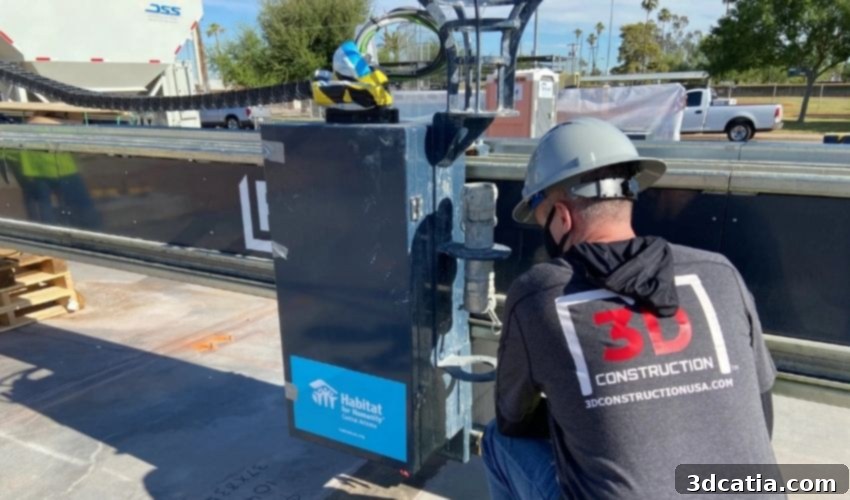
Habitat for Humanity Pioneers Affordable 3D Printed Homes in Arizona: A New Era in Construction
The landscape of residential construction is undergoing a significant transformation, with 3D printing technology emerging as a powerful solution to some of the most pressing global challenges. In a groundbreaking move that highlights the immense potential of additive manufacturing, Habitat for Humanity, a renowned nonprofit housing organization, has commenced construction on its first-ever 3D-printed home in the United States. This landmark project, located in Tempe, Arizona, represents a pivotal step towards addressing the escalating housing crisis by demonstrating a scalable, efficient, and innovative approach to building affordable homes.
This particular initiative involves the creation of a three-bedroom, two-bathroom, single-family residence. The construction utilizes COBOD’s advanced BOD2 printer, a testament to the cutting-edge technology now available in the building sector. Partnering with Peri, a company celebrated for its extensive experience in constructing multi-story 3D-printed buildings across Europe, Habitat for Humanity is leveraging established expertise to ensure the success and scalability of this endeavor. This collaboration not only showcases the viability of 3D printing in residential construction but also sets a precedent for how nonprofits can embrace technological innovation to achieve their humanitarian goals.
The Rapid Evolution of 3D Printing in Construction
The construction industry has witnessed an unprecedented acceleration in the adoption of 3D printing technology over the past few years. What was once considered a futuristic concept is now a tangible reality, with numerous projects demonstrating its practical applications and substantial benefits. The year 2021, for instance, marked several significant milestones globally. The first 3D-printed home officially went on the market in the US, signalling a commercial readiness previously unseen. Beyond single homes, ambitious multi-home 3D-printed projects have emerged in states like Texas and California, illustrating the technology’s capacity for larger-scale residential development. Internationally, the innovation extends to unique applications, such as a 3D-printed bio-habitat constructed from local soil in Italy, highlighting the potential for sustainable and environmentally conscious building practices.
Crucially, construction 3D printing is increasingly recognized for its profound ability to address a variety of humanitarian issues, most notably the escalating problem of homelessness and the scarcity of affordable housing. The inherent advantages of 3D printing – including accelerated construction timelines, reduced labor costs, minimization of material waste, and enhanced design flexibility – make it an ideal tool for organizations dedicated to social good. It is precisely these compelling benefits that motivated Habitat for Humanity to integrate this transformative technology into their mission in Arizona, seeking to provide dignified and stable housing solutions to communities in need.
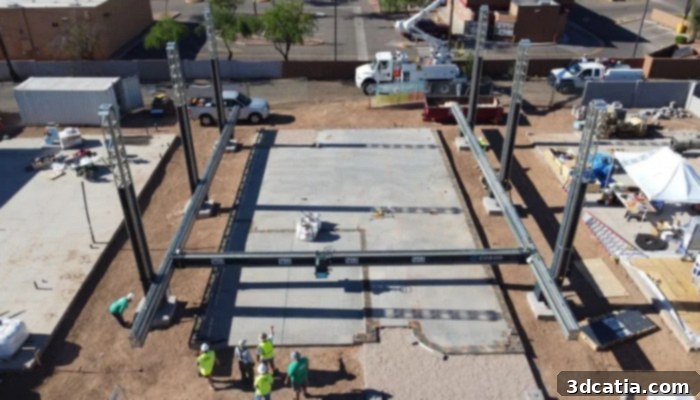
The building site including COBOD’s BOD2 Printer (photo credits: COBOD)
Habitat for Humanity: Innovating for a Global Mission
Habitat for Humanity is a globally recognized nonprofit organization dedicated to tackling the pervasive issue of inadequate housing. Operating in communities around the world and across all 50 states in the United States, their core mission revolves around building strength, stability, and self-reliance through shelter. They achieve this by partnering with families in need to build or improve a place they can call home. For decades, Habitat has utilized traditional construction methods, relying heavily on volunteer labor and community support. However, as the housing crisis intensifies, particularly in rapidly growing urban areas, the need for more scalable and efficient solutions has become paramount.
According to insights shared in their press release regarding this project, Habitat for Humanity intentionally turned to 3D printing technology in their search for innovative and affordable homeownership solutions. This strategic shift is particularly pertinent in areas like the Phoenix metro area, where the lack of affordable housing has reached an unprecedented high. This local crisis mirrors a disturbing global trend, where rising housing costs and limited supply are pushing homeownership out of reach for countless families. By embracing 3D printing, Habitat for Humanity aims to circumvent some of the traditional barriers to construction, offering a pathway to significantly reduce building times and costs, thereby making homeownership a more attainable dream for deserving families.
Unveiling the 3D-Printed Home in Arizona
The specifics of the Arizona project underscore the practical application and forward-thinking design inherent in 3D-printed construction. For this particular undertaking, Habitat for Humanity Central Arizona has deployed a state-of-the-art BOD2 printer from COBOD. This robust and versatile printer is renowned for its speed and precision, capable of constructing building elements with remarkable efficiency. The house itself, designed by the reputable Candelaria Design Associates, LLC, encompasses a comfortable liveable space of approximately 1,722 square feet (160 sqm).
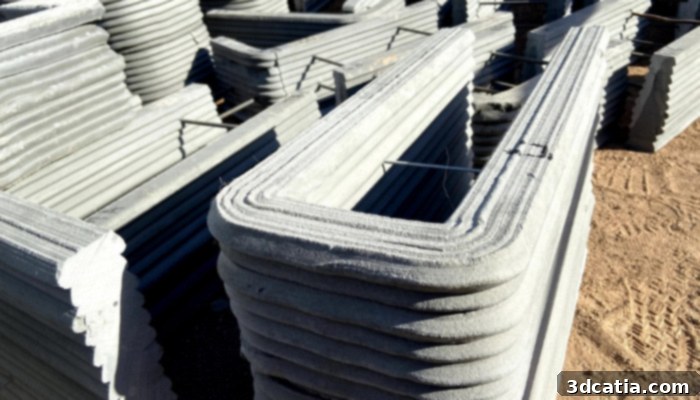
This single-family home is planned to feature three spacious bedrooms and two modern bathrooms, catering to the needs of a typical family. While the number of floors hasn’t been explicitly specified, the significant collaboration with PERI, a company known for its expertise in multi-story 3D printed buildings in Europe, strongly suggests the potential for a multi-level structure. A substantial portion of the home, estimated to be between 70-80%, including both internal and external walls, will be rapidly produced using the 3D printing method. This automated process dramatically cuts down on construction time and labor, streamlining the entire building phase.
Beyond efficiency, Habitat for Humanity is also harnessing the inherent sustainability advantages of 3D printing. The project aims for the home to be “solar ready,” incorporating infrastructure designed to easily integrate solar power systems for reduced energy consumption and lower utility costs. Furthermore, Habitat Central Arizona is ambitiously pursuing LEED® Platinum certification, the highest level of recognition for sustainable building practices, and the IBHS FORTIFIED Home™ designation, which signifies resilience against natural disasters. These certifications reflect a commitment not just to affordability but also to environmental responsibility and long-term durability, ensuring the home is a safe, efficient, and sustainable dwelling for its future occupants.
A Home, Not Just a Demonstration: Impact and Implications
What truly distinguishes this project from many other 3D printing initiatives is its core purpose: this is not merely a demonstration home or a conceptual prototype. This house is being built with a specific family in mind, chosen by Habitat for Humanity, who will soon call it their own. The construction is projected to be completed in early Fall, a significantly shorter timeframe than what would typically be required for a home built using conventional construction methods. With occupancy anticipated as early as October 2021, the speed of 3D printing offers tangible, immediate relief to families awaiting stable housing.
The implications of this speed and efficiency are profound. In states across the US, and indeed globally, a severe lack of housing supply has driven property prices to unprecedented highs, rendering homeownership an unattainable dream for many low-to-moderate income families. By dramatically reducing both the time and cost associated with building, 3D printing technology opens up a myriad of possibilities. It creates a viable pathway to deliver more homes, faster, and at a price point that makes them accessible to those who need them most, directly combating the affordability crisis.
Jason Barlow, President and CEO of Habitat Central Arizona, perfectly encapsulates this sentiment. Reflecting on the strategic decision to embrace 3D printing, he shared, “This is really a moonshot opportunity for Habitat for Humanity Central Arizona. When we consider the housing issues facing Arizona, the need for affordable homeownership solutions becomes clear. If we can deliver decent, affordable, more energy-efficient homes at less cost, in less time, and with less waste, we think that could be a real game-changer just think of the implications.” His words highlight the organization’s ambitious vision: to transform the housing landscape by challenging traditional paradigms and leveraging innovation for social good. The ability to build homes that are not only affordable but also energy-efficient and built with minimal waste addresses multiple facets of the housing challenge simultaneously. This holistic approach signals a potential paradigm shift in how we conceive and execute affordable housing projects, promising a future where innovative technology serves as a cornerstone for community development and social equity.
For those interested in delving deeper into the specifics of this pioneering project, additional information and detailed insights can be found in the official press release HERE.
What are your thoughts on Habitat for Humanity’s innovative approach to constructing a 3D-printed home in Arizona? We invite you to share your perspective in a comment below or engage with us on ourFacebook,Twitter, andLinkedIn pages! Don’t miss out on the latest advancements and news in 3D printing; sign up for our free weeklyNewsletter here and have the most important industry updates delivered directly to your inbox!