

Relativity Space: Revolutionizing Space Exploration with Fully 3D Printed Rockets
Relativity Space is at the forefront of a new era in aerospace, pioneering the development of fully 3D printed rockets designed to make space access more frequent, flexible, and affordable. In a significant validation of their innovative approach, NASA has recently awarded Relativity Space a $3 million contract through its Launch Services Program (LSP). This funding is designated for the Venture Class Launch Services Demonstration 2 (VCLS Demo 2) mission, an initiative crucial for establishing uncrewed research missions in space. Such missions are increasingly vital for advancing multi-planetary research, technological development, and deep space exploration, laying the groundwork for humanity’s future beyond Earth.
The contract supports the inaugural flight of Relativity’s Terran 1 rocket, a groundbreaking vehicle poised to make history. Scheduled for launch from Cape Canaveral LC-16 by June 30th, 2022, the Terran 1 will deploy a variety of small, lightweight satellites—including CubeSats, SmallSats, microsats, and nanosats—into Low Earth Orbit (LEO). This mission is set to become a monumental achievement, marking the first time a satellite is launched into orbit using a rocket that is entirely 3D printed, showcasing the immense potential of additive manufacturing in the aerospace industry.
Indeed, the Terran 1 stands as the world’s first entirely 3D printed rocket, a testament to Relativity Space’s relentless pursuit of innovation since its inception in 2015. The company’s proprietary Stargate 3D printers, which are central to the Terran 1’s manufacturing process, are housed within Relativity’s state-of-the-art Stargate factory. This cutting-edge facility represents a paradigm shift in aerospace production, integrating intelligent robotics, sophisticated software, data-driven 3D printing technology, and AI-driven controls. As the world’s largest metal 3D printers, the Stargate systems power the first-ever aerospace platform to automate the entire rocket manufacturing process, significantly streamlining production and enhancing capabilities.
NASA’s Strategic Investment in Advanced Manufacturing
NASA’s Venture Class Launch Services Demonstration 2 contract with Relativity Space underscores the agency’s commitment to fostering innovation and supporting emerging commercial space capabilities. The VCLS program is designed to provide dedicated launch opportunities for small satellites, which are becoming increasingly vital for a wide range of scientific, technological, and educational endeavors. By partnering with companies like Relativity Space, NASA aims to reduce the cost and complexity of launching these critical payloads, thereby accelerating the pace of space research and development.
Small satellites, including CubeSats and SmallSats, offer unique advantages for space missions, enabling cost-effective data collection, rapid technology demonstration, and distributed observation platforms. These tiny spacecraft are instrumental in areas such as Earth observation, climate monitoring, space weather prediction, and in-orbit technology validation. The Terran 1’s ability to precisely deliver these diverse small payloads to Low Earth Orbit provides an invaluable service to the scientific community and strengthens the infrastructure for future deep space exploration.
Disrupting Traditional Aerospace Manufacturing with Additive Techniques
While the $3 million NASA contract is a significant milestone, it represents just a fraction of the substantial investments Relativity Space has garnered over recent years. The company has attracted a staggering total of $685 million in funding, with an impressive $500 million secured in the past year alone. This immense financial backing reflects strong investor confidence in Relativity’s disruptive technology and its potential to reshape the space industry. Despite the Terran 1’s inaugural launch being scheduled for later this year, Relativity’s innovations have already earned them two contracts from the U.S. government, alongside a critical agreement with Lockheed Martin for a NASA cryogenic testing mission slated for 2023.
Relativity’s recent successes and the substantial investments they have received highlight the profound value of their work, yet they only begin to capture the full significance of their advancements in applying additive manufacturing to aerospace. These investments have empowered Relativity to expand its facilities and refine its manufacturing processes, leading to remarkable improvements in quality, design flexibility, production speed, and overall efficiency. The most compelling outcome of this technological leap is the drastic reduction in the time required to manufacture a flight-ready rocket from raw materials to a mere sixty days.
To put this into perspective, a conventionally manufactured rocket typically comprises over 100,000 individual parts, demands a build time of approximately 24 months, and has an iteration time of 48 months. In stark contrast, the Terran 1, produced using Relativity’s revolutionary Stargate additive manufacturing system, requires less than 1,000 parts, boasts a build time of just 2 months (60 days), and an iteration time of only 6 months. This translates to astonishing reductions of 99% in part count, 91.6% in build time, and 87.5% in iteration time, respectively. Such dramatic improvements fundamentally transform the economics and agility of rocket production.
Beyond these remarkable statistics, Relativity’s technology also profoundly simplifies the aerospace supply chain and significantly reduces physical complexity. By consolidating hundreds or even thousands of individual components into a single 3D printed structure, the company eliminates countless manufacturing steps, assembly points, and potential failure modes. This not only speeds up production but also enhances reliability and reduces overall costs. The ability to rapidly iterate designs means engineers can test and implement improvements at an unprecedented pace, fostering continuous innovation.
Relativity Space has already established itself as a groundbreaking force in both the additive manufacturing and aerospace industries. Now, through its strategic partnership with NASA’s Launch Service Program (LSP), the company has a unique opportunity not only to make history with the first fully 3D printed rocket launch but also to profoundly shape humanity’s multiplanetary future. Their vision is to enable more frequent, accessible, and sustainable access to space, opening doors for unprecedented scientific discovery, commercial opportunities, and ultimately, the establishment of a robust human presence beyond Earth.
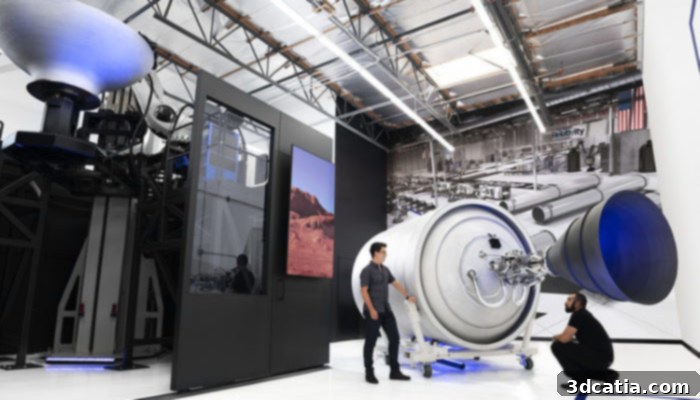
Inside the Stargate factory where the Terran 1 is manufactured. (Credit: Relativity Space)
Paving the Way for Humanity’s Multiplanetary Future
The vision behind Relativity Space extends far beyond the Terran 1. Their ultimate goal is to enable the colonization of other planets by making spaceflight as accessible and routine as air travel is today. The efficiencies gained through their autonomous 3D printing factory are critical to achieving this ambitious objective. By drastically cutting down lead times and part counts, Relativity is demonstrating a scalable model for producing rockets that can support not just Earth-orbiting missions but also the more complex and demanding requirements of lunar and Martian endeavors.
The implications of this technology are profound. A future where rockets can be built in weeks rather than years, with minimal human intervention and significantly fewer parts, means that the barriers to entry for space exploration and commerce are dramatically lowered. This rapid production capability could facilitate the establishment of lunar bases, support Mars missions, and enable a burgeoning in-space economy. Relativity Space is not just building rockets; they are building the infrastructure for an off-world future, democratizing access to space for governments, private enterprises, and scientific communities alike.
In essence, Relativity Space is leading a revolution that merges the cutting edge of additive manufacturing with the audacious goals of space exploration. The partnership with NASA and the impending launch of the Terran 1 are not merely technological demonstrations; they are foundational steps toward a future where humanity’s reach extends far beyond its home planet, powered by the incredible possibilities of 3D printing.