
Revolutionizing Industries: Latest Advancements in 3D Printing Technology Across Japan, India, and the Art World
The world of additive manufacturing continues to innovate at an exhilarating pace, consistently pushing the boundaries of what’s possible across diverse sectors. This week brought forth a flurry of exciting developments, showcasing 3D printing’s transformative potential in infrastructure, education, defense, and artistic expression. We’ll delve into significant milestones, starting with the completion of a pioneering 3D printed train station shelter in Japan, a project that highlights the speed and efficiency of concrete additive manufacturing for public utilities. Following this, we explore how veterinarians are gaining invaluable hands-on training through sophisticated 3D printed anatomical models. Our journey then takes us to the challenging terrains of the Himalayas, where a groundbreaking 3D printed military bunker has been successfully deployed at an unprecedented altitude – a true testament to engineering ingenuity. Finally, we’ll immerse ourselves in the creative realm, examining two fascinating instances where 3D printing is not just contributing to, but actively revolutionizing the art world, marrying ancient techniques with modern digital fabrication and enabling sustainable exhibition design. These stories collectively illustrate the profound and varied impact of this cutting-edge technology.
Japan’s 3D Printed Train Station Shelter: A New Era for Infrastructure
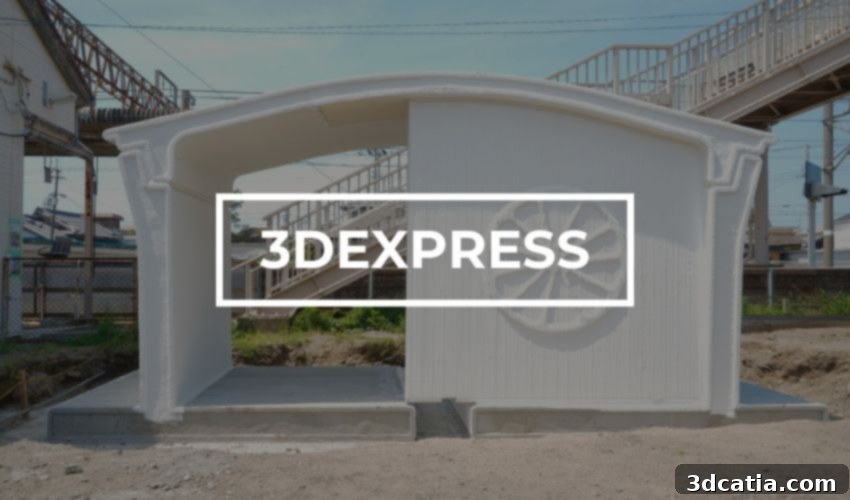
Just a few weeks ago, we announced the ambitious project where Japan embarked on utilizing concrete 3D printing to modernize its railway infrastructure, providing innovative shelters. We are thrilled to report that this groundbreaking initiative has made rapid progress, with the first structure now finished and unveiled! Located in the city of Arida, specifically at Hatsushima station, images of the completed shelter have begun to circulate, marking a significant milestone in urban development. This impressive 10-square-meter, 2.6-meter-high shelter was brought to life using an advanced 3D printing solution developed by the manufacturer Serendix, a leader in construction additive manufacturing. The efficiency of this method is truly remarkable; project teams confirmed that the 3D printing of the various concrete blocks for the shelter took less than a week. Even more astonishing, the on-site assembly of these pre-printed components was completed in a mere six hours, demonstrating the immense potential for accelerated construction timelines in public works. The design itself pays homage to local culture, with the façade featuring intricate reliefs depicting symbols of the region, such as mandarins and fish, seamlessly blending modern technology with traditional aesthetics. With the structure itself largely complete, the next phase involves the installation of a ticket machine, with the full operational launch scheduled for July 2025. This project not only sets a precedent for sustainable and rapid construction in Japan but also offers a compelling vision for the future of urban infrastructure globally. You can witness the installation process in the video provided below, offering a closer look at this pioneering achievement.
Enhancing Veterinary Education with 3D Printed Models
In the demanding field of veterinary medicine, hands-on experience is paramount for aspiring professionals. Before entering the complex and often high-stakes environment of animal care, future veterinarians require extensive practical training to truly understand animal anatomy and physiology. Recognizing this critical need, Oklahoma State University’s College of Veterinary Medicine recently introduced an innovative solution to augment its educational offerings: a life-sized, 3D printed horse skeleton. This initiative aims to provide students with unparalleled opportunities for tactile, interactive learning that goes beyond traditional textbooks and two-dimensional images. To bring this vision to fruition, the faculty collaborated with Edmon Low Creative Studios, a testament to inter-departmental innovation. Shannon Austin, the studio’s director, highlighted the inherent challenges of traditional methods, explaining, “They specifically mentioned that animal skeletons are difficult to obtain and prohibitively expensive, and they inquired if I would be able to help them out by 3D printing a model.” This statement underscores a common hurdle in veterinary education, which 3D printing is uniquely positioned to overcome by offering accessible and cost-effective alternatives to real specimens. Austin further elaborated on the complexities of the project, including the strategic decision-making process concerning whether to print the massive structure in one go or in multiple parts for subsequent assembly. The actual printing process took an intensive three days, followed by four hours dedicated to the meticulous removal of support structures. Once all components were ready, they were securely assembled using hot glue. Shannon Austin enthusiastically concluded, “This model will allow vet students to be able to not just learn about equine morphology by simply looking at pictures in a textbook or on a screen, but instead they will now be able to physically manipulate and observe the intricacies of the animal’s skeletal structure in a literal hands-on way.” This project exemplifies how additive manufacturing is transforming educational methodologies, providing immersive and tangible learning tools that empower students with a deeper, more practical understanding of their chosen profession.
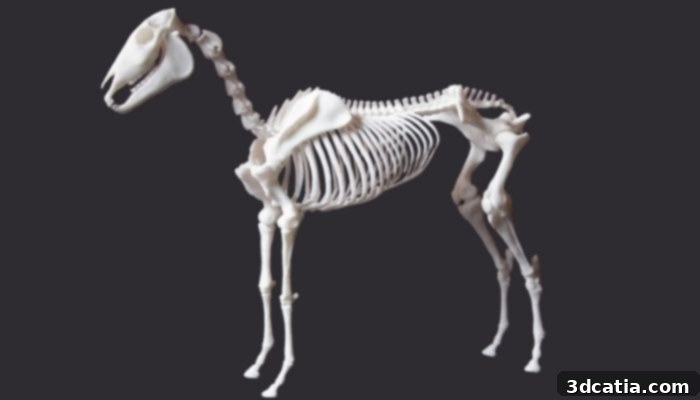
Photo Credits: Shannon Austin
The World’s First 3D Printed Military Bunker in the Himalayas
A monumental stride has been taken in the fields of engineering and defense, marking a new milestone for rapid deployment and strategic infrastructure! The Indian Institute of Technology (IIT) Hyderabad, in a remarkable collaboration with Simpliforge Creations and the Indian Army, has successfully constructed the world’s highest 3D-printed military bunker. This formidable structure stands at an astounding altitude of over 3,300 meters, nestled within the challenging Ladakh region of the Himalayas. The project presented an extraordinary technological and logistical challenge, primarily due to the extreme environmental conditions prevalent at the site. Sub-zero temperatures, minimal humidity, and significantly lower oxygen levels demanded an innovative approach to material design and construction methodology. In response, the dedicated team developed a specialized concrete mix, cleverly formulated using locally sourced aggregates. This not only ensured the material’s suitability for the harsh climate but also underscored a commitment to sustainable and resource-efficient practices in remote areas. The speed of construction was equally impressive; the entire project, from ground preparation to completion, took just five days, with the actual 3D printing process accomplished in a swift 14 hours. This achievement powerfully demonstrates the viability and efficiency of additive manufacturing even in the most demanding and unforgiving environments on Earth. Those involved in the program, known as the Prabal project, conveyed to the Indian media that this pioneering accomplishment significantly strengthens India’s defense capabilities. Furthermore, it paves the way for the future construction of critical infrastructure in remote and strategically important terrains, offering a paradigm shift in how military and civil structures can be rapidly and effectively deployed in challenging geographical locations. This bunker is not just a structure; it’s a symbol of human ingenuity overcoming nature’s extremes through advanced technology.
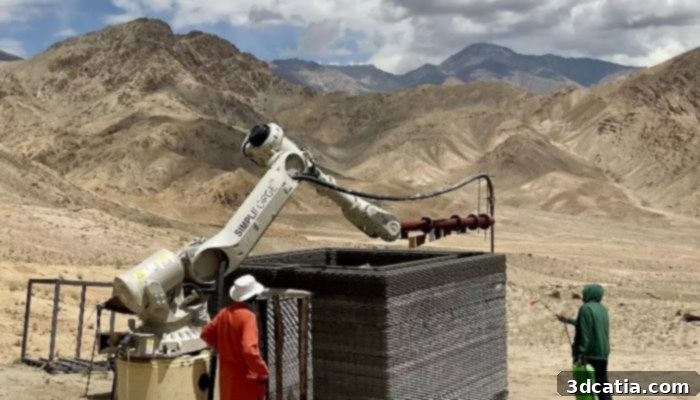
Photo Credits: Newsmeter
Adobe Oasis: A 3D Printed Art Installation at Coachella Valley
While the vibrant energy of this year’s Coachella festival may have subsided, the Coachella Valley continues to host captivating and thought-provoking installations. Among them is the mesmerizing “Adobe Oasis” by renowned American artist and architect Ronald Rael, exhibited as part of the prestigious Desert X 2025 exhibition. This installation is a profound exploration, masterfully uniting ancestral construction techniques with the cutting-edge capabilities of digital fabrication technologies. Rael’s inspiration draws deeply from the rich history of traditional mud construction found in the San Luis Valley, Colorado—a region that, until 1848, significantly marked the border between Mexico and the U.S. By channeling this historical and cultural context, Rael employs advanced 3D printing to reinterpret the timeless material of adobe. The result is a series of structures that not only evoke the earthy, organic texture of adobe but also mimic the distinctive trunks of local palms, creating a harmonious dialogue with the desert landscape. “Adobe Oasis” transcends the conventional boundaries of art, presenting itself simultaneously as a striking artistic statement and a compelling architectural experiment. It boldly proposes an ecological alternative to the often-resource-intensive industrial materials dominant in contemporary construction. This work challenges viewers to consider sustainable practices and the potential for ancient wisdom to inform future building methods, all through the lens of modern technology. The installation is a temporary marvel, slated to be on display until May 11th, coinciding with the conclusion of the Desert X 2025 exhibition. It serves as a powerful reminder of 3D printing’s capacity to facilitate artistic expression that is deeply rooted in history while looking forward to a more sustainable future.
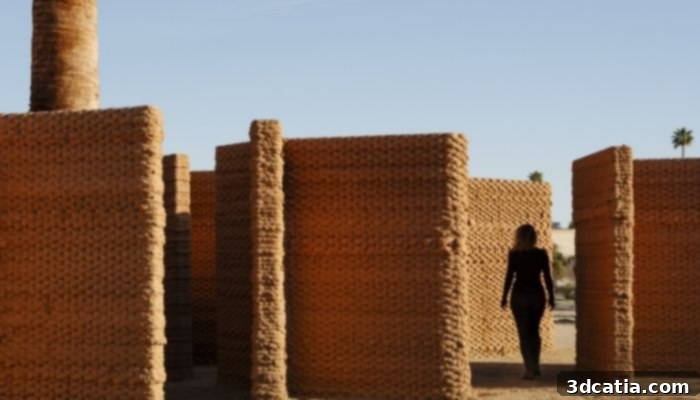
“Adobe Oasis” by Ronald Rael combines tradition and technology (photo credits: Desert X)
3D Printed Ceramics for Sustainable Exhibitions at London’s Natural History Museum
Continuing our exploration of 3D printing’s impact on the art and cultural sphere, we turn our attention to an exceptional application within London’s esteemed Natural History Museum. For its latest exhibition, “Fixing our Broken Planet,” a groundbreaking approach was adopted for the construction of the exhibition space itself, with a strong emphasis on sustainability. The challenge was multifaceted: the project required preserving the architectural integrity of the century-old museum, ensuring flexibility for future adaptations, and, crucially, aligning the construction methods with the exhibition’s overarching theme of environmental stewardship and sustainable living. This is where WASP, an Italian company renowned for its large-scale 3D printing solutions, stepped in with an ingenious answer. WASP developed and produced ten flexible ceramic modules specifically for the exhibition using its innovative 3D printing technology. The WASP 40100 3D printer, equipped with a robotic arm as an extruder, meticulously produced all the necessary components over a period of three months. This method allowed for precise, customized fabrication while minimizing waste—a key benefit of additive manufacturing. The choice of 3D printing was particularly well-suited to the exhibition’s core message: promoting sustainable living to combat climate change and save our planet. By utilizing a technology that allows for efficient material usage, on-demand production, and the potential for using recyclable or natural materials, the museum demonstrated a commitment to its message not just through content, but through its very infrastructure. This project highlights the transformative potential of 3D printing in museum design, offering a blueprint for creating adaptable, environmentally conscious, and visually engaging exhibition spaces within historical settings. It’s a testament to how technology can actively support and amplify critical messages about our planet’s future.
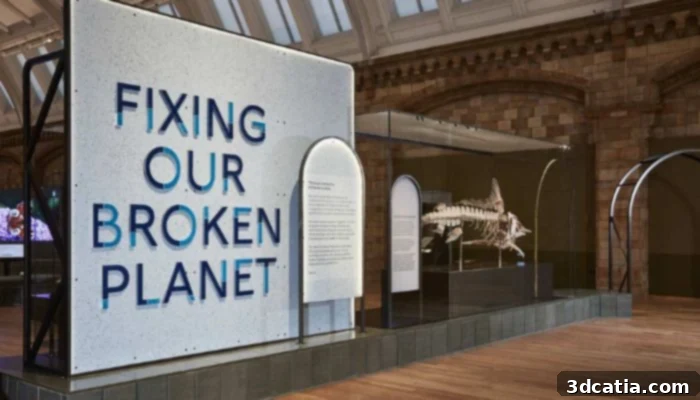
The exhibition in London (photo credits: LAMÁQUINA on LinkedIn)
From the completion of Japan’s pioneering 3D printed train station shelter to the innovative application of 3D printing in veterinary education, the strategic deployment of a high-altitude military bunker in the Himalayas, and its profound influence on artistic and sustainable exhibition design, the breadth and depth of additive manufacturing’s impact are truly astounding. This past week’s developments underscore 3D printing’s capacity to deliver efficient, customized, and often sustainable solutions across virtually every industry. As this technology continues to evolve, we can anticipate even more revolutionary applications that will reshape our infrastructure, education, defense capabilities, and creative expressions. We are living in an era where the future is literally being printed. What do you think of these incredible advancements, particularly the finished 3D printed train station in Japan? Let us know your thoughts and insights in a comment below or join the conversation on our LinkedIn, Facebook, and Twitter pages! Don’t forget to sign up for our free weekly Newsletter here, ensuring you receive the very latest 3D printing news directly to your inbox! You can also find all our compelling videos on our YouTube channel for visual insights into these innovations. If your interest lies specifically in 3D printing news within the automotive and transportation sector, make sure to visit our dedicated page HERE to stay fully informed.