
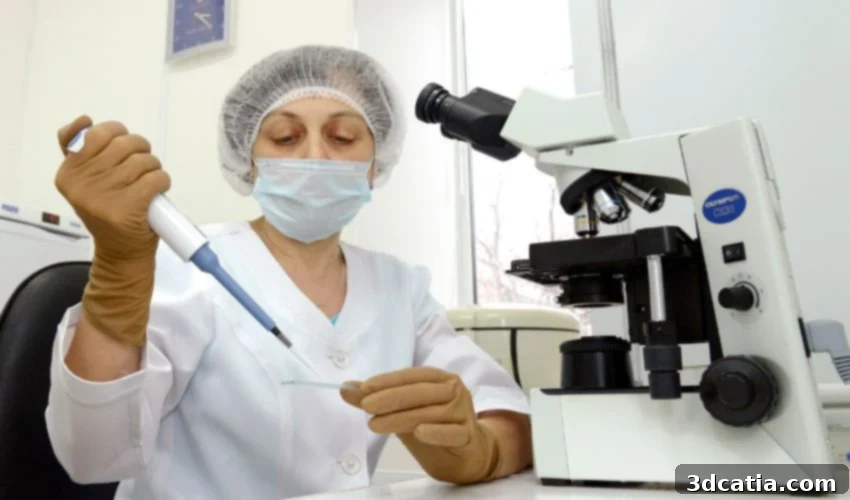
Revolutionizing IVF: How Advanced 3D Printing and Micro-Devices Boost Fertility Success Rates
The medical field continues to be a fertile ground for innovation, particularly with the advent of 3D printing technology. A remarkable new application has recently emerged from a collaboration between UpNano, a leading provider of high-resolution and micro 3D printing systems, and Fertilis, an Australian-based specialist in In Vitro Fertilization (IVF). Their groundbreaking announcement reveals that a novel 3D printing material combined with 2-photon polymerization (2PP) 3D printing is poised to significantly enhance the efficiency of IVF treatments, aiming to reduce the number of implantation cycles required for successful pregnancies.
In Vitro Fertilization, commonly known as IVF, stands as one of the most widely utilized assisted reproductive technologies globally. It offers a beacon of hope for countless couples struggling with infertility. In the United States alone, approximately 12% of women face challenges in conceiving. This widespread need has led to a significant impact, with approximately one million babies born via IVF in the USA by 2014, reflecting the procedure’s vital role in modern reproductive medicine. Despite its prevalence and life-changing potential, IVF is often a demanding journey. The procedure is not only costly but also characterized by varying success rates. For women under 30, the chance of a live birth in their first IVF cycle hovers around 44%, a percentage that unfortunately declines considerably with increasing age. Consequently, aspiring parents frequently require multiple implantation cycles, accumulating substantial financial and emotional burdens. This latest research from UpNano and Fertilis seeks to address these critical challenges by offering a more efficient and less stressful path to parenthood.
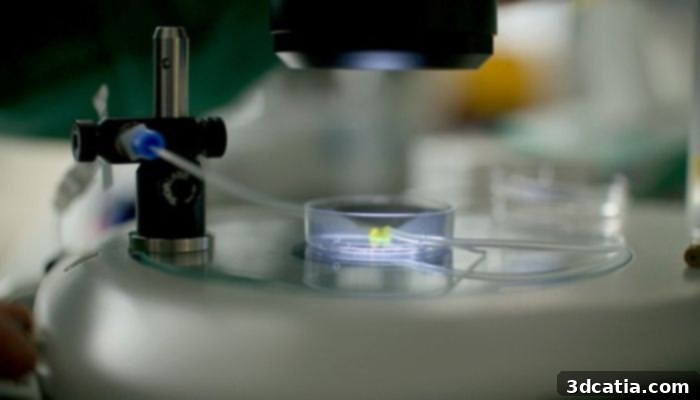
The innovative 3D printed micro-device developed by Fertilis to optimize embryo culture (photo credits: Fertilis)
The Critical Role of 3D Printing in Enhancing IVF Success
The fundamental question arises: how exactly can advanced manufacturing techniques like 3D printing revolutionize IVF? Fertilis found its answer in UpNano’s sophisticated 2PP 3D printing method and their innovative UpFlow material. This powerful combination enabled the creation of a novel, dynamic cell culture environment specifically designed for IVF procedures. Unlike traditional static petri dishes, this new system is engineered to more closely mimic the intricate physiological conditions found within the human body. By providing a more natural and stable environment, the technology significantly reduces stress on developing embryos.
Traditional IVF protocols often necessitate repeatedly moving embryos between different culture dishes, exposing them to fluctuating conditions that can induce stress and increase the risk of failure. The dynamic environment fostered by the UpNano-Fertilis solution mitigates these issues, thereby enhancing embryo viability. UpNano and Fertilis confidently assert that this breakthrough technology has the potential to reduce the number of implantation cycles required to achieve pregnancy by an impressive 30-40%. This projected reduction is not merely a statistical improvement; it translates directly into less emotional distress, fewer invasive procedures, and significant cost savings for individuals and couples undergoing fertility treatment.
The Innovative 3D Printed Micro-Device: A Game Changer
The core of this innovation lies in Fertilis’s development of a unique, first-of-its-kind 3D printed micro-device. This miniature marvel, measuring a mere 0.05mm in diameter, establishes an optimal environment for the embryo during the most critical phase of its early development: from fertilization through to the crucial implantation stage. Its intricate design allows for unprecedented precision in monitoring and controlling the entire culturing process of the fertilized egg. This precise control over environmental parameters, such as temperature, pH levels, and nutrient supply, is crucial for fostering healthy embryo development.
One of the most significant advantages of this micro-device is its ability to eliminate the necessity of manually transferring cells between multiple petri dishes. In conventional IVF, embryos are frequently moved, which introduces risks of mechanical damage, contamination, and exposure to varying environmental conditions. By consolidating the entire culture process within a single, stable micro-environment, Fertilis’s device minimizes external interferences, thereby protecting the delicate embryos and significantly enhancing their chances of survival and successful development. This integrated approach not only streamlines the IVF workflow but also contributes directly to the increased success rates projected by the companies.
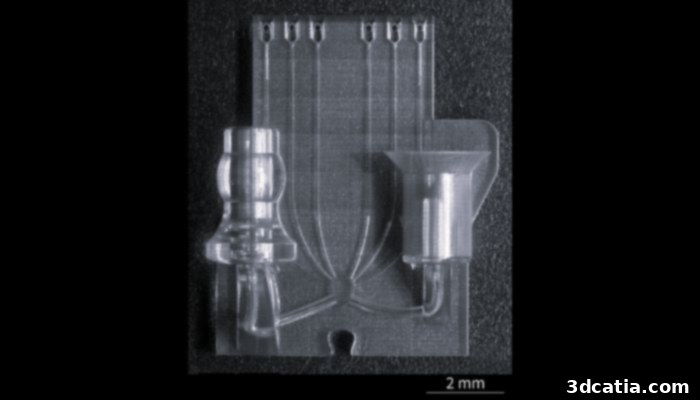
A micro-scale component fabricated using UpNano’s UpFlow material and 2PP 3D printing technology, showcasing incredible detail and precision (photo credits: UpNano)
The Power of 2PP 3D Printing and UpFlow Material
The sophisticated capabilities of this micro-device are largely attributable to the cutting-edge technology employed in its fabrication. UpFlow, one of UpNano’s specialized 2-photon resins, was meticulously chosen for this application due to its uniquely low viscosity. Fertilis specifically highlighted the importance of this characteristic, as it facilitates superior post-production processing. The low viscosity allows for far more effective flushing of the extremely fine channels within the micro-device, ensuring that all unpolymerized material is completely removed. This meticulous cleaning process is paramount for maintaining biocompatibility and preventing any adverse interactions with the sensitive biological samples.
Beyond the material, UpNano’s 2PP micro 3D printing method itself is a cornerstone of this innovation. Two-photon polymerization is an additive manufacturing technique renowned for its ability to create exceptionally fine details, far beyond what conventional 3D printing methods can achieve. This high-resolution capability is critical for fabricating the intricate micro-fluidic channels and chambers essential for mimicking the human body’s internal environment. Moreover, this advanced printing method is remarkably fast; Fertilis can produce these complex micro-devices in an astonishingly short time of just four hours. The ability to print the final part within a single production cycle also contributes to a higher quality product, ensuring the tight fitting of connectors to tubes and significantly reducing the risk of leakages, which could compromise the delicate embryo culture.
Transforming the IVF Journey: Reducing Stress, Time, and Costs
Marty Guavin, CEO of Fertilis, succinctly encapsulates the profound impact of this new technology: “Our device allows fertilization, embryo culture, and embryo cryopreservation to occur in the one structure – no more moving embryos around by hand. This, in fact, increases the success rate significantly and reduces time, costs, and stress for the parents.” His statement underscores the multifaceted benefits of this integrated approach. By centralizing these critical stages, the device not only enhances the biological success rate but also dramatically improves the overall experience for prospective parents. The emotional and financial toll of multiple IVF cycles cannot be overstated, and a reduction in these burdens represents a monumental step forward in fertility treatment.
This innovation exemplifies the incredible potential when advanced manufacturing meets critical medical needs. The collaboration between UpNano’s expertise in precision 3D printing and Fertilis’s specialized knowledge in IVF has resulted in a solution that promises to make the dream of parenthood more accessible and less daunting. The synergy between a state-of-the-art material like UpFlow and the unparalleled precision of 2PP 3D printing has created a micro-environment that is not just a container but a truly dynamic and supportive incubator for life’s earliest stages. This technological leap offers a tangible pathway to higher success rates, fewer cycles, and ultimately, a more positive and hopeful journey for those seeking to build families.
To delve deeper into this groundbreaking research, you can explore the official press release from UpNano HERE. Additionally, the scientific findings have been peer-reviewed and published in a detailed research paper, available HERE, providing in-depth technical specifications and validation of the results.
What are your thoughts on the transformative potential of 3D printing in improving IVF success rates? We invite you to share your insights and comments below, or engage with us on our social media platforms: LinkedIn, Facebook, and Twitter. Don’t miss out on the latest advancements in additive manufacturing; sign up for our free weekly Newsletter here to receive top 3D printing news directly in your inbox! You can also find all our compelling video content and interviews on our dedicated YouTube channel.
*Cover Photo Credits: Galina Fomina, CC BY 4.0, via Wikimedia Commons