
Mycelium-Based 3D Printed Soundproofing: A Sustainable Revolution in Acoustic Solutions
The global demand for effective soundproofing solutions continues to rise, driven by urbanization, industrial growth, and the increasing need for quieter living and working environments. However, the vast majority of modern soundproofing panels rely heavily on materials that pose significant environmental challenges. These typically include synthetic foams, such as polyurethane or polystyrene, and mineral fibers like rock wool or fiberglass. While effective in their primary function, these conventional materials are far from ideal when it comes to sustainability. Their production often involves energy-intensive processes, reliance on non-renewable resources, and the generation of significant waste. Furthermore, they are neither easily recyclable nor biodegradable, contributing to landfill accumulation and persistent environmental pollution at the end of their lifecycle.
In a groundbreaking development, researchers have unveiled a revolutionary approach to sustainable soundproofing that harnesses the power of nature and advanced manufacturing: using the fungus-based material, mycelium, in conjunction with 3D printing technologies. This innovative combination presents a compelling alternative, offering a material that is not only highly effective as a sound absorber but also inherently sustainable, biodegradable, and capable of contributing to resource conservation. This pioneering work is being led by interdisciplinary teams at the Fraunhofer Institute for Environmental, Safety and Energy Technology (UMSICHT) and the Fraunhofer Institute for Building Physics (IBP). These institutes have successfully discovered and refined a method to adapt mycelium and 3D printers to additively manufacture novel, eco-friendly sound absorbers that promise to redefine acoustic engineering.
Understanding Mycelium: Nature’s Intricate Network for Advanced Materials
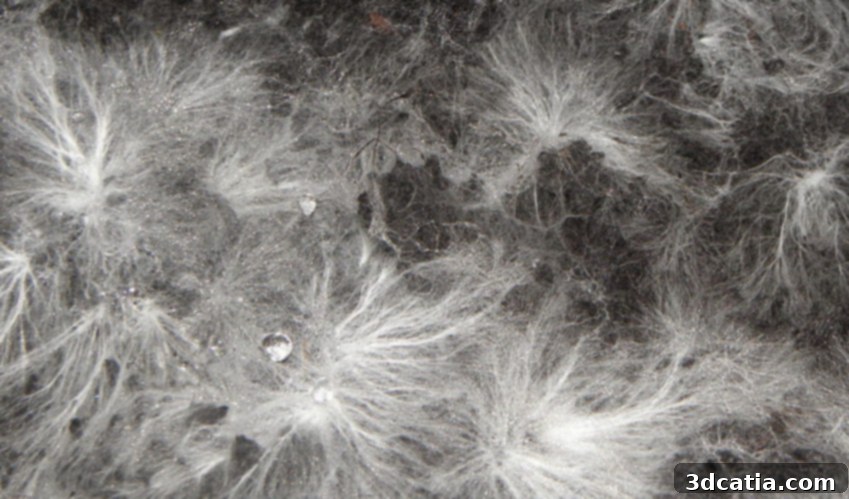
Mycelium is essentially the vegetative body of a fungus, analogous to the intricate root system of a plant. It comprises an extensive, branching network of thread-like tubular filaments known as hyphae. These hyphae grow and spread, permeating their environment and breaking down organic matter. This natural biological process is what makes mycelium so promising as a material for sustainable manufacturing. When cultivated for material production, mycelium’s hyphae grow and interlace, forming a dense, resilient, and naturally porous structure that can be engineered for various applications.
From Biological Network to 3D Printable Composite
Transforming this living biological network into a material suitable for advanced manufacturing, particularly 3D printing, requires a carefully orchestrated process. The first critical step involves combining the mycelium with a vegetal substrate. This substrate acts as a nutrient source for the fungus and provides the bulk material for the final composite. Common examples of suitable vegetal substrates include agricultural waste products such as straw, wood chips, sawdust, or even waste materials from food production, further enhancing the material’s sustainability credentials by valorizing waste streams. This mixture forms a homogeneous paste or slurry, which is then carefully prepared to achieve the optimal viscosity and consistency required for precision 3D printing.
Once the mycelium-substrate mixture is prepared, it is fed into a specialized 3D printer. The printer then extrudes this bio-composite material layer by layer, meticulously building up the desired shape and internal architecture of the sound-absorbing panel. The beauty of 3D printing in this context is its unparalleled design freedom. Researchers can create complex geometries, intricate lattice structures, and optimized internal pore networks that are specifically tailored to maximize sound absorption efficiency—something that would be incredibly challenging or impossible with traditional manufacturing methods. During and after the printing process, the mycelium continues to grow, permeating the entire substrate and fusing it into a cohesive, interconnected matrix.
The final stage involves a crucial post-processing step: placing the newly printed part in a kiln. This heat treatment serves a dual purpose. Firstly, it effectively kills the fungus, halting its growth and preventing any further biological activity. Secondly, and equally important, the kiln-firing process dries and solidifies the mycelium-substrate composite. This results in a final structure that is solid yet inherently porous. It is this unique combination of solidity and porosity, especially when the material is printed in thin, optimized layers, that makes it such an effective sound absorber. The intricate network of pores within the mycelium structure traps sound waves, dissipating their energy through friction and vibration, thereby converting acoustic energy into negligible heat.
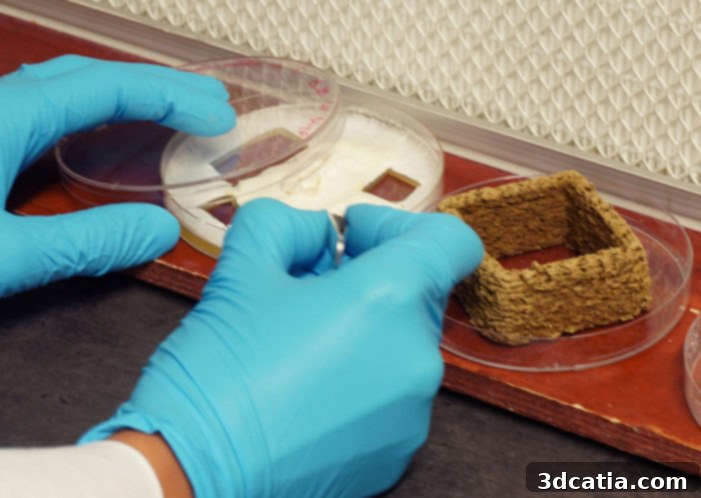
Mycelium being used to create soundproofing. (Credit: Fraunhofer UMSICHT)
Beyond Sound Absorption: The Multifaceted Benefits of Mycelium Materials
The appeal of mycelium extends far beyond its acoustic properties. As a raw material, it boasts an impressive array of environmental and functional advantages that position it as a leading contender in the race for sustainable materials. Parts manufactured from mycelium composites are not only strong and remarkably lightweight but are also inherently eco-friendly and entirely biodegradable. This means that at the end of their useful life, these materials can safely return to nature without leaving a lasting environmental footprint, embodying a true cradle-to-cradle approach to material design.
One of the most compelling features of mycelium is its sheer abundance and renewable nature. In its natural habitat, a single fungal organism’s mycelial network can span vast distances, sometimes over a kilometer underground, demonstrating its incredible growth potential and ubiquitous presence in ecosystems worldwide. Furthermore, mycelium plays a crucial role in carbon sequestration. As it grows, it absorbs carbon dioxide from the atmosphere and stores it within its biomass, effectively acting as a natural carbon storage facility. Research suggests that mycelium can even double an environment’s natural carbon-capture rate. While many advanced 3D printing materials are celebrated for their low to zero carbon footprints, mycelium goes a step further by offering a *negative* carbon footprint, making it a powerful tool in combating climate change and reducing atmospheric CO2 levels.
Expanding Horizons: Mycelium’s Diverse Applications with 3D Printing
The synergistic combination of mycelium and 3D printing has unlocked a wealth of potential applications across various industries, showcasing its versatility and transformative capabilities. Beyond soundproofing, this duo is revolutionizing product design and sustainable manufacturing. For instance, mycelium has been explored for fashion, leading to innovations such as a pair of high heels, demonstrating its potential for durable and aesthetically pleasing consumer goods. From packaging materials to furniture, and even insulation for buildings, the lightweight yet robust nature of mycelium composites makes them an ideal candidate for replacing conventional, less sustainable alternatives.
Perhaps one of the most exciting and ambitious prospective applications for mycelium is in the realm of extraterrestrial exploration: the construction of habitats on Mars. This interest stems largely from two exceptional qualities that mycelium possesses, which are particularly critical for off-world colonization. First, mycelium exhibits an incredible capacity for rapid growth and can thrive in a wide range of environments, even those with limited resources. This means that if cultivated on Mars, very little material would need to be transported from Earth, dramatically reducing launch costs and logistical complexities. The effort required for its cultivation would be minimal, allowing for efficient in-situ resource utilization (ISRU) to build necessary infrastructure.
Secondly, and perhaps even more vital for long-duration space missions, mycelium is remarkably effective at absorbing radiation. The Martian environment, while possessing a thin atmosphere, offers significantly less protection from cosmic radiation and solar flares compared to Earth. While the ambient radiation levels on Mars might be low enough for humans to withstand for short periods, prolonged exposure can lead to serious health issues, including radiation sickness, increased risk of cancer, and genetic diseases. Constructing habitats partially or entirely out of mycelium could significantly mitigate these risks by creating effective radiation shielding, thereby reducing the amount of exposure for astronauts and greatly enhancing the safety and viability of long-term human presence on the Red Planet.
The Fraunhofer Innovation and Future Outlook
The dedicated employees at Fraunhofer UMSICHT are currently manufacturing a diverse range of prototypes for these advanced mycelium-based sound absorbers. These prototypes encompass various designs, densities, and structural configurations, each optimized for different acoustic performance requirements. Following their fabrication, these innovative panels will undergo rigorous testing at Fraunhofer IBP, where their sound absorption coefficients, structural integrity, and durability will be meticulously evaluated against industry standards. This iterative process of design, fabrication, and testing is crucial for refining the material and manufacturing techniques to bring this sustainable solution to commercial readiness.
The research conducted by the Fraunhofer Institutes represents a significant leap forward in the development of truly sustainable building materials. By combining the natural power of mycelium with the precision and design flexibility of 3D printing, they are paving the way for a future where our built environments are not only quieter but also healthier for the planet. This convergence of biotechnology and additive manufacturing exemplifies how interdisciplinary research can unlock innovative solutions to some of our most pressing environmental challenges, offering a vision of circularity and responsibility in material science.
You can find out more about the project and its ongoing progress HERE. We invite you to share your thoughts on the groundbreaking potential of 3D printing with mycelium. What applications do you envision for this material? Let us know in a comment below or connect with us on our Facebook and Twitter pages! Stay informed on the latest advancements in additive manufacturing by signing up for our free weekly Newsletter here, delivering cutting-edge 3D printing news straight to your inbox!