
Exploring the Cutting Edge: Top Innovations in 3D Printing and Additive Manufacturing
The world of 3D printing, also known as additive manufacturing, continues to evolve at a breathtaking pace, pushing the boundaries of what’s possible across various industries. From sophisticated scanning techniques that overcome traditional limitations to the creation of advanced robotic systems and the optimization of complex supply chains, 3D printing is proving itself as an indispensable technology. This week, we dive into some of the most compelling examples of how this innovative technology is being leveraged today. We’ll explore how experts are tackling difficult surfaces for precise 3D scans, witness the incredible agility of robots built with 3D printed components, marvel at an intricately detailed 3D printed map, discover the efficiency of large-format metal additive manufacturing, and see how aerospace companies are revolutionizing their production processes. Prepare to be inspired by the diverse applications and transformative power of 3D printing, showcasing its ability to drive efficiency, innovation, and unprecedented design freedom.
Advanced 3D Scanning: Mastering Challenging Surfaces with Specialized Sprays
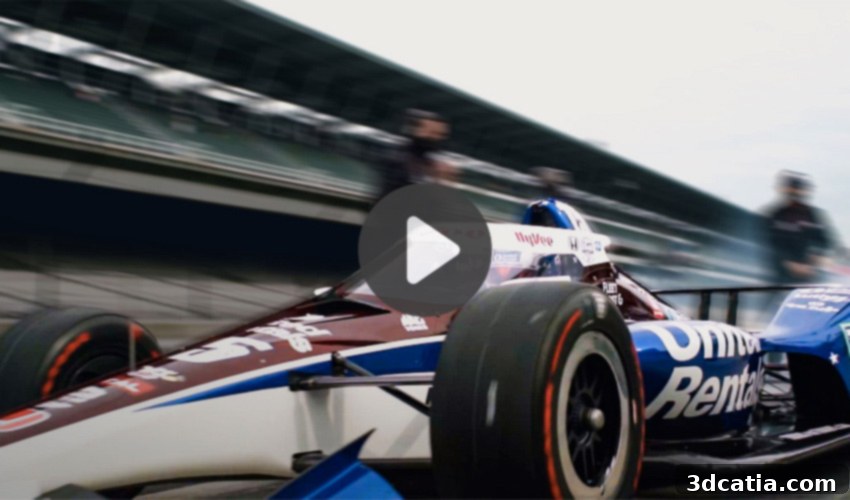
One of the persistent challenges in the realm of 3D scanning involves capturing accurate data from surfaces that are transparent, reflective, or dark. These characteristics can cause laser light or structured light patterns to refract, scatter, or be absorbed, leading to incomplete or inaccurate scan data. HandsOnMetrology, a leader in metrology solutions, recently released an insightful video demonstrating an ingenious solution to this very problem. Their focus was on a scenario faced by the IndyCar RLL racing team, which required precise 3D scans of racing car windshields – a quintessential example of a transparent and reflective surface.
Traditional 3D scanning methods often falter when confronted with such materials. Lasers tend to pass straight through transparent objects, while reflective surfaces create glare and noise in the scan data, making it impossible to capture true geometric information. The breakthrough solution presented by HandsOnMetrology involves the use of specialized 3D scanning sprays, specifically AESUB sprays. These innovative sprays apply a thin, temporary, and often self-evaporating matte coating to the object’s surface. This coating serves a dual purpose: it eliminates transparency by creating an opaque layer and eradicates reflectivity by providing a uniform, diffuse surface for the scanner to interact with.
By applying the AESUB spray to the IndyCar windshield, the laser was no longer crossing the surface but rather reflecting off a precisely defined, matte layer. This simple yet effective technique allowed HandsOnMetrology to obtain high-quality, accurate 3D scan data, dramatically improving the end result. This technology is not limited to racing car windshields; its applications are vast and varied. Industries ranging from automotive design and reverse engineering to quality control, cultural heritage preservation, and medical device manufacturing can benefit immensely. For instance, scanning intricate glass sculptures, shiny metal engine components, or even dark composite materials becomes significantly more feasible, ensuring engineers, designers, and researchers can gather the critical dimensional data they need without compromise. The ability to scan previously “difficult” surfaces unlocks new possibilities for product development, inspection, and digital archiving, reinforcing 3D scanning’s role as a cornerstone of modern industrial processes.
Boston Dynamics’ Atlas Robots: Parkour, 3D Printing, and the Future of Robotics
The field of robotics is constantly pushing the boundaries of what machines can achieve, and few entities exemplify this progress as vividly as Boston Dynamics. Their humanoid robots, particularly the Atlas series, have consistently captured global attention with their astonishing agility, balance, and sophisticated movements. Recently, these incredible machines once again caused a sensation across the internet and social media platforms, demonstrating their prowess in parkour – a discipline that demands exceptional athleticism, precision, and the ability to navigate complex obstacles at remarkable speed. Watching Atlas robots fluidly jump, vault, and run through challenging courses is a testament to advanced engineering and intelligent design.
A significant factor enabling Atlas’s extraordinary capabilities lies in the strategic integration of 3D printed components. Boston Dynamics, a pioneer in advanced robotics, has heavily relied on additive manufacturing to construct parts that are simultaneously lightweight, strong, and highly complex. For instance, critical components like the robot’s legs are manufactured through 3D printing. This approach allows for the creation of intricate internal geometries that would be impossible or prohibitively expensive to produce with traditional manufacturing methods. Crucially, 3D printing facilitates the integration of hydraulic lines and other internal mechanisms directly within the structure of the leg, reducing part count, minimizing assembly time, and optimizing weight distribution. This level of functional integration is vital for achieving the dynamic balance and power required for parkour maneuvers.
The benefits of using 3D printing extend beyond mere weight reduction. Additive manufacturing enables rapid prototyping and iteration, allowing Boston Dynamics to quickly test and refine new designs, accelerating their development cycle. The ability to produce custom, optimized parts on demand also streamlines their supply chain for these highly specialized robots. While Atlas robots have already achieved significant milestones, pushing the boundaries of humanoid locomotion and manipulation, Boston Dynamics’ ambition extends much further. They continue to develop these robots, aiming to enhance their autonomy, dexterity, and utility in a variety of environments, from industrial inspection and logistics to potential roles in disaster response or even space exploration. The synergy between advanced robotics and additive manufacturing is a powerful force, continuously redefining the potential of intelligent machines.
Grand Theft Auto in the Real World: A Massive 3D Printed Map
Beyond industrial applications and scientific breakthroughs, 3D printing also fuels incredible creative and artistic endeavors. Product designer Dom Riccobene showcased the immense potential of additive manufacturing by undertaking an extraordinary project: creating an ultra-accurate, tangible 3D-printed map of the fictional, crime-ridden US state of San Andreas from the wildly popular video game Grand Theft Auto. This wasn’t merely a decorative piece; it was a meticulous, data-driven recreation on a massive scale, demonstrating dedication and technical prowess.
The sheer scope of Riccobene’s project is impressive. It took him a staggering 400 hours to bring the digital landscape of San Andreas into the physical world. His process began with a deep dive into cartography and mapping software, employing a custom script to extract an incredible 500 million coordinates from the game’s virtual environment. This monumental dataset formed the foundation for his physical model, ensuring an unparalleled level of detail and geographical accuracy. Transforming this vast digital information into a printable format required careful segmentation.
Riccobene then individually printed 24 separate tiles, each representing a segment of the sprawling San Andreas map. The choice of 3D printing allowed for the precise rendering of topographical features, urban infrastructure, and natural landmarks with a level of detail that would be impossible through other manufacturing methods. Once all 24 tiles were printed, the final challenge was the careful and precise assembly of these individual pieces into a seamless, coherent representation of the entire state. The final product is not just a gaming novelty but a stunning example of how 3D printing can bridge the gap between virtual worlds and physical reality, offering a tactile and immersive experience of digital landscapes. This project highlights 3D printing’s capacity for intricate detail, large-scale production through modular design, and its increasing role in visualization, education, and even art, captivating audiences far beyond the gaming community.
Lincoln Electric Additive Solutions: Large Format Metal Parts, Faster Than Ever
The realm of metal additive manufacturing has seen rapid advancements, particularly in the production of large-format parts. Lincoln Electric Additive Solutions, a company with an unparalleled 126-year legacy in welding technology, is at the forefront of this revolution. They are ingeniously leveraging their extensive expertise in welding to produce massive metal additive printed components, molds, and replacement parts with unprecedented speed and efficiency. This fusion of traditional welding knowledge with cutting-edge additive manufacturing processes is transforming how heavy industries approach production.
At the core of their operations is a sophisticated process, often employing Wire Arc Additive Manufacturing (WAAM), which builds parts layer by layer using an electric arc to melt metal wire. Customers provide their CAD (Computer-Aided Design) files, which are then fed into Lincoln Electric’s advanced CNC (Computer Numerical Control) systems. These systems precisely control the robotic welding equipment, depositing metal with extreme accuracy to create complex geometries. This method is particularly well-suited for producing large components that would traditionally require extensive machining, casting, or forging processes, which are often slow and costly.
The most significant advantage offered by Lincoln Electric Additive Solutions is the drastic reduction in lead times. Compared to conventional manufacturing techniques, which can take months to produce large, specialized metal parts, Lincoln Electric can deliver projects in a matter of days or weeks. This acceleration is a game-changer for industries requiring rapid prototyping, on-demand replacement parts for critical machinery, or custom tooling with intricate designs. By eliminating the need for expensive molds and complex tooling setups, and by dramatically shortening the production cycle, companies can significantly reduce costs, minimize downtime, and bring products to market faster. This innovative approach by Lincoln Electric not only highlights the scalability of additive manufacturing but also its profound impact on supply chain resilience and operational efficiency for heavy industries seeking agile and cost-effective solutions for large metal components.
East/West Industries & Additive Manufacturing: Streamlining Aerospace Production
The aerospace industry is characterized by its stringent requirements for precision, reliability, and safety, often leading to complex manufacturing processes and extended lead times. Founded in 1969, East/West Industries, Inc. has established itself as a critical designer and manufacturer of specialized parts for this demanding sector. Their product portfolio ranges from high-performance airplane seats to crucial crew survival equipment designed to ensure safety in emergency situations. For decades, they have adhered to traditional manufacturing methods, but recognizing the need for greater efficiency and innovation, East/West recently embarked on a transformative journey by incorporating additive manufacturing into their production workflow.
To facilitate this strategic shift, East/West engaged the services of TriMech, a leading provider of engineering solutions and additive manufacturing expertise. The pivotal addition to their production capabilities was the Stratasys Fortus 450mc 3D printer. This industrial-grade FDM (Fused Deposition Modeling) machine is renowned for its ability to produce robust, functional prototypes and end-use parts using engineering-grade thermoplastics. Its reliability, precision, and capacity to handle demanding materials make it an ideal choice for the aerospace industry, where parts must withstand extreme conditions and rigorous testing.
The integration of the Stratasys Fortus 450mc brought about immediate and significant benefits for East/West Industries. One of the most impactful outcomes was the drastic shortening of their supply chain. By being able to produce complex parts in-house and on-demand, they reduced reliance on external suppliers, mitigating risks associated with lead times, material availability, and shipping delays. Furthermore, additive manufacturing allowed them to significantly reduce both manufacturing time and cost. Traditional methods often involve expensive tooling and multiple fabrication steps, whereas 3D printing enables the creation of intricate geometries in a single build, reducing material waste and labor. This not only accelerated their product development cycles but also offered greater flexibility in design iteration and customization. For an industry where every gram of weight and every hour of production time counts, the adoption of additive manufacturing, spearheaded by the Stratasys Fortus 450mc, has empowered East/West Industries to achieve unparalleled levels of efficiency and innovation, securing their competitive edge in a highly demanding market.
These compelling examples offer just a glimpse into the diverse and impactful applications of 3D printing and additive manufacturing across various sectors. From revolutionizing how we scan challenging surfaces to enabling the extraordinary feats of Boston Dynamics’ robots, creating intricate physical representations of virtual worlds, accelerating large-scale metal part production, and streamlining complex aerospace supply chains, the technology continues to redefine industries. Its ability to foster innovation, reduce costs, compress timelines, and open up new design possibilities is undeniable. The future of manufacturing is increasingly additive, promising even more incredible breakthroughs and efficiencies. What do you think of this week’s compilation of 3D printing videos? Let us know in a comment below or on our Facebook and Twitter pages. Don’t forget to sign up for our free weekly newsletter, with all the latest news in 3D printing delivered straight to your inbox!